School of Clinical Sciences and Institute for Health and Biomedical Innovation, Queensland University of Technology, Gardens Point, Brisbane 4001, Australia.
Queensland Health Scientific Services, 39 Kessels Rd, Coopers Plains, QLD 4108, Australia.
Environ Int. 2014 Oct;71:74-80. doi: 10.1016/j.envint.2014.05.019. Epub 2014 Jun 27.
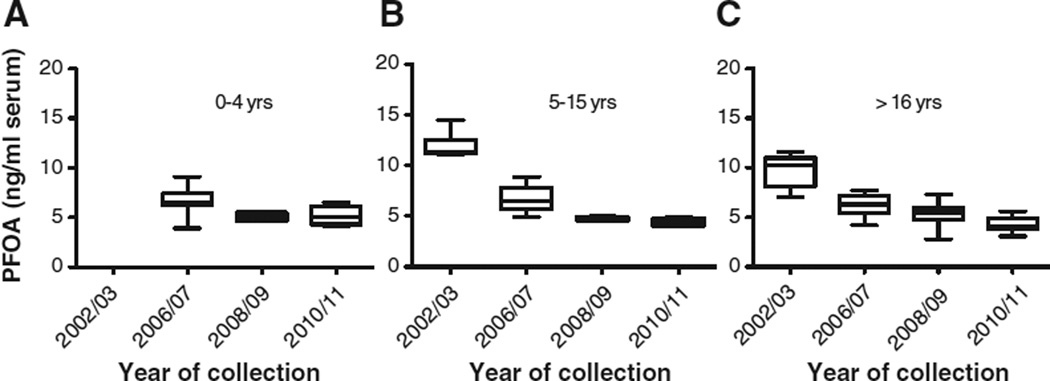
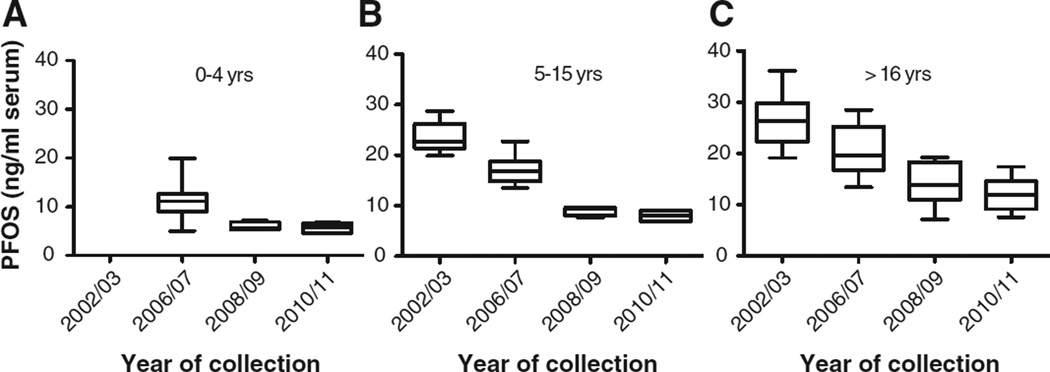
Some perfluoroalkyl and polyfluoroalkyl substances (PFASs) have become widespread pollutants detected in human and wildlife samples worldwide. The main objective of this study was to assess temporal trends of PFAS concentrations in human blood in Australia over the last decade (2002-2011), taking into consideration age and sex trends. Pooled human sera from 2002/03 (n=26); 2008/09 (n=24) and 2010/11 (n=24) from South East Queensland, Australia were obtained from de-identified surplus pathology samples and compared with samples collected previously from 2006/07 (n=84). A total of 9775 samples in 158 pools were available for an assessment of PFASs. Stratification criteria included sex and age: <16 years (2002/03 only); 0-4 (2006/07, 2008/09, 2010/11); 5-15 (2006/07, 2008/09, 2010/11); 16-30; 31-45; 46-60; and >60 years (all collection periods). Sera were analyzed using on-line solid-phase extraction coupled to high-performance liquid chromatography-isotope dilution-tandem mass spectrometry. Perfluorooctane sulfonate (PFOS) was detected in the highest concentrations ranging from 5.3-19.2 ng/ml (2008/09) to 4.4-17.4 ng/ml (2010/11). Perfluorooctanoate (PFOA) was detected in the next highest concentration ranging from 2.8-7.3 ng/ml (2008/09) to 3.1-6.5 ng/ml (2010/11). All other measured PFASs were detected at concentrations <1 ng/ml with the exception of perfluorohexane sulfonate which ranged from 1.2-5.7 ng/ml (08/09) and 1.4-5.4 ng/ml (10/11). The mean concentrations of both PFOS and PFOA in the 2010/11 period compared to 2002/03 were lower for all adult age groups by 56%. For 5-15 year olds, the decrease was 66% (PFOS) and 63% (PFOA) from 2002/03 to 2010/11. For 0-4 year olds the decrease from 2006/07 (when data were first available for this age group) was 50% (PFOS) and 22% (PFOA). This study provides strong evidence for decreasing serum PFOS and PFOA concentrations in an Australian population from 2002 through 2011. Age trends were variable and concentrations were higher in males than in females. Global use has been in decline since around 2002 and hence primary exposure levels are expected to be decreasing. Further biomonitoring will allow assessment of PFAS exposures to confirm trends in exposure as primary and eventually secondary sources are depleted.
一些全氟烷基和多氟烷基物质(PFAS)已成为在全球范围内人类和野生动物样本中检测到的广泛存在的污染物。本研究的主要目的是评估过去十年(2002-2011 年)澳大利亚人类血液中 PFAS 浓度的时间趋势,同时考虑年龄和性别趋势。从澳大利亚东南部昆士兰州 2002/03 年(n=26);2008/09 年(n=24)和 2010/11 年(n=24)的多余病理样本中获得了合并的人类血清,并与之前从 2006/07 年(n=84)收集的样本进行了比较。共有 9775 个样本在 158 个样本池中可用于评估 PFAS。分层标准包括性别和年龄:<16 岁(仅 2002/03 年);0-4 岁(2006/07 年、2008/09 年、2010/11 年);5-15 岁(2006/07 年、2008/09 年、2010/11 年);16-30 岁;31-45 岁;46-60 岁;>60 岁(所有收集期)。使用在线固相萃取与高效液相色谱-同位素稀释-串联质谱联用的方法对血清进行了分析。全氟辛烷磺酸(PFOS)的浓度最高,范围为 5.3-19.2ng/ml(2008/09 年)至 4.4-17.4ng/ml(2010/11 年)。全氟辛酸(PFOA)的浓度次之,范围为 2.8-7.3ng/ml(2008/09 年)至 3.1-6.5ng/ml(2010/11 年)。所有其他测量的 PFAS 浓度均<1ng/ml,除了全氟己烷磺酸,其浓度范围为 1.2-5.7ng/ml(08/09 年)和 1.4-5.4ng/ml(10/11 年)。与 2002/03 年相比,2010/11 年所有成年年龄组的 PFOS 和 PFOA 平均浓度降低了 56%。对于 5-15 岁的儿童,2002/03 年至 2010/11 年的降幅分别为 66%(PFOS)和 63%(PFOA)。对于 0-4 岁的儿童,自 2006/07 年(首次为该年龄组提供数据时)以来,降幅分别为 50%(PFOS)和 22%(PFOA)。本研究为澳大利亚人群 2002 年至 2011 年期间血清 PFOS 和 PFOA 浓度降低提供了有力证据。年龄趋势各不相同,男性浓度高于女性。自 2002 年以来,全球使用量一直在下降,因此预计初级暴露水平正在下降。进一步的生物监测将允许评估 PFAS 暴露情况,以确认暴露趋势是由于初级和最终次级来源枯竭所致。