Zhao Xiao-su, Wang Xu-hua, Zhao Xiang-yu, Chang Ying-jun, Xu Lan-ping, Zhang Xiao-hui, Huang Xiao-jun
Peking University People's Hospital, Peking University Institute of Hematology, Beijing Key Laboratory of Hematopoietic Stem Cell Transplantation, Beijing 100044, China.
J Transl Med. 2014 Jul 1;12:187. doi: 10.1186/1479-5876-12-187.
Non-traditional CD4+CD25-CD69+ T cells were found to be involved in disease progression in tumor-bearing mouse models and cancer patients recently. We attempted to define whether this subset of T cells were related to leukemia relapse after allogeneic hematopoietic cell transplantation (allo-HSCT).
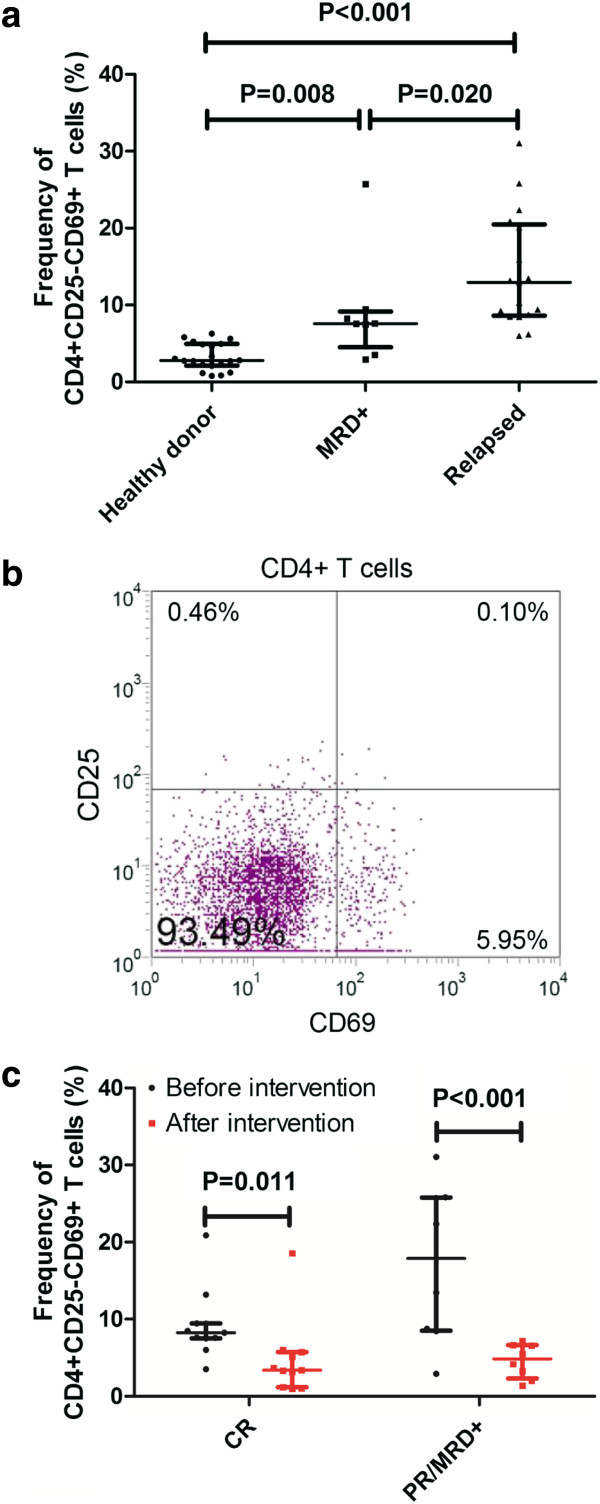
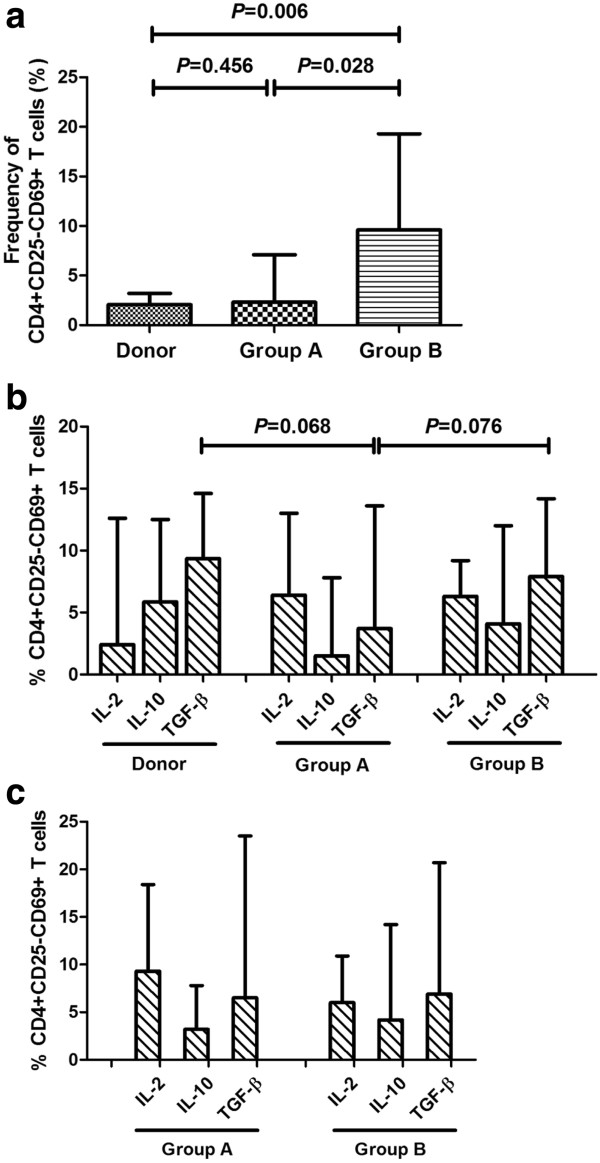
The frequency of CD4+CD25-CD69+ T cells among the CD4+ T cell population from the bone marrow of relapsed patients, patients with positive minimal residual disease (MRD+) and healthy donors was examined by flow cytometry. The CD4+CD25-CD69+ T cells were also stained with the intracellular markers to determine the cytokine (TGF-β, IL-2 and IL-10) secretion.
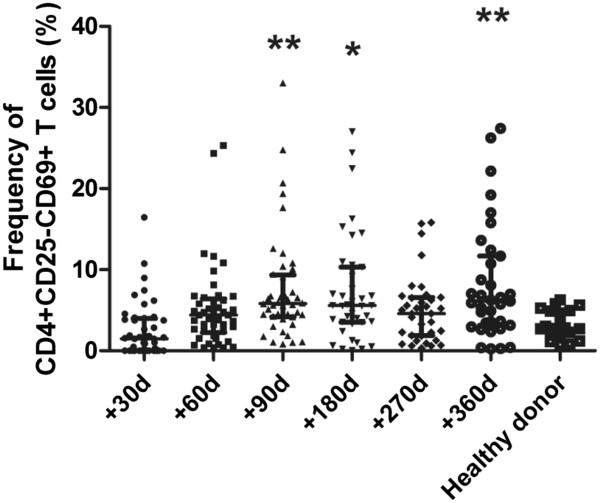
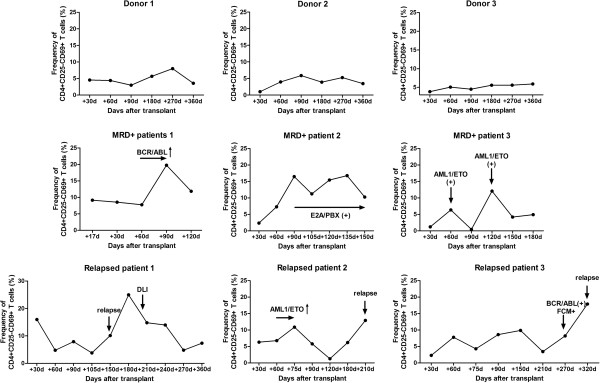
The results showed that the frequency of CD4+CD25-CD69 + T cells was markedly increased in patients in the relapsed group and the MRD + group compared to the healthy donor group. The percentage of this subset of T cells was significantly decreased after effective intervention treatment. We also analyzed the reconstitution of CD4+CD25-CD69+ T cells at various time points after allo-HSCT, and the results showed that this subset of T cells reconstituted rapidly and reached a relatively higher level at +60 d in patients compared to controls. The incidence of either MRD+ or relapse in patients with a high frequency of CD4+CD25-CD69+ T cells (>7%) was significantly higher than that of patients with a low frequency of CD4+CD25-CD69+ T cells at +60 d, +90 d and +270 d after transplant. However, our preliminary data indicated that CD4+CD25-CD69+ T cells may not exert immunoregulatory function via cytokine secretion.
This study provides the first clinical evidence of a correlation between non-traditional CD4+CD25-CD69+ Tregs and leukemia relapse after allo-HSCT and suggests that exploration of new methods of adoptive immunotherapy may be beneficial. Further research related to regulatory mechanism behind this phenomenon would be necessary.
最近发现非传统的CD4+CD25-CD69+ T细胞参与荷瘤小鼠模型和癌症患者的疾病进展。我们试图确定这一T细胞亚群是否与异基因造血细胞移植(allo-HSCT)后的白血病复发有关。
采用流式细胞术检测复发患者、微小残留病阳性(MRD+)患者及健康供者骨髓中CD4+ T细胞群体中CD4+CD25-CD69+ T细胞的频率。CD4+CD25-CD69+ T细胞也用细胞内标志物染色,以确定细胞因子(TGF-β、IL-2和IL-10)的分泌情况。
结果显示,与健康供者组相比,复发组和MRD+组患者中CD4+CD25-CD69 + T细胞的频率显著增加。有效干预治疗后,该T细胞亚群的百分比显著降低。我们还分析了allo-HSCT后不同时间点CD4+CD25-CD69+ T细胞的重建情况,结果显示,与对照组相比,该T细胞亚群在患者中重建迅速,并在+60 d时达到相对较高水平。移植后+60 d、+90 d和+270 d时,CD4+CD25-CD69+ T细胞频率高(>7%)的患者中MRD+或复发的发生率显著高于CD4+CD25-CD69+ T细胞频率低的患者。然而,我们的初步数据表明,CD4+CD25-CD69+ T细胞可能不会通过细胞因子分泌发挥免疫调节功能。
本研究首次提供了临床证据,证明非传统的CD4+CD25-CD69+ Tregs与allo-HSCT后的白血病复发之间存在相关性,并表明探索新的过继性免疫治疗方法可能有益。有必要对这一现象背后的调节机制进行进一步研究。