Linser Rasmus, Bardiaux Benjamin, Andreas Loren B, Hyberts Sven G, Morris Vanessa K, Pintacuda Guido, Sunde Margaret, Kwan Ann H, Wagner Gerhard
Max-Planck Institute for Biophysical Chemistry , Am Fassberg 11, 37077 Göttingen, Germany.
J Am Chem Soc. 2014 Aug 6;136(31):11002-10. doi: 10.1021/ja504603g. Epub 2014 Jul 25.
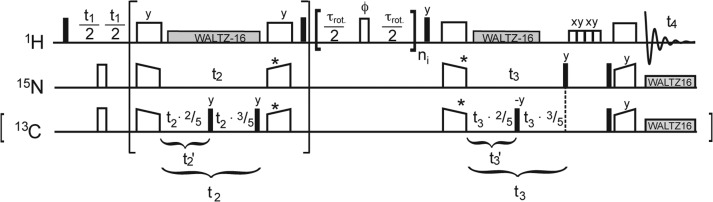
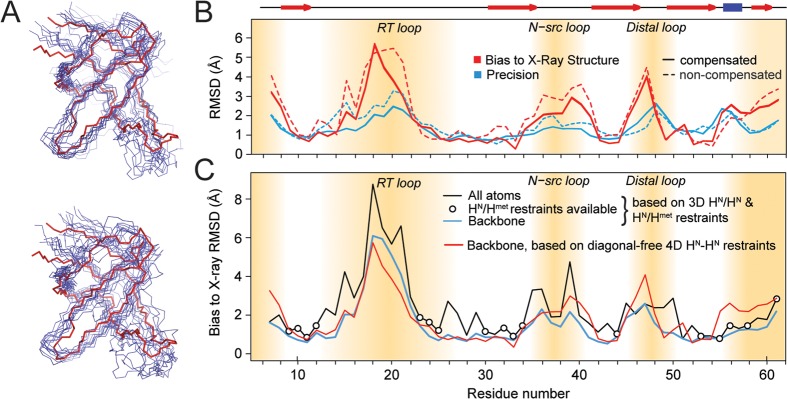
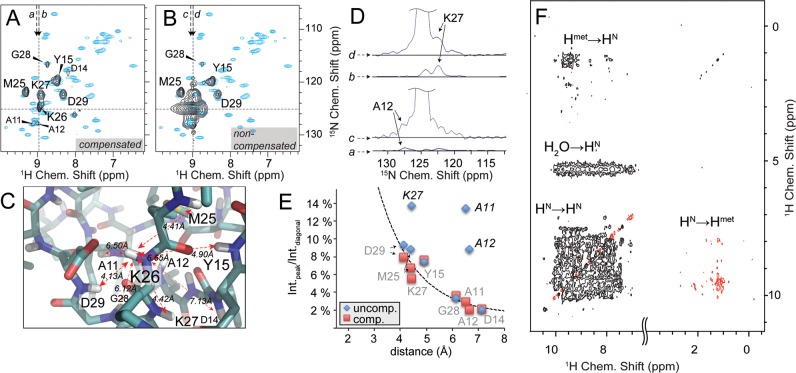
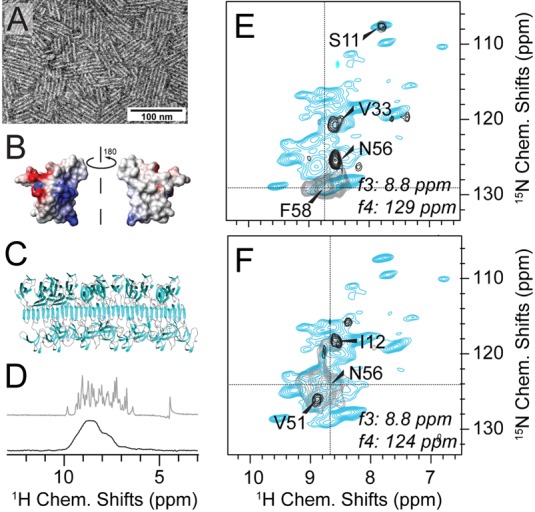
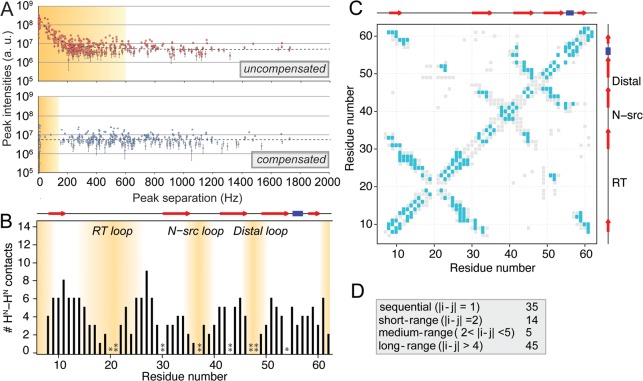
We report acquisition of diagonal-compensated protein structural restraints from four-dimensional solid-state NMR spectra on extensively deuterated and (1)H back-exchanged proteins. To achieve this, we use homonuclear (1)H-(1)H correlations with diagonal suppression and nonuniform sampling (NUS). Suppression of the diagonal allows the accurate identification of cross-peaks which are otherwise obscured by the strong autocorrelation or whose intensity is biased due to partial overlap with the diagonal. The approach results in unambiguous spectral interpretation and relatively few but reliable restraints for structure calculation. In addition, the diagonal suppression produces a spectrum with low dynamic range for which ultrasparse NUS data sets can be readily reconstructed, allowing straightforward application of NUS with only 2% sampling density with the advantage of more heavily sampling time-domain regions of high signal intensity. The method is demonstrated here for two proteins, α-spectrin SH3 microcrystals and hydrophobin functional amyloids. For the case of SH3, suppression of the diagonal results in facilitated identification of unambiguous restraints and improvement of the quality of the calculated structural ensemble compared to nondiagonal-suppressed 4D spectra. For the only partly assigned hydrophobin rodlets, the structure is yet unknown. Applied to this protein of biological significance with large inhomogeneous broadening, the method allows identification of unambiguous crosspeaks that are otherwise obscured by the diagonal.
我们报道了在高度氘代且进行了(1)H 反向交换的蛋白质上,通过四维固态核磁共振谱获取对角补偿蛋白质结构约束的方法。为实现这一点,我们使用具有对角抑制和非均匀采样(NUS)的同核(1)H-(1)H 相关性。对角抑制使得能够准确识别交叉峰,否则这些交叉峰会被强自相关所掩盖,或者由于与对角线部分重叠而导致强度存在偏差。该方法可实现明确的光谱解释,并为结构计算提供相对较少但可靠的约束。此外,对角抑制产生了一个动态范围较低的光谱,对于该光谱可以很容易地重建超稀疏 NUS 数据集,从而允许仅以 2%的采样密度直接应用 NUS,其优点是更多地对高信号强度的时域区域进行采样。本文针对两种蛋白质,即α-血影蛋白 SH3 微晶和疏水蛋白功能性淀粉样蛋白,展示了该方法。对于 SH3 的情况,与未进行对角抑制的 4D 光谱相比,对角抑制有助于明确识别约束条件并提高计算结构集合的质量。对于仅部分归属的疏水蛋白小杆,其结构尚不清楚。将该方法应用于这种具有大的不均匀展宽且具有生物学意义的蛋白质时,能够识别出否则会被对角线掩盖的明确交叉峰。