Floyd Christopher N, Ellis Benjamin H, Ferro Albert
Department of Clinical Pharmacology, Cardiovascular Division, British Heart Foundation Centre of Research Excellence, King's College London, London, United Kingdom.
PLoS One. 2014 Jul 2;9(7):e100239. doi: 10.1371/journal.pone.0100239. eCollection 2014.
The PlA1/A2 polymorphism of glycoprotein IIIa (GPIIIa) has been reported to be associated with risk of stroke in some studies, although other studies suggest no such association. This meta-analysis and systematic review was conducted to investigate the hypothesis that carriage of the PlA2 allele is a risk factor for stroke.
Electronic databases (MEDLINE and EMBASE) were searched for all articles evaluating carriage of the PlA2 allele and the incidence of stroke. Pooled odds ratios (ORs) were calculated using fixed-effect and random-effect models.
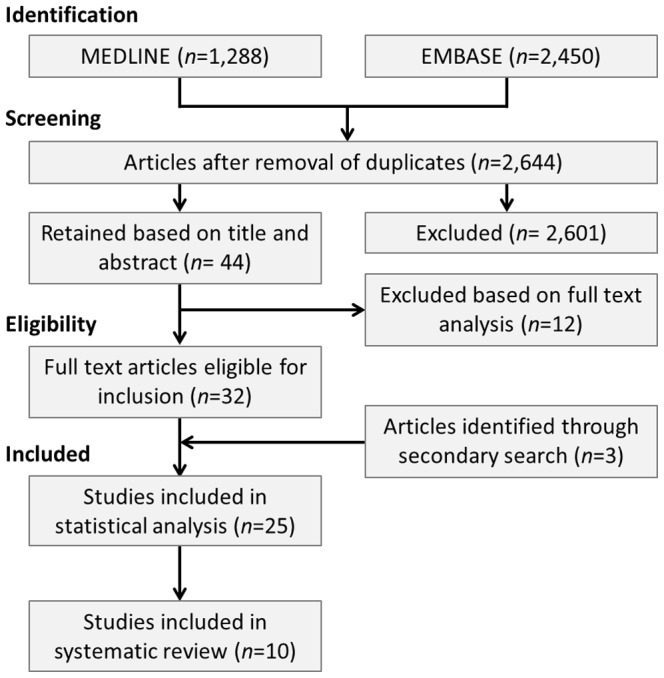
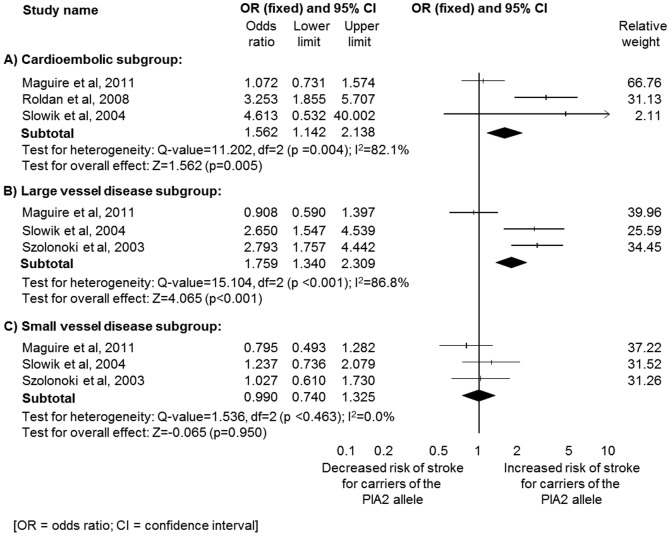
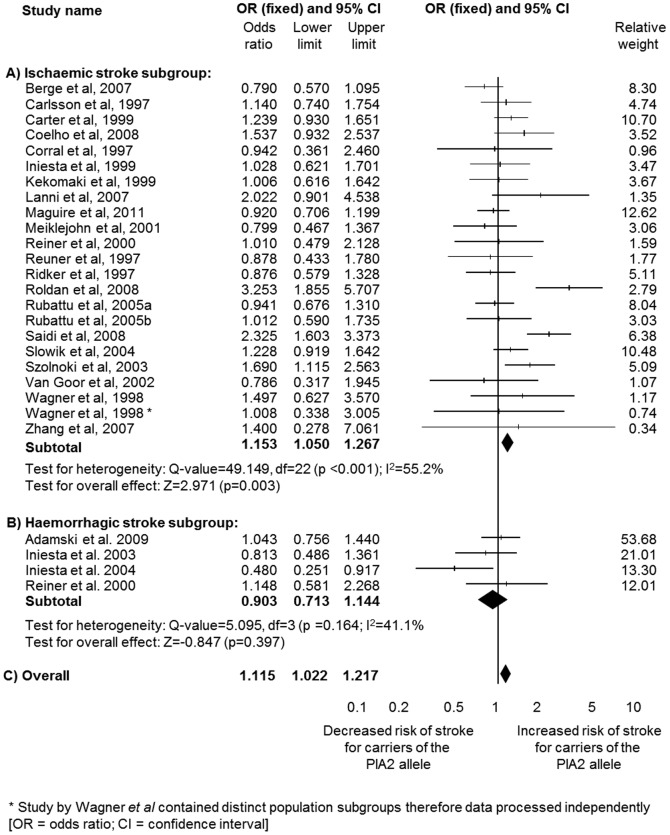
A total of 35 articles were eligible for inclusion, of which 25 studies were suitable for statistical analysis. For carriage of the PlA2 allele, OR 1.12 (n = 11,873; 95% CI = 1.03-1.22; p = 0.011) was observed for the incidence of stroke in adults, with subgroup analyses identifying the association driven by stroke of an ischaemic (n = 10,494; OR = 1.15, 95% CI = 1.05-1.27; p = 0.003) but not haemorrhagic aetiology (n = 2,470; OR = 0.90, 95% CI = 0.71-1.14; p = 0.398). This association with ischaemic stroke was strongest in individuals homozygous for the PlA2 allele compared to those homozygous for wild-type PlA1 (n = 5,906; OR = 1.74, 95% CI = 1.34-2.26; p<0.001). Subgroup analysis of ischaemic stroke subtypes revealed an increased association with stroke of cardioembolic (n = 1,271; OR 1.56, 95% CI 1.14-2.12; p = 0.005) and large vessel (n = 1,394; OR = 1.76, 95% CI 1.34-2.31; p<0.001) aetiology, but not those of small vessel origin (n = 1,356; OR = 0.99, 95% CI 0.74-1.33; p = 0.950). Egger's regression test suggested a low probability of publication bias for all analyses (p>0.05).
The totality of published data supports the hypothesis that carriage of the PlA2 polymorphism of GPIIIa is a risk factor for ischaemic strokes, and specifically those of cardioembolic and large vessel origin.
糖蛋白IIIa(GPIIIa)的PlA1/A2多态性在一些研究中被报道与中风风险相关,尽管其他研究表明不存在这种关联。进行这项荟萃分析和系统评价以研究携带PlA2等位基因是中风危险因素这一假设。
检索电子数据库(MEDLINE和EMBASE)以获取所有评估PlA2等位基因携带情况和中风发病率的文章。使用固定效应和随机效应模型计算合并优势比(OR)。
共有35篇文章符合纳入标准,其中25项研究适合进行统计分析。对于PlA2等位基因的携带情况,在成年人中风发病率方面观察到OR为1.12(n = 11,873;95% CI = 1.03 - 1.22;p = 0.011),亚组分析表明这种关联由缺血性中风(n = 10,494;OR = 1.15,95% CI = 1.05 - 1.27;p = 0.003)驱动,而非出血性病因(n = 2,470;OR = 0.90,95% CI = 0.71 - 1.14;p = 0.398)。与野生型PlA1纯合子相比,PlA2等位基因纯合子个体中与缺血性中风的这种关联最强(n = 5,906;OR = 1.74,95% CI = 1.34 - 2.26;p < 0.001)。缺血性中风亚型的亚组分析显示与心源性栓塞性中风(n = 1,271;OR 1.56,95% CI 1.14 - 2.12;p = 0.005)和大动脉病因性中风(n = 1,394;OR = 1.76,95% CI 1.34 - 2.31;p < 0.001)的关联增加,但与小血管源性中风(n = 1,356;OR = 0.99,95% CI 0.74 - 1.33;p = 0.950)无关。Egger回归检验表明所有分析存在发表偏倚的可能性较低(p > 0.05)。
已发表数据的总体情况支持以下假设,即GPIIIa的PlA2多态性携带是缺血性中风的危险因素,特别是心源性栓塞性和大动脉源性中风。