Haghighat Abbas, Behnia Ali, Kaviani Naser, Khorami Behnam
Department of Oral and Maxillofacial Surgery, School of Dentistry, Isfahan University of Medical Sciences, Isfahan, Iran.
J Res Pharm Pract. 2013 Jan;2(1):34-9. doi: 10.4103/2279-042X.114087.
Ibuprofen - a non-steroidal anti-inflammatory drug (NSAID)- and glucosamine sulfate - a natural compound and a food supplement- are two therapeutic agents which have been widely used for treatment of patients with temporomandibular joint (TMJ) disorders. This study was aimed to compare the effectiveness and safety of these two medications in the treatment of patients suffering from TMJ disorders.
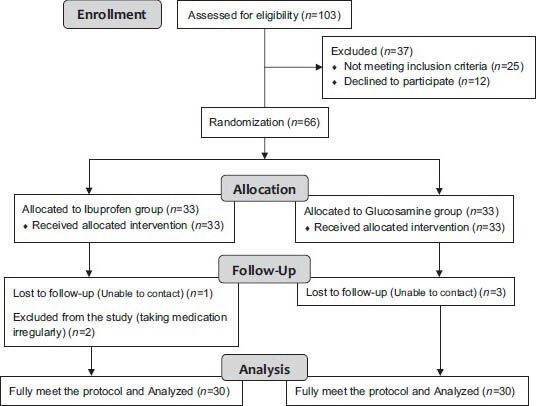
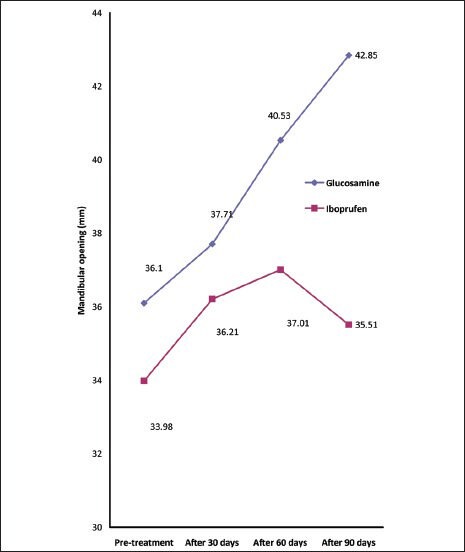
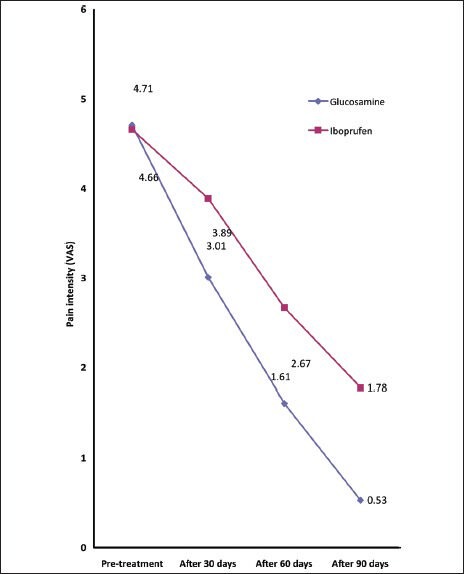
After obtaining informed consent, 60 patients were randomly allocated to two groups. Patients with painful TMJ, TMJ crepitation or limitation of mouth opening entered the study. Exclusion criteria were history of depressive disorders, cardiovascular disease, musculoskeletal disorders, asthma, gastrointestinal problems, kidney or liver dysfunction or diabetes mellitus, dental diseases needing ongoing treatment; taking aspirin or warfarin, or concomitant treatment of TMJ disorder with other agents or methods. Thirty patients were treated with ibuprofen 400 mg twice a day, (mean age 27.12 ± 10.83 years) and 30 patients (mean age 26.60 ± 10) were treated with glucosamine sulfate 1500 mg daily. Patients were visited 30, 60 and 90 days after starting the treatment, pain and mandibular opening were checked and compared within and between two groups.
Comparing with baseline measures, both groups had significantly improved post-treatment pain (P < 0.0001 for both groups) and mandibular opening (P value: 0.001 for glucosamine sulfate and 0.03 for ibuprofen). Post treatment pain and mandibular opening showed significantly more improvement in the glucosamine treated patients (P < 0.0001 and 0.01 respectively). Rate of adverse events was significantly lower in the P value glucosamine sulfate group (P < 0.0001).
This investigation demonstrated that comparing with a commonly prescribed NSAID - ibuprofen-, glucosamine sulfate is a more effective and safer therapeutic agent for treatment of patients with TMJ degenerative join disorder.
布洛芬(一种非甾体抗炎药)和硫酸氨基葡萄糖(一种天然化合物及食品补充剂)是两种已广泛用于治疗颞下颌关节(TMJ)紊乱患者的治疗药物。本研究旨在比较这两种药物治疗TMJ紊乱患者的有效性和安全性。
在获得知情同意后,将60例患者随机分为两组。患有TMJ疼痛、TMJ摩擦音或张口受限的患者进入研究。排除标准包括抑郁症病史、心血管疾病、肌肉骨骼疾病、哮喘、胃肠道问题、肾或肝功能障碍或糖尿病、需要持续治疗的牙科疾病;正在服用阿司匹林或华法林,或正在用其他药物或方法同时治疗TMJ紊乱。30例患者每天两次服用400mg布洛芬(平均年龄27.12±10.83岁),30例患者(平均年龄26.60±10岁)每天服用1500mg硫酸氨基葡萄糖。在开始治疗后30、60和90天对患者进行访视,检查并比较两组内及两组间的疼痛和下颌开口情况。
与基线测量相比,两组治疗后的疼痛均显著改善(两组P均<0.0001),下颌开口情况也显著改善(硫酸氨基葡萄糖组P值为0.001,布洛芬组P值为0.03)。治疗后,硫酸氨基葡萄糖治疗的患者疼痛和下颌开口改善更为显著(分别为P<0.0001和0.01)。硫酸氨基葡萄糖组不良事件发生率显著更低(P<0.0001)。
本研究表明,与常用的非甾体抗炎药布洛芬相比,硫酸氨基葡萄糖是治疗TMJ退行性关节紊乱患者更有效、更安全的治疗药物。