Geraets Liesbeth, Oomen Agnes G, Krystek Petra, Jacobsen Nicklas R, Wallin Håkan, Laurentie Michel, Verharen Henny W, Brandon Esther F A, de Jong Wim H
National Institute for Public Health and the Environment (RIVM), PO Box 1, 3720 BA, Bilthoven, The Netherlands.
Part Fibre Toxicol. 2014 Jul 3;11:30. doi: 10.1186/1743-8977-11-30.
The aim of this study was to obtain kinetic data that can be used in human risk assessment of titanium dioxide nanomaterials.
Tissue distribution and blood kinetics of various titanium dioxide nanoparticles (NM-100, NM-101, NM-102, NM-103, and NM-104), which differ with respect to primary particle size, crystalline form and hydrophobicity, were investigated in rats up to 90 days post-exposure after oral and intravenous administration of a single or five repeated doses.
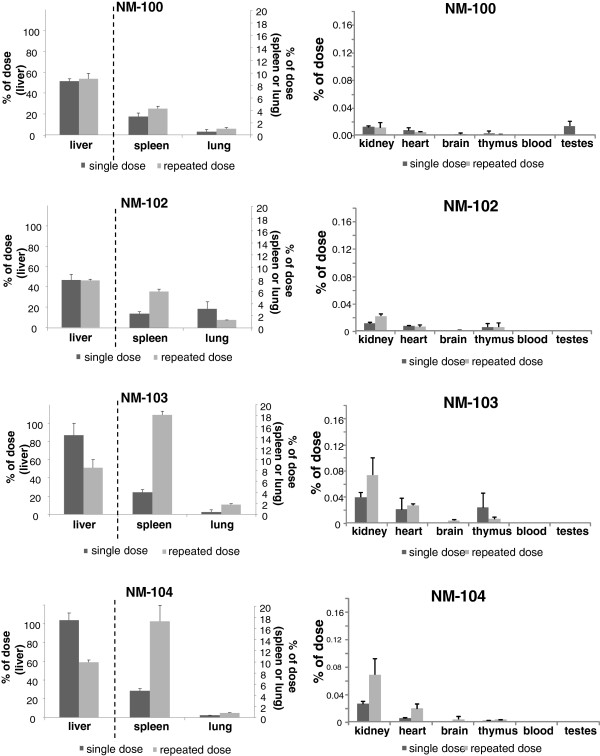
For the oral study, liver, spleen and mesenteric lymph nodes were selected as target tissues for titanium (Ti) analysis. Ti-levels in liver and spleen were above the detection limit only in some rats. Titanium could be detected at low levels in mesenteric lymph nodes. These results indicate that some minor absorption occurs in the gastrointestinal tract, but to a very limited extent.Both after single and repeated intravenous (IV) exposure, titanium rapidly distributed from the systemic circulation to all tissues evaluated (i.e. liver, spleen, kidney, lung, heart, brain, thymus, reproductive organs). Liver was identified as the main target tissue, followed by spleen and lung. Total recovery (expressed as % of nominal dose) for all four tested nanomaterials measured 24 h after single or repeated exposure ranged from 64-95% or 59-108% for male or female animals, respectively. During the 90 days post-exposure period, some decrease in Ti-levels was observed (mainly for NM-100 and NM-102) with a maximum relative decrease of 26%. This was also confirmed by the results of the kinetic analysis which revealed that for each of the investigated tissues the half-lifes were considerable (range 28-650 days, depending on the TiO(2)-particle and tissue investigated). Minor differences in kinetic profile were observed between the various particles, though these could not be clearly related to differences in primary particle size or hydrophobicity. Some indications were observed for an effect of crystalline form (anatase vs. rutile) on total Ti recovery.
Overall, the results of the present oral and IV study indicates very low oral bioavailability and slow tissue elimination. Limited uptake in combination with slow elimination might result in the long run in potential tissue accumulation.
本研究的目的是获取可用于二氧化钛纳米材料人体风险评估的动力学数据。
研究了单次或五次重复给药后,口服和静脉给药大鼠体内不同二氧化钛纳米颗粒(NM - 100、NM - 101、NM - 102、NM - 103和NM - 104)的组织分布和血液动力学,这些纳米颗粒在初级粒径、晶型和疏水性方面存在差异,观察期长达暴露后90天。
对于口服研究,选择肝脏、脾脏和肠系膜淋巴结作为钛(Ti)分析的靶组织。仅在部分大鼠中,肝脏和脾脏中的钛水平高于检测限。在肠系膜淋巴结中可检测到低水平的钛。这些结果表明,胃肠道存在一些轻微吸收,但程度非常有限。单次和重复静脉注射(IV)暴露后,钛迅速从体循环分布到所有评估组织(即肝脏、脾脏、肾脏、肺、心脏、大脑、胸腺、生殖器官)。肝脏被确定为主要靶组织,其次是脾脏和肺。单次或重复暴露后24小时测量的所有四种测试纳米材料的总回收率(以标称剂量的百分比表示),雄性动物为64 - 95%,雌性动物为59 - 108%。在暴露后90天期间,观察到钛水平有所下降(主要针对NM - 100和NM - 102),最大相对下降率为26%。动力学分析结果也证实了这一点,该分析表明,对于每个研究组织,半衰期都相当长(范围为28 - 650天,取决于所研究的TiO₂颗粒和组织)。不同颗粒之间观察到动力学特征存在微小差异,尽管这些差异与初级粒径或疏水性的差异没有明显关联。观察到一些晶型(锐钛矿与金红石)对总钛回收率有影响的迹象。
总体而言,本次口服和静脉注射研究的结果表明口服生物利用度非常低,组织消除缓慢。长期来看,有限的摄取与缓慢的消除可能导致潜在的组织蓄积。