Kushwaha Deepa, Ramakrishnan Valya, Ng Kimberly, Steed Tyler, Nguyen Thien, Futalan Diahnn, Akers Johnny C, Sarkaria Jann, Jiang Tao, Chowdhury Dipanjan, Carter Bob S, Chen Clark C
Dept. of Radiation Oncology, Dana-Farber Cancer Institute, Boston, MA; These authors contributed equally as first authors.
Center for Theoretical and Applied Neuro-Oncology, Moores Cancer Center, Division of Neurosurgery, University of California San Diego, San Diego, CA. These authors contributed equally as first authors.
Oncotarget. 2014 Jun 30;5(12):4026-39. doi: 10.18632/oncotarget.1974.
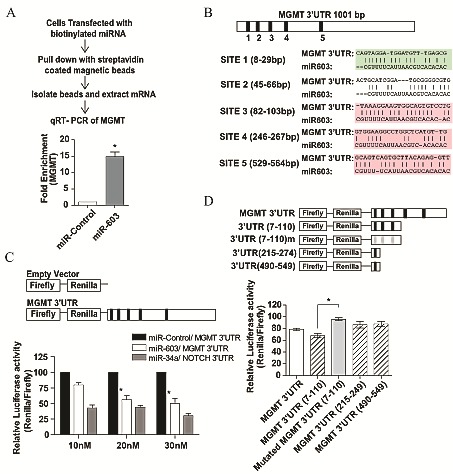
MGMT expression is a critical determinant for therapeutic resistance to DNA alkylating agents. We previously demonstrated that MGMT expression is post-transcriptionally regulated by miR-181d and other miRNAs. Here, we performed a genome-wide screen to identify MGMT regulating miRNAs. Candidate miRNAs were further tested for inverse correlation with MGMT expression in clinical specimens. We identified 15 candidate miRNAs and characterized the top candidate, miR-603. Transfection of miR-603 suppressed MGMT mRNA/protein expression in vitro and in vivo; this effect was reversed by transfection with antimiR-603. miR-603 affinity-precipitated with MGMT mRNA and suppressed luciferase activity in an MGMT-3'UTR-luciferase assay, suggesting direct interaction between miR-603 and MGMT 3'UTR. miR-603 transfection enhanced the temozolomide (TMZ) sensitivity of MGMT-expressing glioblastoma cell lines. Importantly, miR-603 mediated MGMT suppression and TMZ resistance were reversed by expression of an MGMT cDNA. In a collection of 74 clinical glioblastoma specimens, both miR-603 and miR-181d levels inversely correlated with MGMT expression. Moreover, a combined index of the two miRNAs better reflected MGMT expression than each individually. These results suggest that MGMT is co-regulated by independent miRNAs. Characterization of these miRNAs should contribute toward strategies for enhancing the efficacy of DNA alkylating agents.
O6-甲基鸟嘌呤-DNA甲基转移酶(MGMT)表达是对DNA烷化剂治疗耐药性的关键决定因素。我们之前证明MGMT表达受miR-181d和其他微小RNA(miRNA)的转录后调控。在此,我们进行了全基因组筛选以鉴定调控MGMT的miRNA。在临床标本中进一步测试候选miRNA与MGMT表达的负相关性。我们鉴定出15个候选miRNA,并对排名首位的候选miRNA miR-603进行了特性分析。转染miR-603在体外和体内均抑制MGMT mRNA/蛋白表达;用抗miR-603转染可逆转此效应。miR-603与MGMT mRNA进行亲和沉淀,并在MGMT 3'非翻译区(UTR)荧光素酶测定中抑制荧光素酶活性,提示miR-603与MGMT 3'UTR之间存在直接相互作用。转染miR-603增强了表达MGMT的胶质母细胞瘤细胞系对替莫唑胺(TMZ)的敏感性。重要的是,MGMT cDNA的表达逆转了miR-603介导的MGMT抑制和TMZ耐药性。在74例临床胶质母细胞瘤标本中,miR-603和miR-181d水平均与MGMT表达呈负相关。此外,这两种miRNA的联合指数比各自单独使用能更好地反映MGMT表达。这些结果表明MGMT受独立的miRNA共同调控。对这些miRNA的特性分析应有助于制定提高DNA烷化剂疗效的策略。