Khalil Susanna, Fabbri Enrica, Santangelo Alessandra, Bezzerri Valentino, Cantù Cinzia, Di Gennaro Gianfranco, Finotti Alessia, Ghimenton Claudio, Eccher Albino, Dechecchi Maria, Scarpa Aldo, Hirshman Brian, Chen Clark, Ferracin Manuela, Negrini Massimo, Gambari Roberto, Cabrini Giulio
Department of Pathology and Diagnostics, Laboratory of Molecular Pathology, University Hospital, Verona, Italy.
Department of Life Sciences and Biotechnology, Section of Biochemistry and Molecular Biology, University of Ferrara, Ferrara, Italy.
Oncotarget. 2016 May 10;7(19):28195-206. doi: 10.18632/oncotarget.8618.
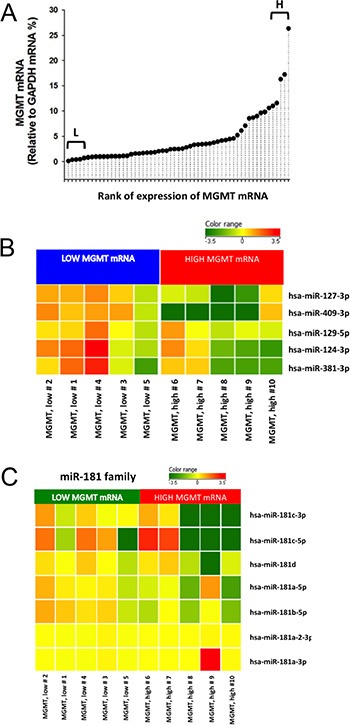
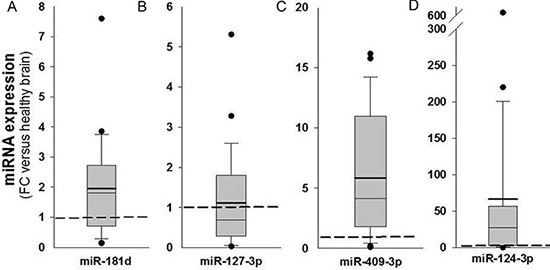
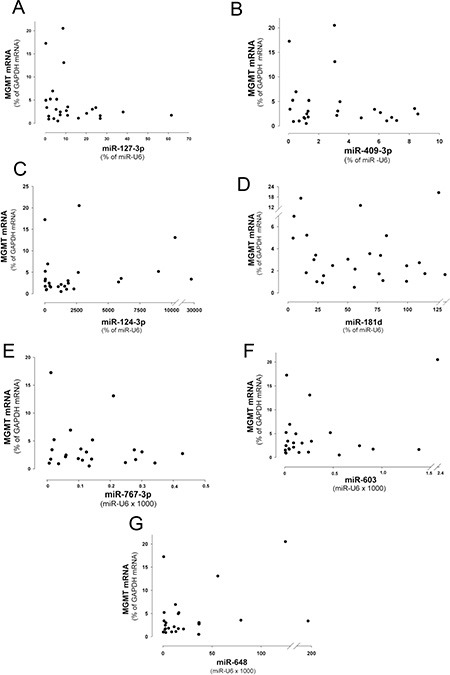
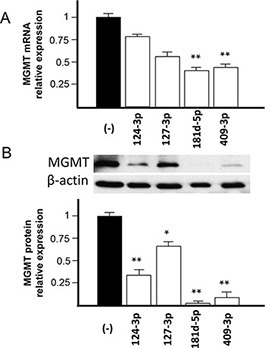
The levels of expression of O6-methylguanine-DNA methyltransferase (MGMT) are relevant in predicting the response to the alkylating chemotherapy in patients affected by glioblastoma. MGMT promoter methylation and the published MGMT regulating microRNAs (miRNAs) do not completely explain the expression pattern of MGMT in clinical glioblastoma specimens. Here we used a genome-wide microarray-based approach to identify MGMT regulating miRNAs. Our screen unveiled three novel MGMT regulating miRNAs, miR-127-3p, miR-409-3p, and miR-124-3p, in addition to the previously identified miR-181d-5p. Transfection of these three novel miRNAs into the T98G glioblastoma cell line suppressed MGMT mRNA and protein expression. However, their MGMT- suppressive effects are 30-50% relative that seen with miR-181d-5p transfection. In silico analyses of The Cancer Genome Atlas (TCGA) and Chinese Glioma Genome Atlas (CGGA) revealed that miR-181d-5p is the only miRNA that consistently exhibited inverse correlation with MGMT mRNA expression. However, statistical models incorporating both miR-181d-5p and miR-409-3p expression better predict MGMT expression relative to models involving either miRNA alone. Our results confirmed miR-181d-5p as the key MGMT-regulating miRNA. Other MGMT regulating miRNAs, including the miR-409-3p identified in this report, modify the effect of miR-181d-5p on MGMT expression. MGMT expression is, thus, regulated by cooperative interaction between key MGMT-regulating miRNAs.
O6-甲基鸟嘌呤-DNA甲基转移酶(MGMT)的表达水平与预测胶质母细胞瘤患者对烷化剂化疗的反应相关。MGMT启动子甲基化以及已发表的MGMT调控微小RNA(miRNA)并不能完全解释临床胶质母细胞瘤标本中MGMT的表达模式。在此,我们采用基于全基因组微阵列的方法来鉴定调控MGMT的miRNA。我们的筛选发现了三种新的调控MGMT的miRNA,即miR-127-3p、miR-409-3p和miR-124-3p,此外还有先前鉴定出的miR-181d-5p。将这三种新的miRNA转染到T98G胶质母细胞瘤细胞系中可抑制MGMT的mRNA和蛋白表达。然而,它们对MGMT的抑制作用相对于转染miR-181d-5p时所见的抑制作用而言为30%-50%。对癌症基因组图谱(TCGA)和中国胶质瘤基因组图谱(CGGA)的生物信息学分析显示,miR-181d-5p是唯一与MGMT mRNA表达始终呈负相关的miRNA。然而,相对于仅涉及任一miRNA的模型,纳入miR-181d-5p和miR-409-3p表达的统计模型能更好地预测MGMT的表达。我们的结果证实miR-181d-5p是调控MGMT的关键miRNA。其他调控MGMT的miRNA,包括本报告中鉴定出的miR-409-3p,可改变miR-181d-5p对MGMT表达的影响。因此,MGMT的表达受关键调控MGMT的miRNA之间协同相互作用的调节。