Gilden Daniel M, Kubisiak Joanna M, Kahle-Wrobleski Kristin, Ball Daniel E, Bowman Lee
JEN Associates, 5 Bigelow Street, Cambridge, MA 02139, USA.
BMC Health Serv Res. 2014 Jul 7;14:291. doi: 10.1186/1472-6963-14-291.
The burden experienced by spouses of patients with Alzheimer's disease (AD) may have negative consequences for their physical health. We describe here a method for analyzing United States Medicare records to determine the changes in health service use and costs experienced by spouses after their marital partner receives an AD diagnosis.
We initially identified all beneficiaries in the 2001-2005 Medicare 5% sample who had multiple claims listing the ICD-9 diagnostic code for AD, 331.0. The 5% sample includes spouses who share a Medicare account with their marital partners because they lack a sufficient work history for full eligibility on their own. A matched cohort study assessed incremental health costs in the spouses of AD patients versus a control group of spouses of non-AD patients. Longitudinal and cross-sectional analyses tracked the impact of a patient's AD diagnosis on his or her spouse's healthcare costs.
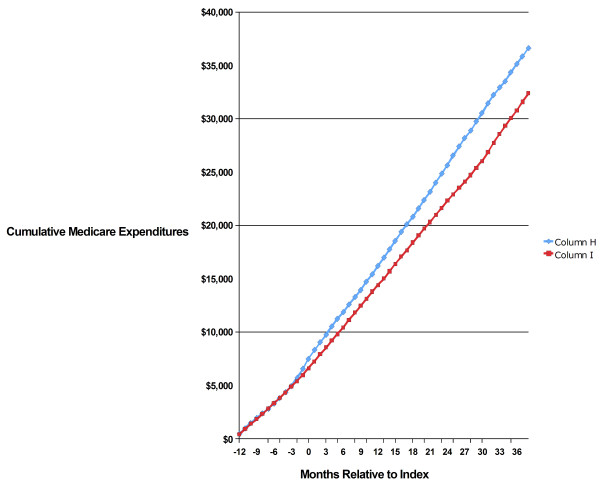
Our method located 54,593 AD patients of whom 11.5% had spouses identifiable via a shared Medicare account. AD diagnosis in one member of a couple was associated with significantly higher monthly Medicare payments for the other member's healthcare. The spouses' elevated costs commenced 2 to 3 months before their partners' AD diagnosis and persisted over the follow-up period. After 31 months, the cumulative additional Medicare reimbursements totaled a mean $4,600 in the spouses of AD patients. This excess was significant even after accounting for differences in baseline health status between the cohorts.
The study methodology provides a framework for comprehensively evaluating medical costs of both chronically ill patients and their spouses. This method also provides monthly data, which makes possible a longitudinal evaluation of the cost effects of specific health events. The observed correlations provide a coherent demonstration of the interdependence between AD patients' and spouses' health. Future research should examine caregiving burden and other possible factors contributing to the AD spouses' health outcomes. It should also extend the method presented here to evaluations of other chronic diseases of the elderly.
阿尔茨海默病(AD)患者的配偶所承受的负担可能会对他们的身体健康产生负面影响。我们在此描述一种分析美国医疗保险记录的方法,以确定配偶在其婚姻伴侣被诊断为AD后,其医疗服务使用情况和费用的变化。
我们最初在2001 - 2005年医疗保险5%样本中识别出所有有多项理赔记录且列出AD的ICD - 9诊断代码331.0的受益人。该5%样本包括那些因自身工作经历不足而无法完全符合资格,与婚姻伴侣共用一个医疗保险账户的配偶。一项匹配队列研究评估了AD患者配偶与非AD患者配偶对照组之间的增量医疗费用。纵向和横断面分析追踪了患者AD诊断对其配偶医疗费用的影响。
我们的方法找到了54,593名AD患者,其中11.5%的患者有可通过共用医疗保险账户识别的配偶。夫妻一方被诊断为AD与另一方医疗保健的每月医疗保险支付显著增加有关。配偶费用的增加在其伴侣AD诊断前2至3个月开始,并在随访期间持续。31个月后,AD患者配偶的医疗保险累计额外报销平均总计4600美元。即使考虑到队列之间基线健康状况的差异,这一超额费用仍然显著。
该研究方法为全面评估慢性病患者及其配偶的医疗费用提供了一个框架。此方法还提供月度数据,使得对特定健康事件的成本影响进行纵向评估成为可能。观察到的相关性连贯地证明了AD患者及其配偶健康之间的相互依存关系。未来的研究应检查护理负担和其他可能导致AD患者配偶健康结果的因素。还应将此处介绍的方法扩展到对其他老年慢性病的评估。