Department of Clinical Neuroscience, Institute of Health Biosciences, Graduate School of Medical Sciences, University of Tokushima , Tokushima , Japan ; Department of Motor Neuroscience and Neurotherapeutics, Institute of Health Biosciences, Graduate School of Medical Sciences, University of Tokushima , Tokushima , Japan.
Department of Motor Neuroscience and Neurotherapeutics, Institute of Health Biosciences, Graduate School of Medical Sciences, University of Tokushima , Tokushima , Japan.
Front Neurol. 2014 Jun 23;5:98. doi: 10.3389/fneur.2014.00098. eCollection 2014.
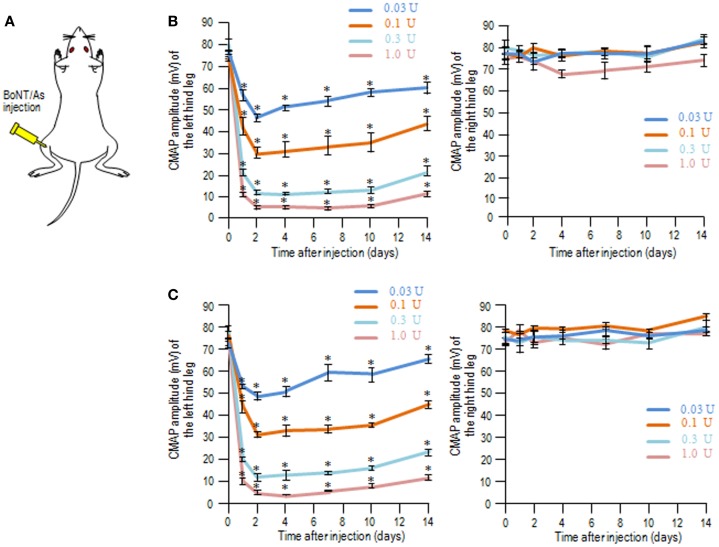
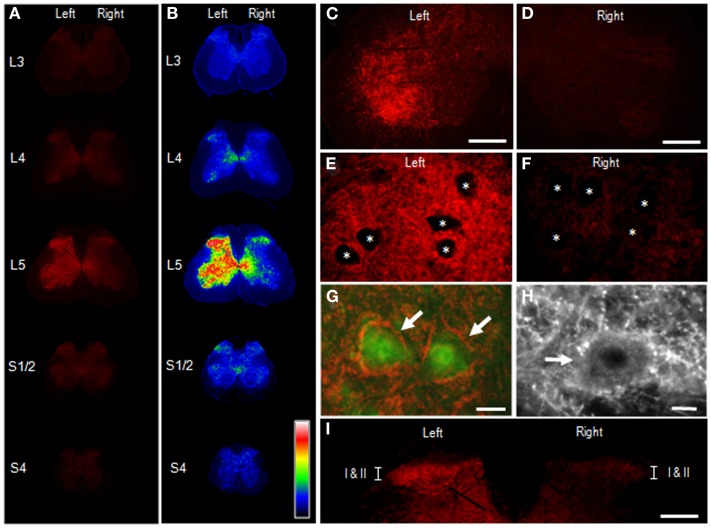
Because of its unique ability to exert long-lasting synaptic transmission blockade, botulinum neurotoxin A (BoNT/A) is used to treat a wide variety of disorders involving peripheral nerve terminal hyperexcitability. However, it has been a matter of debate whether this toxin has central or peripheral sites of action. We employed a rat model in which BoNT/A1 or BoNT/A2 was unilaterally injected into the gastrocnemius muscle. On time-course measurements of compound muscle action potential (CMAP) amplitudes after injection of BoNT/A1 or BoNT/A2 at doses ranging from 1.7 to 13.6 U, CMAP amplitude for the ipsilateral hind leg was markedly decreased on the first day, and this muscle flaccidity persisted up to the 14th day. Of note, both BoNT/A1 and BoNT/A2 administrations also resulted in decreased CMAP amplitudes for the contralateral leg in a dose-dependent manner ranging from 1.7 to 13.6 U, and this muscle flaccidity increased until the fourth day and then slowly recovered. Immunohistochemical results revealed that BoNT/A-cleaved synaptosomal-associated protein of 25 kDa (SNAP-25) appeared in the bilateral ventral and dorsal horns 4 days after injection of BoNT/A1 (10 U) or BoNT/A2 (10 U), although there seemed to be a wider spread of BoNT/A-cleaved SNAP-25 associated with BoNT/A1 than BoNT/A2 in the contralateral spinal cord. This suggests that the catalytically active BoNT/A1 and BoNT/A2 were axonally transported via peripheral motor and sensory nerves to the spinal cord, where they spread through a transcytosis (cell-to-cell trafficking) mechanism. Our results provide evidence for the central effects of intramuscularly administered BoNT/A1 and BoNT/A2 in the spinal cord, and a new insight into the clinical effects of peripheral BoNT/A applications.
由于其具有持久的突触传递阻断能力,肉毒神经毒素 A(BoNT/A)被用于治疗涉及周围神经末梢过度兴奋的各种疾病。然而,关于这种毒素是否具有中枢或外周作用一直存在争议。我们使用了一种大鼠模型,其中 BoNT/A1 或 BoNT/A2 单侧注射到腓肠肌。在注射 BoNT/A1 或 BoNT/A2 的剂量范围为 1.7 至 13.6 U 的时间进程测量中,对侧后腿的复合肌肉动作电位(CMAP)幅度明显降低,这种肌肉松弛持续到第 14 天。值得注意的是,BoNT/A1 和 BoNT/A2 的给药也导致双侧后腿的 CMAP 幅度以剂量依赖性方式降低,范围从 1.7 到 13.6 U,这种肌肉松弛持续增加直到第 4 天,然后缓慢恢复。免疫组织化学结果显示,BoNT/A 切割的突触相关蛋白 25 kDa(SNAP-25)在注射 BoNT/A1(10 U)或 BoNT/A2(10 U)后的第 4 天出现在双侧腹侧和背侧角,尽管似乎 BoNT/A1 切割的 SNAP-25 在对侧脊髓中的分布比 BoNT/A2 更广。这表明催化活性的 BoNT/A1 和 BoNT/A2 通过周围运动和感觉神经轴突运输到脊髓,在那里它们通过胞吞作用(细胞间运输)机制扩散。我们的结果为肌肉内给予的 BoNT/A1 和 BoNT/A2 在脊髓中的中枢作用提供了证据,并为外周 BoNT/A 应用的临床效果提供了新的见解。