Onoa Bibiana, Schneider Anna R, Brooks Matthew D, Grob Patricia, Nogales Eva, Geissler Phillip L, Niyogi Krishna K, Bustamante Carlos
California Institute for Quantitative Biosciences, University of California, Berkeley, California, United States of America.
Biophysics Graduate Group, University of California, Berkeley, California, United States of America.
PLoS One. 2014 Jul 9;9(7):e101470. doi: 10.1371/journal.pone.0101470. eCollection 2014.
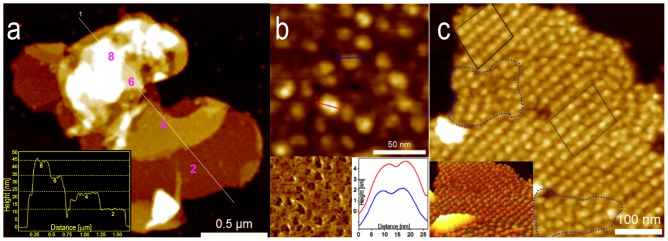
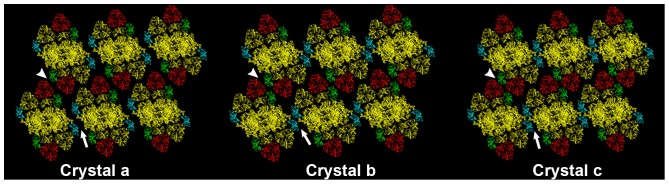
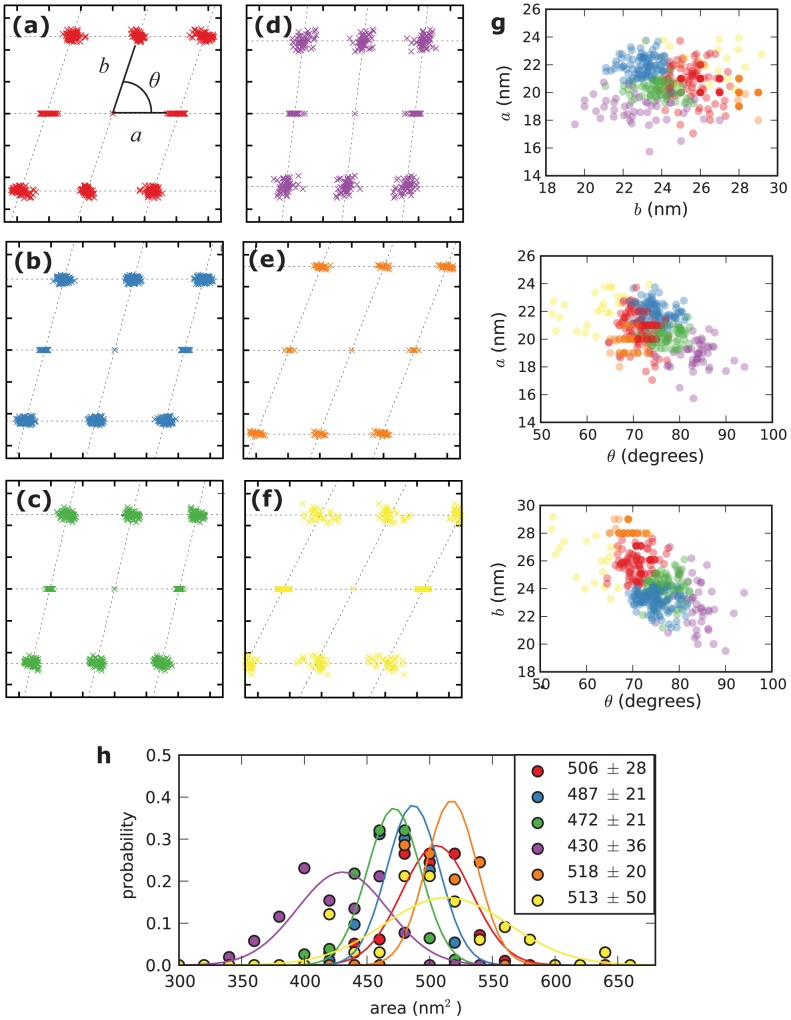
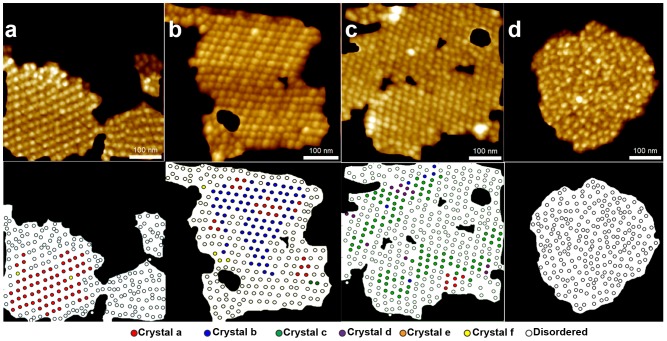
Photoautotrophic organisms efficiently regulate absorption of light energy to sustain photochemistry while promoting photoprotection. Photoprotection is achieved in part by triggering a series of dissipative processes termed non-photochemical quenching (NPQ), which depend on the re-organization of photosystem (PS) II supercomplexes in thylakoid membranes. Using atomic force microscopy, we characterized the structural attributes of grana thylakoids from Arabidopsis thaliana to correlate differences in PSII organization with the role of SOQ1, a recently discovered thylakoid protein that prevents formation of a slowly reversible NPQ state. We developed a statistical image analysis suite to discriminate disordered from crystalline particles and classify crystalline arrays according to their unit cell properties. Through detailed analysis of the local organization of PSII supercomplexes in ordered and disordered phases, we found evidence that interactions among light-harvesting antenna complexes are weakened in the absence of SOQ1, inducing protein rearrangements that favor larger separations between PSII complexes in the majority (disordered) phase and reshaping the PSII crystallization landscape. The features we observe are distinct from known protein rearrangements associated with NPQ, providing further support for a role of SOQ1 in a novel NPQ pathway. The particle clustering and unit cell methodology developed here is generalizable to multiple types of microscopy and will enable unbiased analysis and comparison of large data sets.
光合自养生物能有效调节光能吸收,以维持光化学反应,同时促进光保护作用。光保护作用部分是通过触发一系列称为非光化学猝灭(NPQ)的耗散过程来实现的,这些过程依赖于类囊体膜中光系统(PS)II超复合物的重新组织。我们使用原子力显微镜对拟南芥基粒类囊体的结构属性进行了表征,以将PSII组织的差异与SOQ1的作用相关联,SOQ1是最近发现的一种类囊体蛋白,可防止缓慢可逆的NPQ状态的形成。我们开发了一套统计图像分析程序,以区分无序颗粒和晶体颗粒,并根据其晶胞特性对晶体阵列进行分类。通过对有序和无序相中PSII超复合物局部组织的详细分析,我们发现有证据表明,在没有SOQ1的情况下,光捕获天线复合物之间的相互作用会减弱,从而诱导蛋白质重排,这有利于在多数(无序)相中PSII复合物之间形成更大的间距,并重塑PSII结晶格局。我们观察到的特征与已知的与NPQ相关的蛋白质重排不同,这为SOQ1在一条新的NPQ途径中的作用提供了进一步的支持。这里开发的颗粒聚类和晶胞方法可推广到多种类型的显微镜检查,并将能够对大数据集进行无偏分析和比较。