Kaplan Robert C, Avilés-Santa M Larissa, Parrinello Christina M, Hanna David B, Jung Molly, Castañeda Sheila F, Hankinson Arlene L, Isasi Carmen R, Birnbaum-Weitzman Orit, Kim Ryung S, Daviglus Martha L, Talavera Gregory A, Schneiderman Neil, Cai Jianwen
Department of Epidemiology and Population Health, Albert Einstein College of Medicine, Bronx, NY (R.C.K., C.M.P., D.B.H., M.J., C.R.I., R.S.K.).
Division of Cardiovascular Sciences, National Heart, Lung and Blood Institute, National Institutes of Health, Bethesda, MD (L.A.S.).
J Am Heart Assoc. 2014 Jul 9;3(4):e000923. doi: 10.1161/JAHA.114.000923.
All major Hispanic/Latino groups in the United States have a high prevalence of obesity, which is often severe. Little is known about cardiovascular disease (CVD) risk factors among those at very high levels of body mass index (BMI).
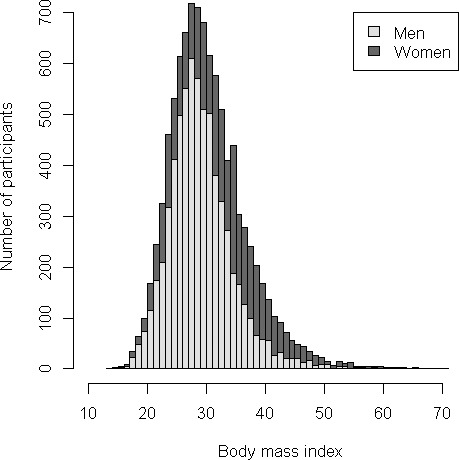
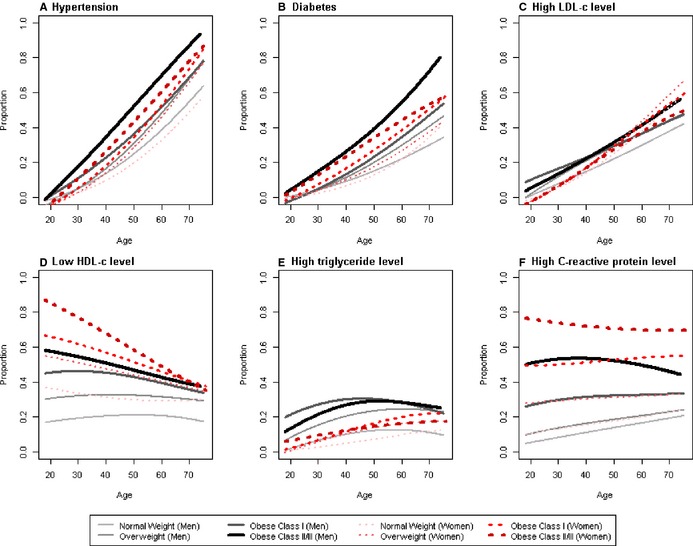
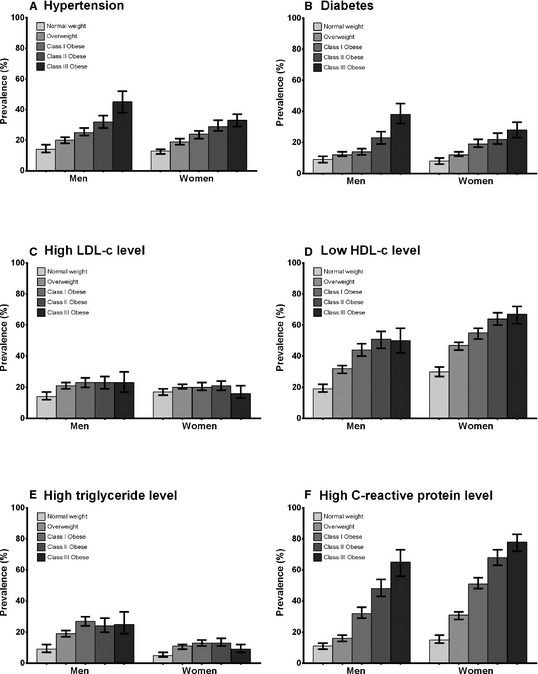
Among US Hispanic men (N=6547) and women (N=9797), we described gradients across the range of BMI and age in CVD risk factors including hypertension, serum lipids, diabetes, and C-reactive protein. Sex differences in CVD risk factor prevalences were determined at each level of BMI, after adjustment for age and other demographic and socioeconomic variables. Among those with class II or III obesity (BMI ≥35 kg/m(2), 18% women and 12% men), prevalences of hypertension, diabetes, low high-density lipoprotein cholesterol level, and high C-reactive protein level approached or exceeded 40% during the fourth decade of life. While women had a higher prevalence of class III obesity (BMI ≥40 kg/m(2)) than did men (7% and 4%, respectively), within this highest BMI category there was a >50% greater relative prevalence of diabetes, hypertension, and hyperlipidemia in men versus women, while sex differences in prevalence of these CVD risk factors were ≈20% or less at other BMI levels.
Elevated BMI is common in Hispanic/Latino adults and is associated with a considerable excess of CVD risk factors. At the highest BMI levels, CVD risk factors often emerge in the earliest decades of adulthood and they affect men more often than women.
美国所有主要的西班牙裔/拉丁裔群体肥胖率都很高,且往往较为严重。对于体重指数(BMI)极高的人群中的心血管疾病(CVD)危险因素,人们了解甚少。
在美国西班牙裔男性(N = 6547)和女性(N = 9797)中,我们描述了包括高血压、血脂、糖尿病和C反应蛋白在内的CVD危险因素在BMI和年龄范围内的梯度变化。在调整年龄及其他人口统计学和社会经济变量后,确定了每个BMI水平上CVD危险因素患病率的性别差异。在患有II级或III级肥胖(BMI≥35 kg/m²,女性为18%,男性为12%)的人群中,在生命的第四个十年中,高血压、糖尿病、低高密度脂蛋白胆固醇水平和高C反应蛋白水平的患病率接近或超过4[X]%。虽然女性III级肥胖(BMI≥40 kg/m²)的患病率高于男性(分别为7%和4%),但在这个最高BMI类别中,男性糖尿病、高血压和高脂血症的相对患病率比女性高50%以上,而在其他BMI水平上,这些CVD危险因素患病率的性别差异约为20%或更低。
BMI升高在西班牙裔/拉丁裔成年人中很常见,并且与大量额外的CVD危险因素相关。在最高BMI水平上,CVD危险因素往往在成年后的最初几十年就出现,而且男性比女性更常受到影响。