Department of Epidemiology & Population Health, Albert Einstein College of Medicine, 1300 Morris Park Avenue, Belfer Bldg, 1312C, Bronx, New York, 10461, USA.
Collaborative Studies Coordinating Center, Department of Biostatistics, Gillings School of Global Public Health, University of North Carolina, Chapel Hill, North Carolina, 27516, USA.
BMC Public Health. 2020 Sep 14;20(1):1400. doi: 10.1186/s12889-020-09497-5.
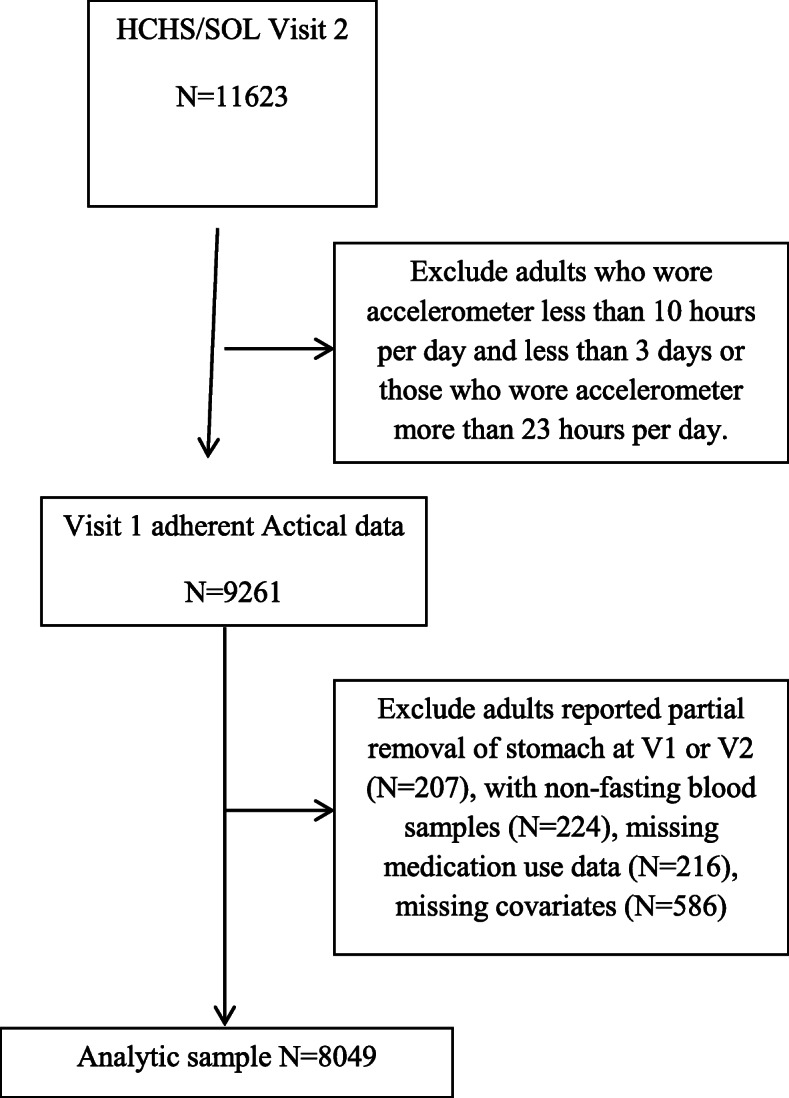
Whether physical activity can reduce cardiometabolic risk particularly in understudied populations such as US Hispanics/Latinos is of public health interest. We prospectively examined the association of physical activity and cardiometabolic biomarkers in n = 8049 participants of the Hispanic Community Health Study/Study of Latinos, a community-based cohort study of 16,415 adults aged 18-74 yr who self-identified as Hispanic/Latino from four US urban centers.
We assessed physical activity using accelerometry in 2008-2011 at visit 1. We assessed cardiometabolic biomarkers twice: once at visit 1 and collected a second measure in 2014-2017 at visit 2. We used survey linear regression models with changes in cardiometabolic markers as the dependent variables and quartiles of sedentary behavior or whether adults met guidelines for moderate-to-vigorous physical activity as the independent variables.
In normoglycemic adults without cardiovascular disease, but not in adults with evidence of cardiometabolic disease, those who were in the lowest quartile for sedentary behavior (< 10.08 h/day) had a significant decline in mean LDL-cholesterol of - 3.94 mg/dL (95% CI: - 6.37, - 1.52) compared to adults in the highest quartile (≥13.0 h/day) who exhibited a significant increase in LDL-cholesterol of 0.14 mg/dL (95% CI, - 2.15,2.42) over the six year period (P < 0.02 in fully adjusted models.) There was also a trend toward lower mean increase in HbA1c comparing the lowest with the highest quartile of sedentary behavior. Overall regardless of glycemic level or evidence of cardiometabolic disease, adults who met guidelines for moderate-to-vigorous physical activity at visit 1, had significantly lower mean increases in level of fasting glucose compared to adults not meeting guidelines in fully adjusted models.
In this cohort of Hispanics/Latinos, being free of cardiometabolic disease and having low levels of sedentary behavior were associated with health benefits. Among all adults regardless of cardiometabolic disease, meeting guidelines for moderate-to-vigorous physical activity was associated with health benefits. Overall these data suggest that an active lifestyle may blunt the association of advancing age with worsening cardiometabolic risk factors.
身体活动是否能降低心血管代谢风险,尤其是在美国西班牙裔/拉丁裔等研究较少的人群中,这是一个公共卫生关注的问题。我们前瞻性地研究了 n = 8049 名西班牙裔社区健康研究/拉丁裔研究参与者的身体活动与心血管代谢生物标志物之间的关系,这是一项基于社区的队列研究,共有来自四个美国城市的 16415 名年龄在 18-74 岁之间的自我认定为西班牙裔/拉丁裔的成年人参与。
我们在 2008-2011 年的第一次访问中使用加速度计评估身体活动。我们两次评估心血管代谢生物标志物:一次在第一次访问时,第二次在 2014-2017 年的第二次访问时收集。我们使用调查线性回归模型,将心血管代谢标志物的变化作为因变量,将久坐行为的四分位间距或成年人是否符合中高强度身体活动指南作为自变量。
在无心血管疾病的血糖正常成年人中,但在有心血管代谢疾病证据的成年人中,与久坐行为最低四分位(<10.08 小时/天)的成年人相比,久坐行为最低四分位的成年人 LDL-胆固醇水平显著下降-3.94mg/dL(95%CI:-6.37,-1.52),而久坐行为最高四分位(≥13.0 小时/天)的成年人 LDL-胆固醇水平显著升高 0.14mg/dL(95%CI,-2.15,2.42)在六年期间(在完全调整后的模型中,P < 0.02)。与久坐行为的最低四分位相比,HbA1c 的平均升高也有下降的趋势。总体而言,无论血糖水平或心血管代谢疾病的证据如何,在第一次访问时符合中高强度身体活动指南的成年人,与不符合指南的成年人相比,空腹血糖水平的平均升高显著降低在完全调整后的模型中。
在这组西班牙裔/拉丁裔人群中,没有心血管代谢疾病和较低水平的久坐行为与健康益处相关。在所有成年人中,无论是否存在心血管代谢疾病,符合中高强度身体活动指南与健康益处相关。总体而言,这些数据表明,积极的生活方式可能会减弱年龄增长与心血管代谢风险因素恶化之间的关联。