Pineda-Munoz Silvia, Alroy John
Department of Biological Sciences, Macquarie University, Sydney, New South Wales 2109, Australia
Department of Biological Sciences, Macquarie University, Sydney, New South Wales 2109, Australia.
Proc Biol Sci. 2014 Aug 22;281(1789):20141173. doi: 10.1098/rspb.2014.1173.
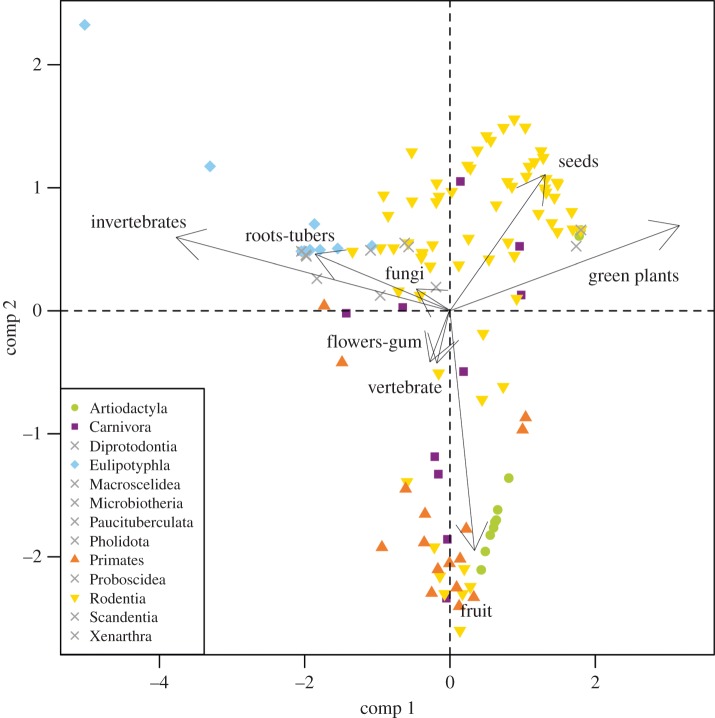
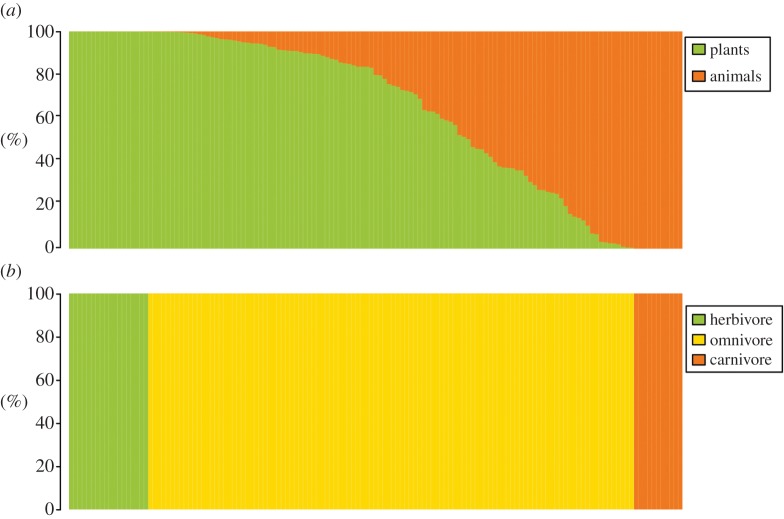
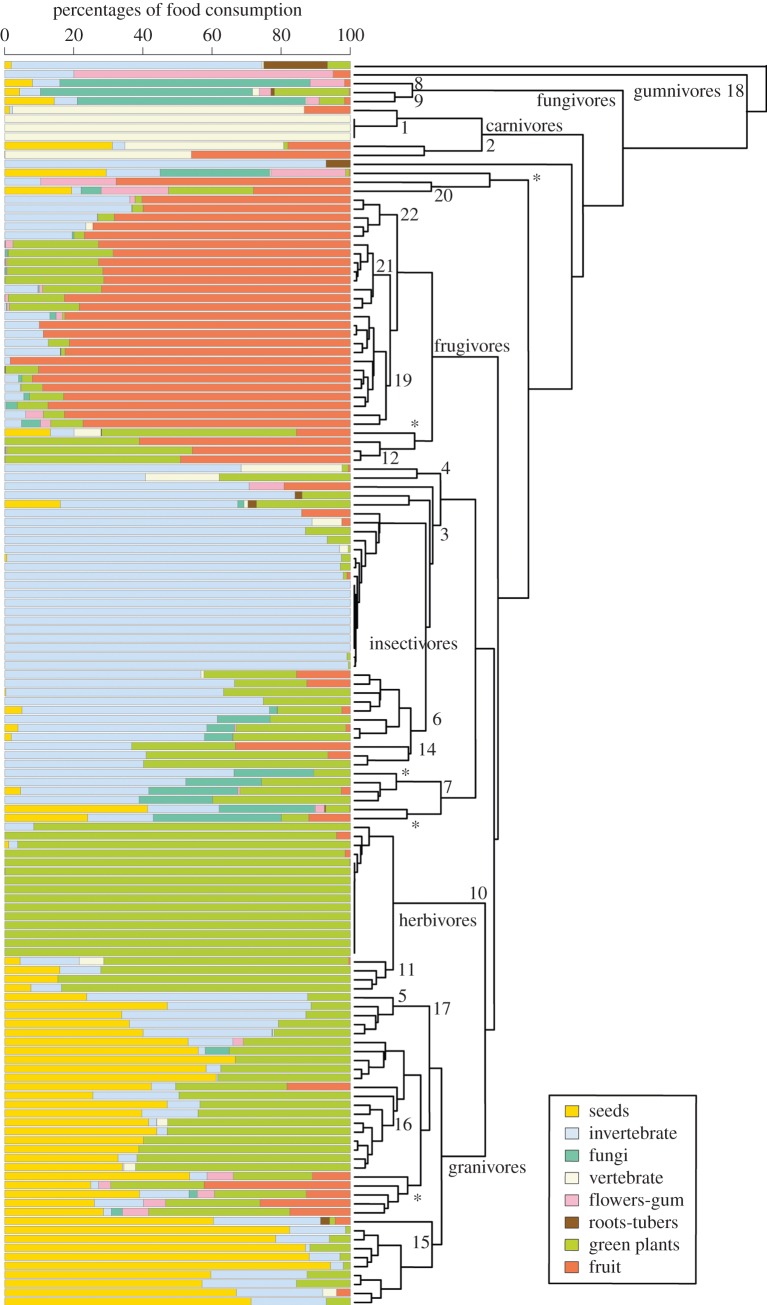
Understanding the feeding behaviour of the species that make up any ecosystem is essential for designing further research. Mammals have been studied intensively, but the criteria used for classifying their diets are far from being standardized. We built a database summarizing the dietary preferences of terrestrial mammals using published data regarding their stomach contents. We performed multivariate analyses in order to set up a standardized classification scheme. Ideally, food consumption percentages should be used instead of qualitative classifications. However, when highly detailed information is not available we propose classifying animals based on their main feeding resources. They should be classified as generalists when none of the feeding resources constitute over 50% of the diet. The term 'omnivore' should be avoided because it does not communicate all the complexity inherent to food choice. Moreover, the so-called omnivore diets actually involve several distinctive adaptations. Our dataset shows that terrestrial mammals are generally highly specialized and that some degree of food mixing may even be required for most species.
了解构成任何生态系统的物种的摄食行为对于开展进一步研究至关重要。哺乳动物已得到深入研究,但其饮食分类标准远未标准化。我们利用已发表的有关陆生哺乳动物胃内容物的数据建立了一个数据库,总结其饮食偏好。我们进行了多变量分析,以建立一个标准化的分类方案。理想情况下,应使用食物消耗百分比而非定性分类。然而,当无法获得高度详细的信息时,我们建议根据动物的主要食物资源进行分类。当没有一种食物资源占饮食的比例超过50%时,它们应被归类为泛化种。应避免使用“杂食动物”一词,因为它无法传达食物选择所固有的所有复杂性。此外,所谓的杂食性饮食实际上涉及几种独特的适应性。我们的数据集表明,陆生哺乳动物通常高度特化,而且大多数物种甚至可能需要一定程度的食物混合。