Silva-Neto Francisco das Chagas, Pavan Silvia E, Astúa Diego
Laboratório de Mastozoologia, Departamento de Zoologia, Universidade Federal de Pernambuco. Av. Prof. Moraes Rego, s.n. Cidade Universitária. 50670-901 Recife, PE, Brazil.
Department of Biological Sciences, California State Polytechnic University, Humboldt, 1 Harpst Street, Arcata, CA 95521, USA.
Curr Zool. 2023 Jun 26;70(4):488-504. doi: 10.1093/cz/zoad027. eCollection 2024 Aug.
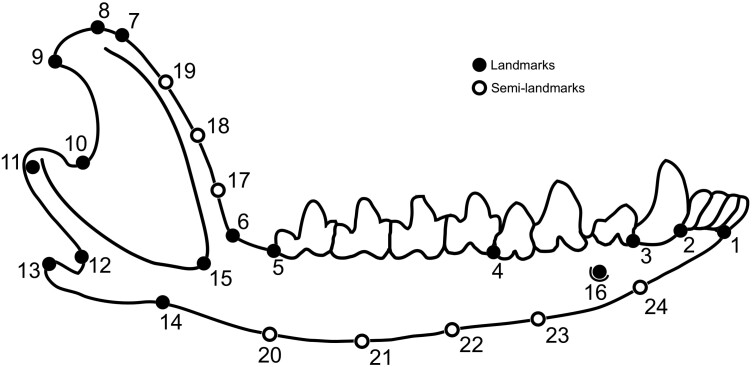
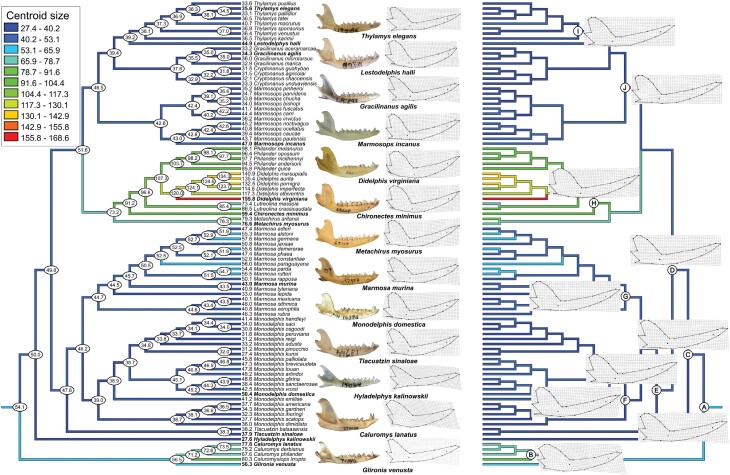
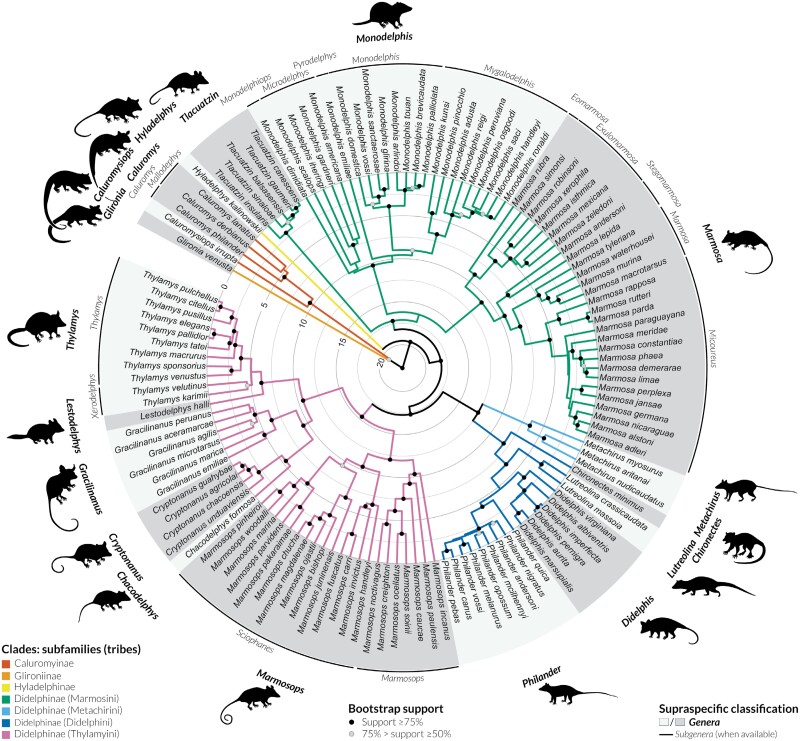
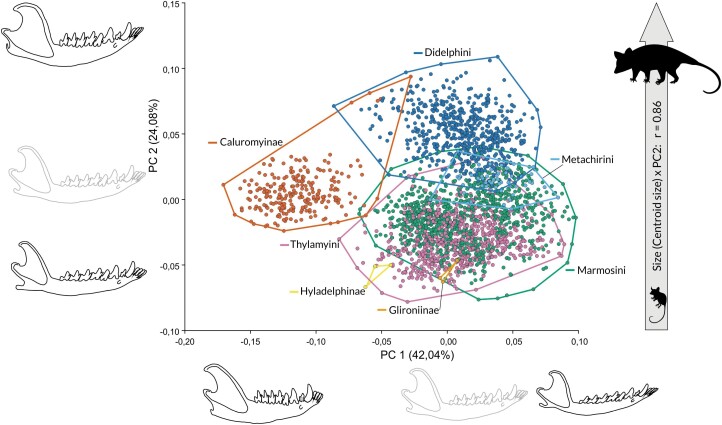
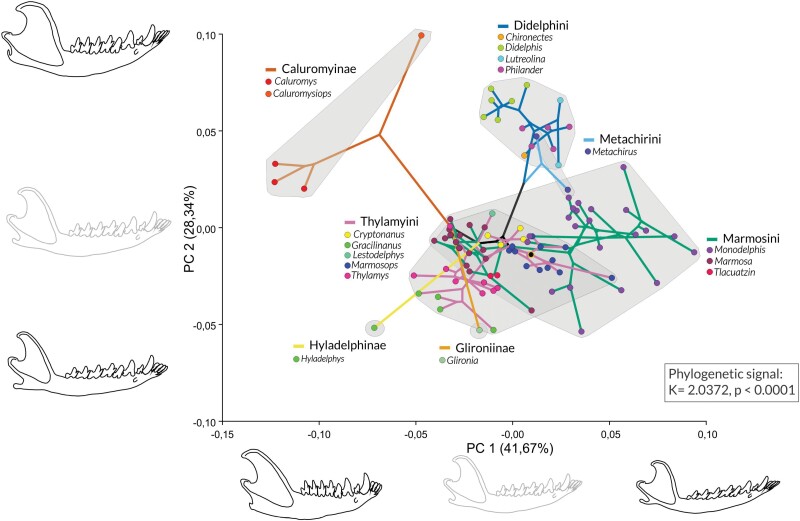
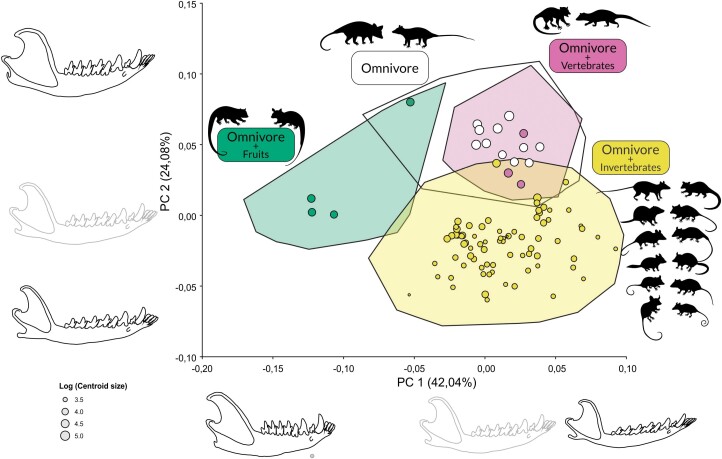
Didelphid marsupials are considered a morphologically unspecialized group with a generalist diet that includes vertebrates, invertebrates, and plant matter. While cranium and scapula variation has already been examined within Didelphidae, variation in mandible shape, usually associated with diet or phylogeny in other mammalian groups, has not yet been properly assessed in the family. We evaluated the variation in mandible shape and size of didelphids (2470 specimens belonging to 94 species) using 2D geometric morphometrics. We classified the diet of the didelphids into four broad categories to assess whether morphospace ordination relates to dietary habits. We also provided the most comprehensive phylogeny for the family (123 out of the 126 living species) using 10 nuclear and mitochondrial genes. We then mapped mandible size and shape onto that phylogeny for 93 selected taxa and ancestral size and shapes were reconstructed by parsimony. We found phylogenetically structured variation in mandible morphology between didelphid groups, and our results indicate that they have a significant phylogenetic signal. The main axis of shape variation is poorly related to size, but the second is strongly allometric, indicating that allometry is not the main factor in shaping morphological diversity on their mandibles. Our results indicate that the shape and size of the ancestral mandible of didelphids would be similar to that of the current species of the genus .
袋鼹科有袋类动物被认为是一个形态上未特化的群体,其饮食具有普遍性,包括脊椎动物、无脊椎动物和植物性物质。虽然已经对袋鼹科内部的颅骨和肩胛骨变异进行了研究,但在该科中,通常与其他哺乳动物群体的饮食或系统发育相关的下颌骨形状变异尚未得到恰当评估。我们使用二维几何形态测量学评估了袋鼹科动物(94个物种的2470个标本)下颌骨形状和大小的变异。我们将袋鼹科动物的饮食分为四大类,以评估形态空间排序是否与饮食习惯相关。我们还利用10个核基因和线粒体基因,为该科(126个现存物种中的123个)提供了最全面的系统发育树。然后,我们将93个选定分类单元的下颌骨大小和形状映射到该系统发育树上,并通过简约法重建祖先的大小和形状。我们发现袋鼹科群体之间下颌骨形态存在系统发育结构变异,我们的结果表明它们具有显著的系统发育信号。形状变异的主轴与大小的相关性较弱,但第二个主轴具有强烈的异速生长关系,这表明异速生长不是塑造其下颌骨形态多样性的主要因素。我们的结果表明,袋鼹科祖先下颌骨的形状和大小与该属当前物种的相似。