Rajendran Rajesh, Kerry Christopher, Rayman Gerry
Diabetes Centre, The Ipswich Hospital NHS Trust, Ipswich, IP4 5PD, UK.
BMJ Open. 2014 Jul 9;4(7):e005165. doi: 10.1136/bmjopen-2014-005165.
To determine whether temporal patterns of hypoglycaemia exist in inpatients with diabetes 'at risk' of hypoglycaemia (those on insulin and/or sulfonylureas), and if so whether patterns differ between hospitals and between these treatments.
Retrospective multicentre audit of inpatients with diabetes involving 11 acute UK National Health Service (NHS) trusts.
Capillary blood glucose readings of 3.9 mmol/L or less (hypoglycaemia) for all adult (≥18 years) inpatients with diabetes 'at risk' of hypoglycaemia were extracted from the Abbott PrecisionWeb Point-of-Care Data Management System over a 4-week period. Overall, 2521 readings of 3.9 mmol/L or less (hypoglycaemia) occurring in 866 participants between 1 June 2013 and 29 June 2013 were analysed.
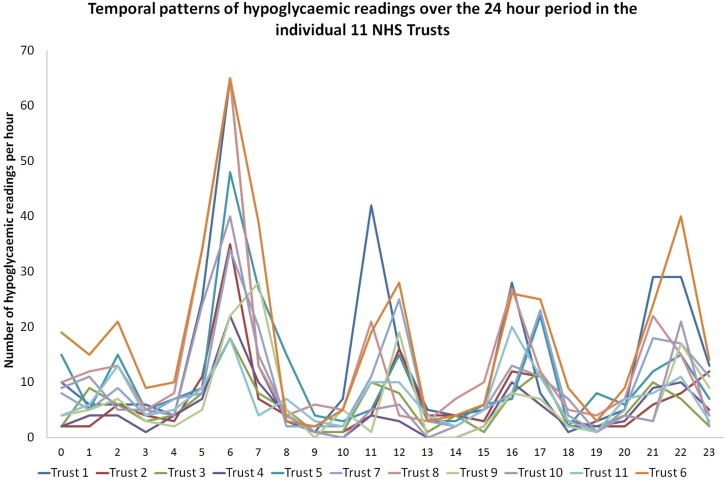
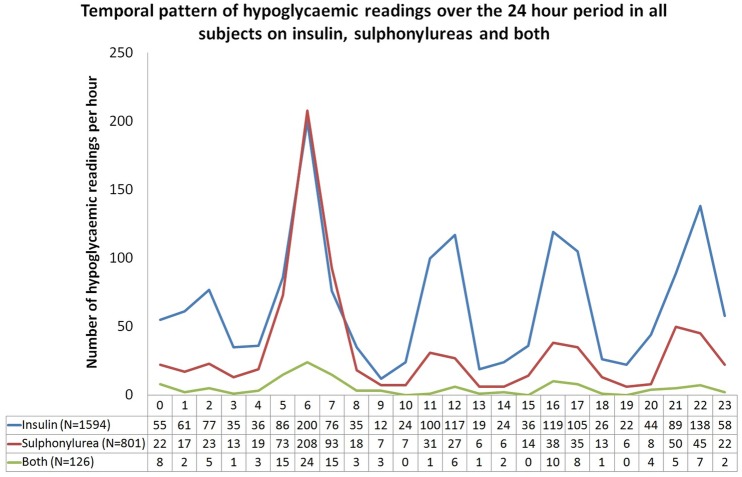
The majority (65%) occurred between 21:00 and 08:59, a pattern common to all Trusts. This was more frequent in sulfonylurea-treated than insulin-treated participants (75.3% vs 59.3%, p=0.0001). Furthermore, hypoglycaemic readings were more frequent between 5:00 and 7:59 in sulfonylurea-treated than insulin-treated participants (46.7% vs 22.7% of readings for respective treatments, p=0.0001). Sulfonylureas accounted for 31.8% of all hypoglycaemic readings. As a group, sulfonylurea-treated participants were older (median age 78 vs 73 years, p=0.0001) and had lower glycated haemoglobin (median 56 (7.3%) vs 69 mmol/mol (8.5%), p=0.0001). Hypoglycaemic readings per participant were as frequent for sulfonylurea-treated participants as for insulin-treated participants (median=2 for both) as were the proportions in each group with ≥5 hypoglycaemic readings (17.3% vs 17.7%).
In all Trusts, hypoglycaemic readings were more frequent between 21:00 and 08:59 in 'at risk' inpatients with diabetes, with a greater frequency in the early morning period (5:00-7:59) in sulfonylurea-treated inpatients. This may have implications for the continuing use of sulfonylureas in the inpatient setting.
确定低血糖风险“高危”的糖尿病住院患者(使用胰岛素和/或磺脲类药物者)是否存在低血糖的时间模式,若存在,各医院之间以及这些治疗方式之间的模式是否存在差异。
对英国11家急性国民医疗服务体系(NHS)信托机构的糖尿病住院患者进行回顾性多中心审计。
在4周时间内,从雅培PrecisionWeb即时护理数据管理系统中提取所有低血糖风险“高危”的成年(≥18岁)糖尿病住院患者的血糖读数≤3.9 mmol/L(低血糖)情况。总体上,对2013年6月1日至2013年6月29日期间866名参与者出现的2521次血糖读数≤3.9 mmol/L(低血糖)情况进行了分析。
大多数(65%)低血糖情况发生在21:00至08:59之间,这是所有信托机构共有的模式。在接受磺脲类药物治疗的参与者中比接受胰岛素治疗的参与者更常见(75.3%对59.3%,p = 0.0001)。此外,在接受磺脲类药物治疗的参与者中,5:00至7:59期间的低血糖读数比接受胰岛素治疗的参与者更频繁(分别占各自治疗读数的46.7%对22.7%,p = 0.0001)。磺脲类药物导致的低血糖读数占所有低血糖读数的31.8%。总体而言,接受磺脲类药物治疗的参与者年龄更大(中位年龄78岁对73岁,p = 0.0001),糖化血红蛋白水平更低(中位值56(7.3%)对69 mmol/mol(8.5%),p = 0.0001)。接受磺脲类药物治疗的参与者与接受胰岛素治疗的参与者相比,每位参与者的低血糖读数频率相同(中位值均为2次),两组中低血糖读数≥5次的比例也相同(17.3%对17.7%)。
在所有信托机构中,低血糖风险“高危”的糖尿病住院患者在21:00至08:59之间低血糖读数更频繁,在接受磺脲类药物治疗的住院患者清晨时段(5:00 - 7:59)频率更高。这可能对住院环境中磺脲类药物的持续使用有影响。