1 School of Psychological Sciences, University of Manchester, Manchester M13 9PL, UK
2 Institute of Psychology, Health and Society, University of Liverpool, Liverpool L69 3BX, UK.
Brain. 2014 Aug;137(Pt 8):2346-55. doi: 10.1093/brain/awu152. Epub 2014 Jul 9.
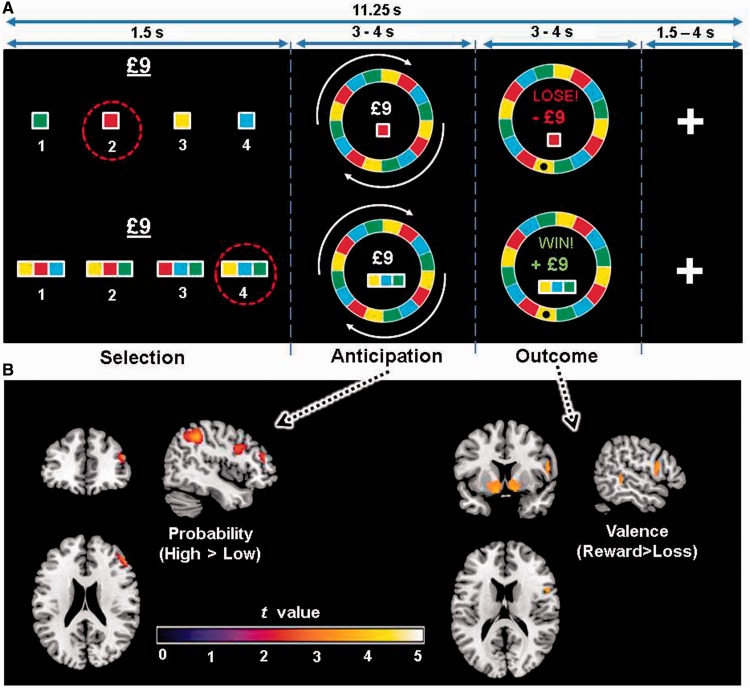
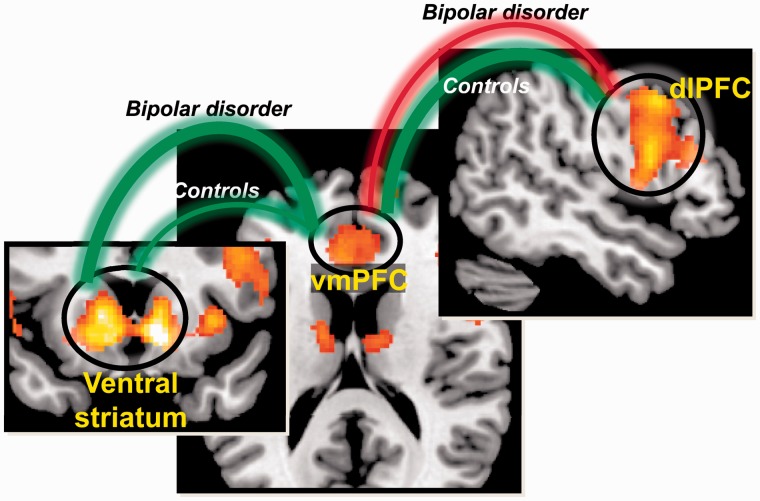
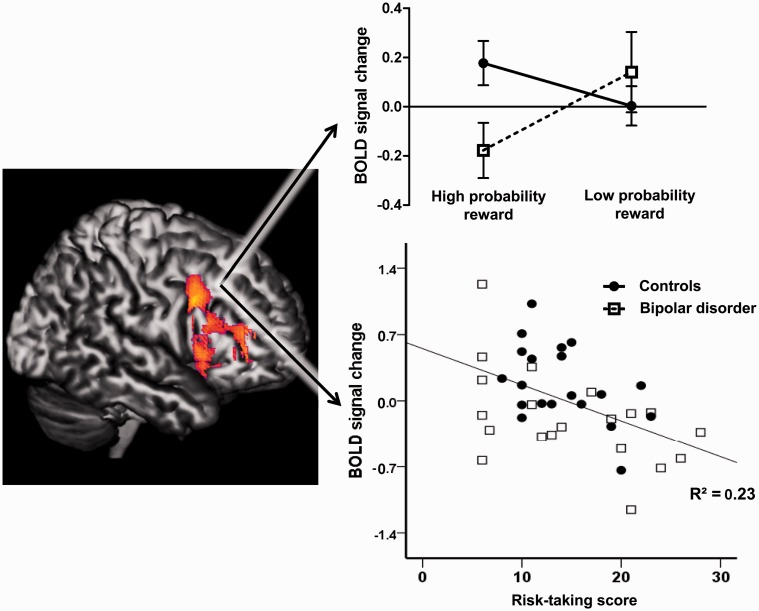
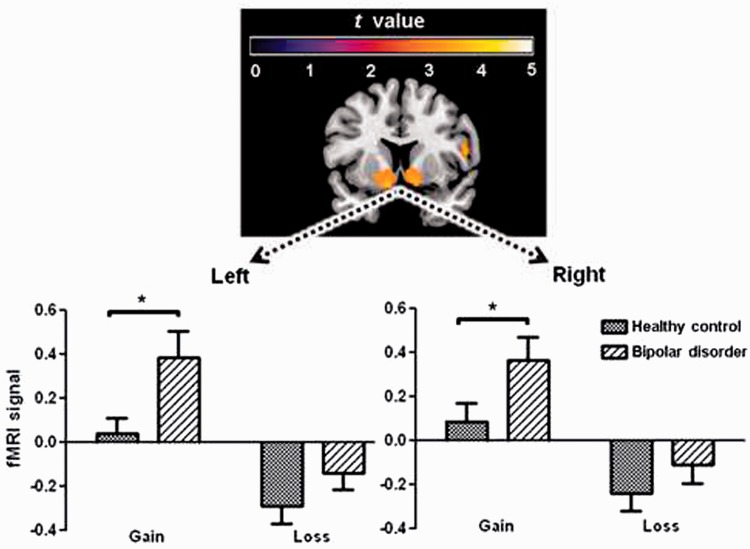
Bipolar disorder is characterized by impaired decision-making captured in impulsivity and risk-taking. We sought to determine whether this is driven by a failure to effectively weight the lower-order goal of obtaining a strongly desired reward in relation to higher-order goals, and how this relates to trait impulsivity and risk-taking. We hypothesized that in bipolar disorder the weighting of valuation signals converging on ventromedial prefrontal cortex are more heavily weighted towards ventral striatum inputs (lower-order), with less weighting of dorsolateral prefrontal cortex inputs (higher-order). Twenty euthymic patients with bipolar disorder not in receipt of antipsychotic medication and 20 case-matched controls performed a roulette task during functional magnetic resonance imaging. Activity in response to high-probability ('safe') and low-probability ('risky') prospects was measured during both anticipation, and outcome. In control subjects, anticipatory and outcome-locked activity in dorsolateral prefrontal cortex was greater for safe than risky reward prospects. The bipolar disorder group showed the opposite pattern with preferential response to risky rewards. This group also showed increased anticipatory and outcome-locked activity in ventral striatum in response to rewards. In control subjects, however, ventromedial prefrontal activation was positively associated with both ventral striatum and dorsolateral prefrontal activity; patients evidenced a strong positive association with ventral striatum, but a negative association with dorsolateral prefrontal cortex. Response to high-probability rewards in dorsolateral prefrontal cortex was inversely associated with trait impulsivity and risk-taking in the bipolar disorder group. Our findings suggest that clinically impulsive and risky decision-making are related to subjective valuation that is biased towards lower-order preference, with diminished integration of higher-order goals. The findings extend a functional neuroanatomical account of disorders characterized by clinically impulsive decision-making, and provide targets for evaluating interventions that foster self-control.
双相情感障碍的特点是决策能力受损,表现为冲动和冒险行为。我们试图确定这是否是由于未能有效地权衡获得强烈渴望的奖励这一较低层次目标与较高层次目标的关系,以及这与特质冲动和冒险行为有何关系。我们假设,在双相情感障碍中,腹内侧前额叶皮层汇聚的估值信号的权重更多地偏向于腹侧纹状体的输入(较低层次),而较少偏向于背外侧前额叶皮层的输入(较高层次)。20 名未服用抗精神病药物的双相情感障碍缓解期患者和 20 名匹配的对照组在功能磁共振成像期间进行了轮盘赌任务。在预期和结果期间测量了对高概率(“安全”)和低概率(“风险”)前景的反应。在对照组中,与安全奖励前景相比,背外侧前额叶皮层在安全和风险奖励前景的预期和结果锁定时的活动更大。双相情感障碍组表现出相反的模式,对风险奖励有偏好反应。该组在对奖励的预期和结果锁定时还显示出腹侧纹状体活动增加。然而,在对照组中,腹内侧前额叶皮层的激活与腹侧纹状体和背外侧前额叶皮层的活动均呈正相关;患者与腹侧纹状体呈强烈的正相关,而与背外侧前额叶皮层呈负相关。背外侧前额叶皮层对高概率奖励的反应与双相情感障碍组的特质冲动和冒险行为呈负相关。我们的研究结果表明,临床上冲动和冒险的决策与偏向较低层次偏好的主观估值有关,较高层次目标的整合能力下降。这些发现扩展了以临床冲动决策为特征的障碍的功能神经解剖学解释,并为评估促进自我控制的干预措施提供了目标。