Institute for Psychology, University of Münster Münster, Germany ; Max Planck Institute for Neurological Research Cologne, Germany ; Department of Neurology, University Hospital Cologne Köln, Germany.
Center for Mind/Brain Sciences (CIMeC), University of Trento Mattarello, Italy.
Front Psychol. 2014 Jun 24;5:636. doi: 10.3389/fpsyg.2014.00636. eCollection 2014.
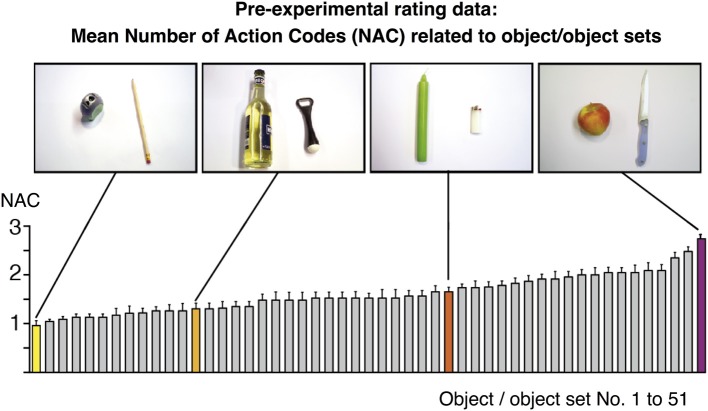
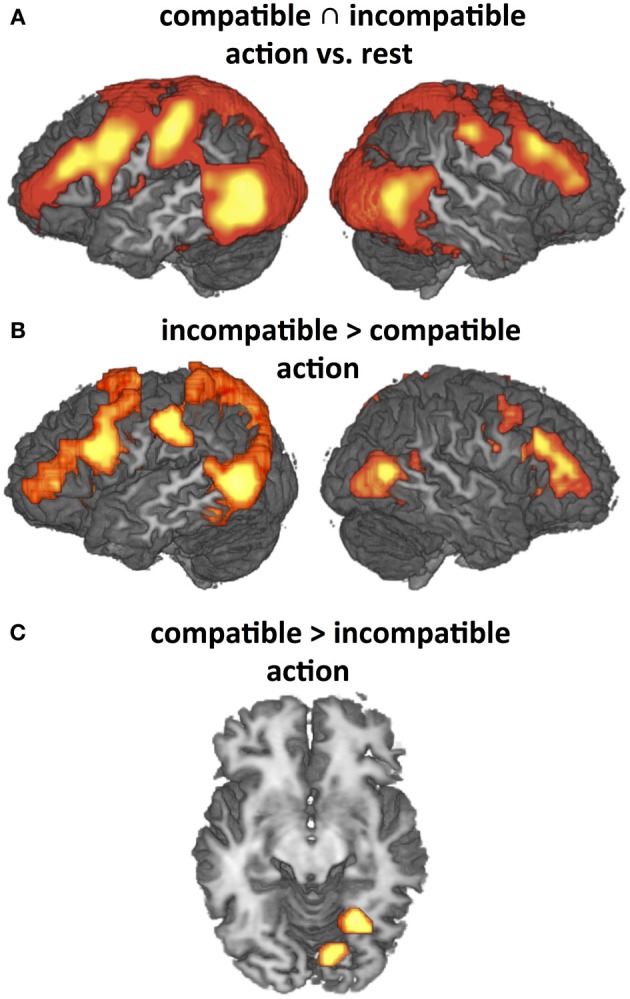
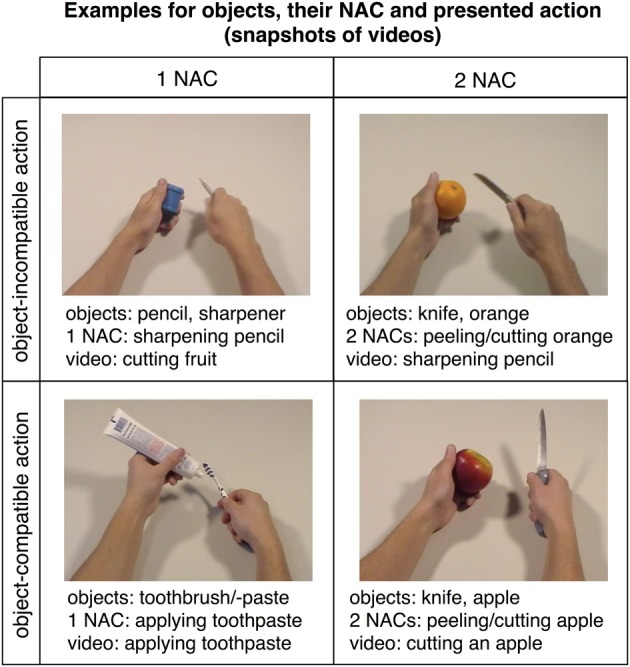
Objects are reminiscent of actions often performed with them:knife and apple remind us on peeling the apple or cutting it. Mnemonic representations of object-related actions (action codes) evoked by the sight of an object may constrain and hence facilitate recognition of unrolling actions. The present fMRI study investigated if and how action codes influence brain activation during action observation. The average number of action codes (NAC) of 51 sets of objects was rated by a group of n = 24 participants. In an fMRI study, different volunteers were asked to recognize actions performed with the same objects presented in short videos. To disentangle areas reflecting the storage of action codes from those exploiting them, we showed object-compatible and object-incompatible (pantomime) actions. Areas storing action codes were considered to positively co-vary with NAC in both object-compatible and object-incompatible action; due to its role in tool-related tasks, we here hypothesized left anterior inferior parietal cortex (aIPL). In contrast, areas exploiting action codes were expected to show this correlation only in object-compatible but not incompatible action, as only object-compatible actions match one of the active action codes. For this interaction, we hypothesized ventrolateral premotor cortex (PMv) to join aIPL due to its role in biasing competition in IPL. We found left anterior intraparietal sulcus (IPS) and left posterior middle temporal gyrus (pMTG) to co-vary with NAC. In addition to these areas, action codes increased activity in object-compatible action in bilateral PMv, right IPS, and lateral occipital cortex (LO). Findings suggest that during action observation, the brain derives possible actions from perceived objects, and uses this information to shape action recognition. In particular, the number of expectable actions quantifies the activity level at PMv, IPL, and pMTG, but only PMv reflects their biased competition while observed action unfolds.
刀和苹果让人想起削苹果或切苹果。看到物体后,人们会对与物体相关的动作(动作代码)进行记忆联想,这些记忆联想可能会限制和促进对展开动作的识别。本 fMRI 研究调查了动作代码是否以及如何影响动作观察过程中的大脑激活。一组 24 名参与者对 51 组物体的平均动作代码数量(NAC)进行了评分。在 fMRI 研究中,不同的志愿者被要求识别用相同物体呈现的短视频中进行的动作。为了将反映动作代码存储的区域与利用这些代码的区域区分开来,我们展示了与物体兼容和不兼容(模仿)的动作。被认为存储动作代码的区域与物体兼容和不兼容动作中的 NAC 呈正相关;由于其在与工具相关的任务中的作用,我们假设左侧前下顶叶皮层(aIPL)。相比之下,只有在物体兼容的动作中,我们期望利用动作代码的区域显示出这种相关性,因为只有物体兼容的动作与一个活动的动作代码匹配。对于这种相互作用,我们假设由于其在 IPL 中的竞争偏向中的作用,腹外侧运动前皮层(PMv)将加入 aIPL。我们发现左侧前内顶叶沟(IPS)和左侧后颞中回(pMTG)与 NAC 相关。除了这些区域外,动作代码还增加了双侧 PMv、右侧 IPS 和外侧枕叶皮层(LO)中物体兼容动作的活动。研究结果表明,在动作观察过程中,大脑从感知到的物体中推断出可能的动作,并利用这些信息来塑造动作识别。特别是,可预期动作的数量量化了 PMv、IPS 和 pMTG 的活动水平,但只有 PMv 反映了它们在观察到的动作展开时的竞争偏向。