Department of Psychiatry (SSD, AS, ZHB, MW, KE), Tulane University School of Medicine, New Orleans, Louisiana; Department of Human Development and Family Studies (EAS, JP), University of Iowa, Ames, Iowa; and Department of Global Community Health Sciences (EM, KPT), Tulane School of Public Health and Tropical Medicine, New Orleans, Louisiana.
Am J Med Sci. 2014 Aug;348(2):92-100. doi: 10.1097/MAJ.0000000000000299.
Given the established relation between testosterone and aging in older adults, we tested whether buccal telomere length (TL), an established cellular biomarker of aging, was associated with testosterone levels in youth.
Children, mean age 10.2 years, were recruited from the greater New Orleans area, and salivary testosterone was measured diurnally and during an acute stressor. Buccal TL was measured using monochrome multiplex quantitative real-time polymerase chain reaction. Testosterone and TL data were available on 77 individuals. The association between buccal TL and testosterone was tested using multivariate generalized estimating equations to account for clustering of children within families.
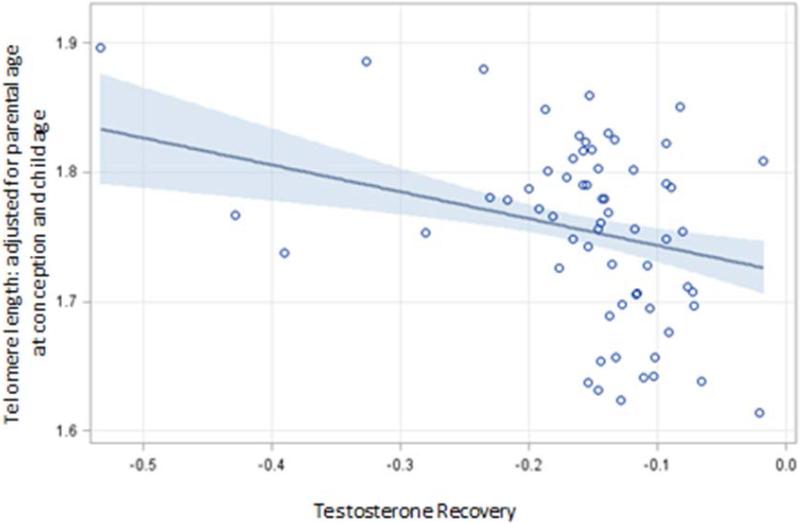
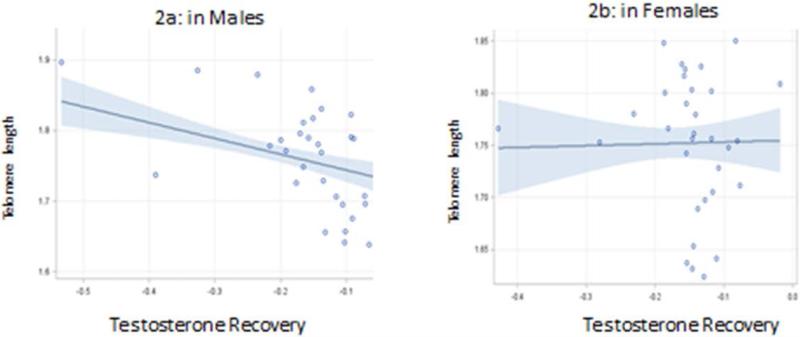
Greater peak testosterone levels (β = -0.87, P < 0.01) and slower recovery (β = -0.56, P < 0.01) and reactivity (β = -1.22, P < 0.01) following a social stressor were significantly associated with shorter buccal TL after controlling for parental age at conception, child age, sex, sociodemographic factors and puberty. No association was initially present between diurnal measurements of testosterone or morning basal testosterone levels and buccal TL. Sex significantly moderated the relation between testosterone reactivity and buccal TL.
The association between testosterone and buccal TL supports gonadal maturation as a developmentally sensitive biomarker of aging within youth. As stress levels of testosterone were significantly associated with buccal TL, these findings are consistent with the growing literature linking stress exposure and accelerated maturation. The lack of association of diurnal testosterone or morning basal levels with buccal TL bolsters the notion of a shared stress-related maturational mechanism between cellular stress and the hypothalamic pituitary gonadal axis. These data provide novel evidence supporting the interaction of aging, physiologic stress and cellular processes as an underlying mechanism linking negative health outcomes and early life stress.
鉴于睾丸激素与老年人衰老之间的既定关系,我们测试了口腔端粒长度(TL),一种已确立的衰老细胞生物标志物,是否与年轻人的睾丸激素水平有关。
从新奥尔良大都市区招募了平均年龄为 10.2 岁的儿童,并对唾液睾丸激素进行了日间和急性应激时的测量。使用单色多重实时聚合酶链反应测量口腔 TL。有 77 名个体提供了睾丸激素和 TL 数据。使用多变量广义估计方程来测试口腔 TL 与睾丸激素之间的关联,以解释儿童在家庭内的聚类。
在控制父母受孕时的年龄、儿童年龄、性别、社会人口因素和青春期后,更大的峰值睾丸激素水平(β=-0.87,P<0.01)以及较慢的恢复(β=-0.56,P<0.01)和反应性(β=-1.22,P<0.01)与口腔 TL 较短相关。最初,昼夜测量的睾丸激素或早晨基础睾丸激素水平与口腔 TL 之间没有关联。性别显著调节了睾丸激素反应性与口腔 TL 之间的关系。
睾丸激素与口腔 TL 之间的关联支持性腺成熟作为年轻人衰老的发育敏感生物标志物。由于睾丸激素的应激水平与口腔 TL 显著相关,这些发现与越来越多的将应激暴露与加速成熟联系起来的文献一致。昼夜睾丸激素或早晨基础水平与口腔 TL 之间缺乏关联,这支持了细胞应激和下丘脑-垂体-性腺轴之间存在共同的应激相关成熟机制的观点。这些数据提供了新的证据,支持衰老、生理应激和细胞过程作为将负面健康结果与早期生活应激联系起来的潜在机制的相互作用。