Tulane Brain Institute, Department of Neuroscience, Tulane University, New Orleans, LA United States.
Department of Psychiatry and Behavioral Sciences, Tulane University School of Medicine, New Orleans, LA United States.
Psychoneuroendocrinology. 2019 Aug;106:20-27. doi: 10.1016/j.psyneuen.2019.03.022. Epub 2019 Mar 22.
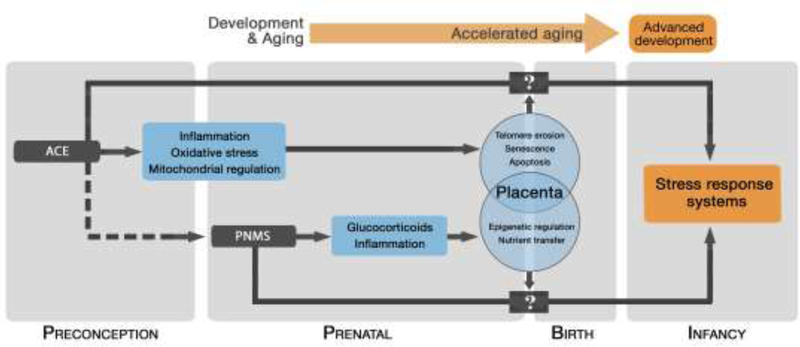
To test alterations in placental cellular aging as one pathway by which maternal early adversity influences physiologic development in her offspring.
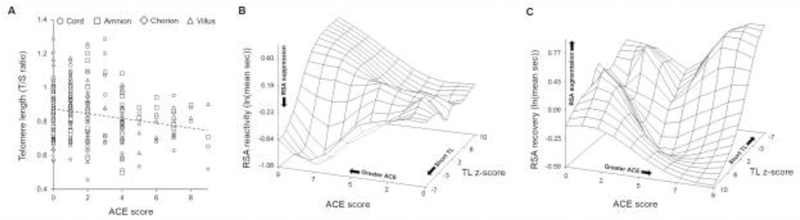
Maternal report of her adverse childhood experiences (ACE) was obtained prenatally along with measures of prenatal stress and demographic information. Placentas (N = 67) were collected at birth and telomere length (TL) was measured in four separate fetally-derived placental tissues: amnion, chorion, villus, and umbilical cord. At four months of age, infants completed the still-face paradigm (SFP) during which respiratory sinus arrhythmia (RSA) data were collected; RSA reactivity and RSA recovery was available from 44 and 41 infants respectively. Multi-level mixed effects models examined the impact of maternal ACE score on placental TL. Generalized linear models tested the relation between composite placental TL and infant RSA, as well as the moderation of maternal ACE score and infant RSA by composite placental TL.
Higher maternal ACE score significantly predicted shorter placental TL across tissues (β = -0.015; P = 0.036) and infant RSA across the SFP. No direct relation was found between placental TL and RSA, however composite placental TL moderated the relation between ACE score and both infant RSA reactivity (β = 0.025; P = 0.005) and RSA recovery (β = -0.028; P = 0.032). In infants with shorter composite placental TL, higher ACE score predicted greater RSA suppression during the still-face epoch relative to play period 1 and greater RSA augmentation during play period 2 relative to the still-face epoch.
These data are the first, to our knowledge, to report that changes in placental TL influence the transgenerational impact of maternal early life adversity on the development of her offspring's autonomic nervous system.
研究胎盘细胞衰老的改变是否是母体早期逆境影响后代生理发育的途径之一。
在产前收集母体的不良童年经历(ACE)报告,同时测量产前应激和人口统计学信息。在出生时收集胎盘(N=67),并在四个单独的胎儿胎盘组织中测量端粒长度(TL):羊膜、绒毛膜、绒毛和脐带。在 4 个月大时,婴儿在进行静止面孔范式(SFP)时完成呼吸窦性心律失常(RSA)数据的采集;分别有 44 名和 41 名婴儿获得了 RSA 反应性和 RSA 恢复数据。多级混合效应模型检验了母体 ACE 评分对胎盘 TL 的影响。广义线性模型检验了复合胎盘 TL 与婴儿 RSA 的关系,以及母体 ACE 评分和婴儿 RSA 之间的复合胎盘 TL 的调节作用。
较高的母体 ACE 评分显著预测了跨组织的胎盘 TL(β=-0.015;P=0.036)和 SFP 中的婴儿 RSA。胎盘 TL 与 RSA 之间未发现直接关系,但复合胎盘 TL 调节了 ACE 评分与婴儿 RSA 反应性(β=0.025;P=0.005)和 RSA 恢复(β=-0.028;P=0.032)之间的关系。在复合胎盘 TL 较短的婴儿中,较高的 ACE 评分预测了在静止面孔期相对于第 1 个游戏期的更大的 RSA 抑制作用,以及在第 2 个游戏期相对于静止面孔期的更大的 RSA 增强作用。
这些数据是我们所知的首次报告,表明胎盘 TL 的变化影响了母体早期逆境对其后代自主神经系统发育的跨代影响。