Chakrabarti Sutapa, Bonneau Fabien, Schüssler Steffen, Eppinger Elfriede, Conti Elena
Max Planck Institute of Biochemistry, Structural Cell Biology Department, Am Klopferspitz 18, D-82152 Martinsried, Germany.
Max Planck Institute of Biochemistry, Structural Cell Biology Department, Am Klopferspitz 18, D-82152 Martinsried, Germany
Nucleic Acids Res. 2014 Aug;42(14):9447-60. doi: 10.1093/nar/gku578. Epub 2014 Jul 10.
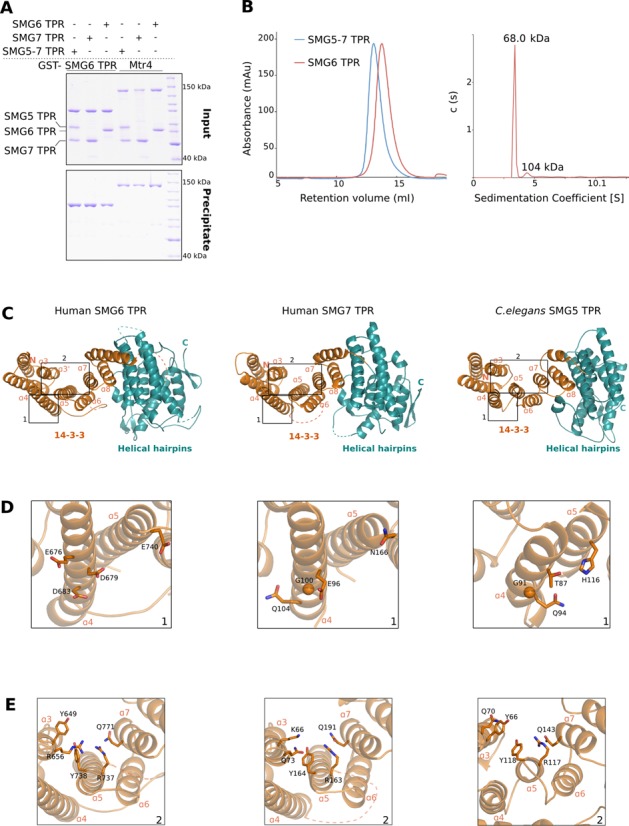
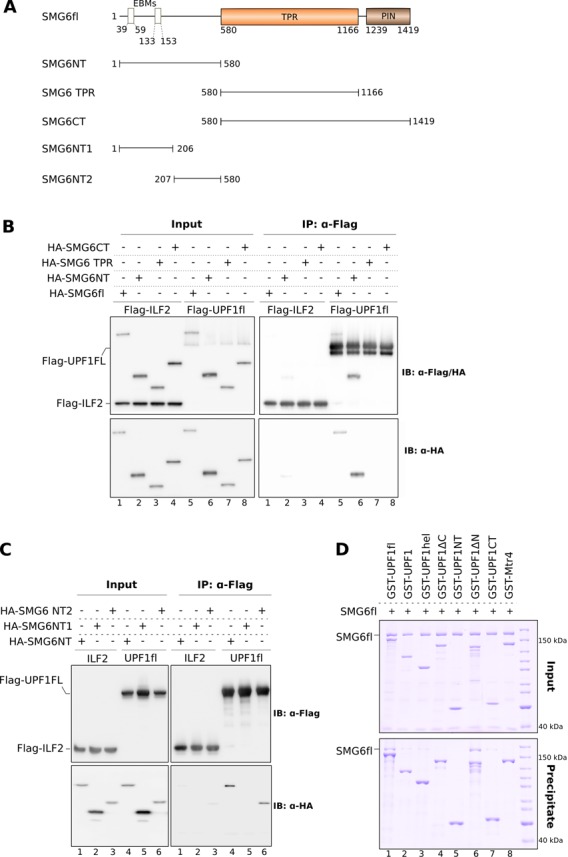
Nonsense-mediated mRNA decay (NMD) is a eukaryotic surveillance pathway that recognizes mRNAs with premature stop codons and targets them for rapid degradation. Evidence from previous studies has converged on UPF1 as the central NMD factor. In human cells, the SMG1 kinase phosphorylates UPF1 at the N-terminal and C-terminal tails, in turn allowing the recruitment of the NMD factors SMG5, SMG6 and SMG7. To understand the molecular mechanisms, we recapitulated these steps of NMD in vitro using purified components. We find that a short C-terminal segment of phosphorylated UPF1 containing the last two Ser-Gln motifs is recognized by the heterodimer of SMG5 and SMG7 14-3-3-like proteins. In contrast, the SMG6 14-3-3-like domain is a monomer. The crystal structure indicates that the phosphoserine binding site of the SMG6 14-3-3-like domain is similar to that of SMG5 and can mediate a weak phospho-dependent interaction with UPF1. The dominant SMG6-UPF1 interaction is mediated by a low-complexity region bordering the 14-3-3-like domain of SMG6 and by the helicase domain and C-terminal tail of UPF1. This interaction is phosphorylation independent. Our study demonstrates that SMG5-SMG7 and SMG6 exhibit different and non-overlapping modes of UPF1 recognition, thus pointing at distinguished roles in integrating the complex NMD interaction network.
无义介导的mRNA降解(NMD)是一种真核生物监测途径,可识别带有提前终止密码子的mRNA并将其靶向快速降解。先前研究的证据表明,UPF1是核心的NMD因子。在人类细胞中,SMG1激酶使UPF1的N端和C端尾部磷酸化,进而允许招募NMD因子SMG5、SMG6和SMG7。为了解分子机制,我们使用纯化的组分在体外重现了NMD的这些步骤。我们发现,磷酸化的UPF1的一个短C端片段包含最后两个Ser-Gln基序,被SMG5和SMG7 14-3-3样蛋白的异二聚体识别。相比之下,SMG6 14-3-3样结构域是单体。晶体结构表明,SMG6 14-3-3样结构域的磷酸丝氨酸结合位点与SMG5的相似,并且可以介导与UPF1的弱磷酸依赖性相互作用。主要的SMG6-UPF1相互作用由与SMG6的14-3-3样结构域相邻的低复杂性区域以及UPF1的解旋酶结构域和C端尾部介导。这种相互作用不依赖于磷酸化。我们的研究表明,SMG5-SMG7和SMG6表现出不同且不重叠的UPF1识别模式,从而指出了在整合复杂的NMD相互作用网络中的不同作用。