Alcalá-Cerra Gabriel, Paternina-Caicedo Angel J, Díaz-Becerra Cindy, Moscote-Salazar Luis R, Fernandes-Joaquim Andrei
Department of Neurological Research, Health Sciences and Neurosciences (CISNEURO) Research Group, Colombia ; Department of Neurosurgery, University of Cartagena, Cartagena de Indias, Colombia.
Department of Neurological Research, Health Sciences and Neurosciences (CISNEURO) Research Group, Colombia.
J Craniovertebr Junction Spine. 2014 Jan;5(1):25-32. doi: 10.4103/0974-8237.135213.
Traditionally, conservative treatment of thoracolumbar (TL) burst fractures without neurologic deficit has encompassed the application of an extension brace. However, their effectiveness on maintaining the alignment, preventing posttraumatic deformities, and improving back pain, disability and quality of life is doubtful.
The objective was to identify and summarize the evidence from randomized controlled trials (RCTs) to determine whether bracing patients who suffer TL fractures adds benefices to the conservative manage without bracing.
Seven databases were searched for relevant RCTs that compared the clinical and radiological outcomes of orthosis versus no-orthosis for TL burst fractures managed conservatively. Primary outcomes were: (1) Loss of kyphotic angle; (2) failure of conservative management requiring subsequent surgery; and (3) disability and pain outcomes. Secondary outcomes were defined by health-related quality of life and in-hospital stay.
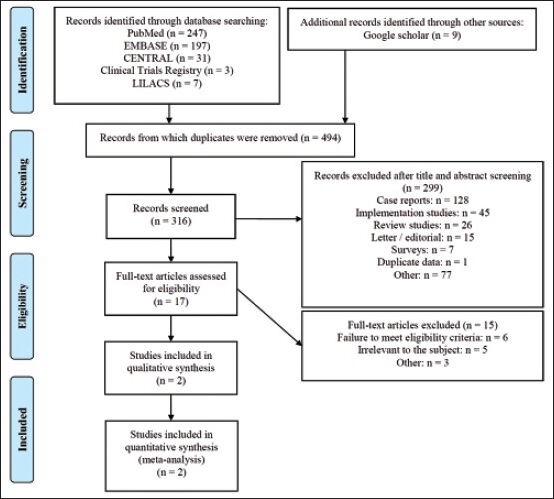
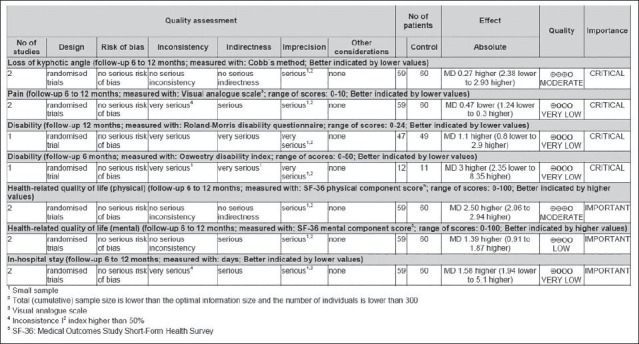
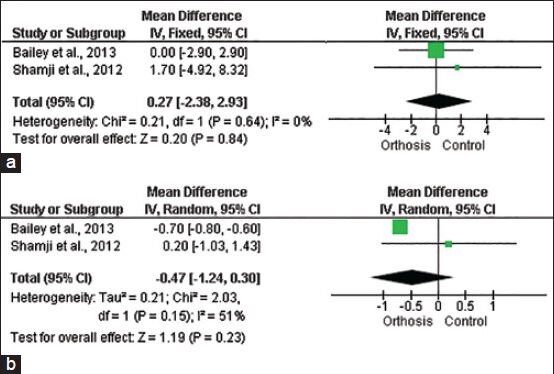
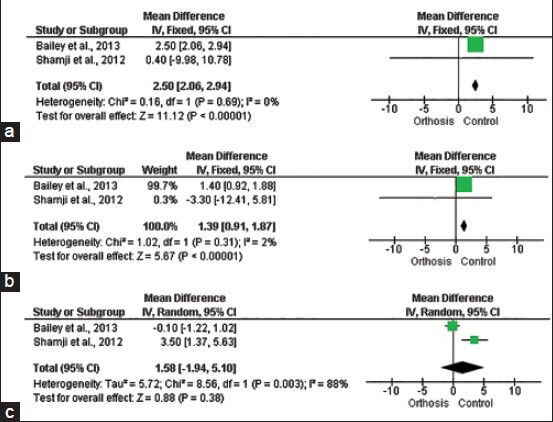
Based on predefined inclusion criteria, only two eligible high-quality RCTs with a total of 119 patients were included. No significant difference was identified between the two groups regarding loss of kyphotic angle, pain outcome, or in-hospital stay. The pooled data showed higher scores in physical and mental domains of the Short-Form Health Survey 36 in the group treated without orthosis.
The current evidence suggests that orthosis could not be necessary when TL burst fractures without neurologic deficit are treated conservatively. However, due to limitations related with number and size of the included studies, more RCTs with high quality are desirable for making recommendations with more certainty.
传统上,对于无神经功能缺损的胸腰椎爆裂骨折,保守治疗包括使用伸展支具。然而,其在维持脊柱排列、预防创伤后畸形以及改善背痛、功能障碍和生活质量方面的有效性值得怀疑。
本研究旨在识别并总结随机对照试验(RCT)的证据,以确定对胸腰椎骨折患者使用支具是否比不使用支具的保守治疗更有益。
检索七个数据库,寻找比较保守治疗胸腰椎爆裂骨折时使用矫形器与不使用矫形器的临床和影像学结果的相关RCT。主要结局指标为:(1)后凸角丢失;(2)保守治疗失败需要后续手术;(3)功能障碍和疼痛结局。次要结局指标由健康相关生活质量和住院时间定义。
根据预先设定的纳入标准,仅纳入两项符合条件的高质量RCT,共119例患者。两组在后凸角丢失、疼痛结局或住院时间方面未发现显著差异。汇总数据显示,未使用矫形器治疗的组在简短健康调查36项的身体和心理领域得分更高。
目前的证据表明,对于无神经功能缺损的胸腰椎爆裂骨折进行保守治疗时,可能不需要使用矫形器。然而,由于纳入研究的数量和规模存在局限性,需要更多高质量的RCT来更确定地提出建议。