Voon Valerie, Mole Thomas B, Banca Paula, Porter Laura, Morris Laurel, Mitchell Simon, Lapa Tatyana R, Karr Judy, Harrison Neil A, Potenza Marc N, Irvine Michael
Department of Psychiatry, Addenbrooke's Hospital, University of Cambridge, Cambridge, United Kingdom; Behavioural and Clinical Neurosciences Institute, University of Cambridge, Cambridge, United Kingdom; Cambridgeshire and Peterborough Foundation Trust, Cambridge, United Kingdom.
Department of Psychiatry, Addenbrooke's Hospital, University of Cambridge, Cambridge, United Kingdom; Cambridgeshire and Peterborough Foundation Trust, Cambridge, United Kingdom.
PLoS One. 2014 Jul 11;9(7):e102419. doi: 10.1371/journal.pone.0102419. eCollection 2014.
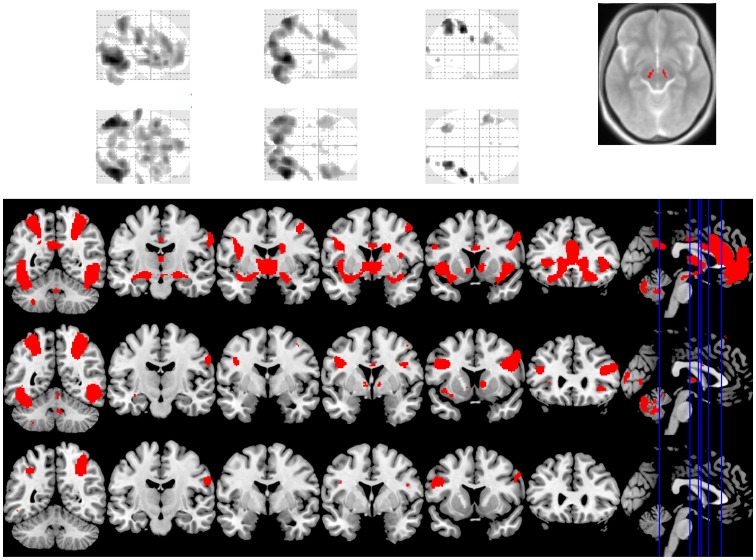
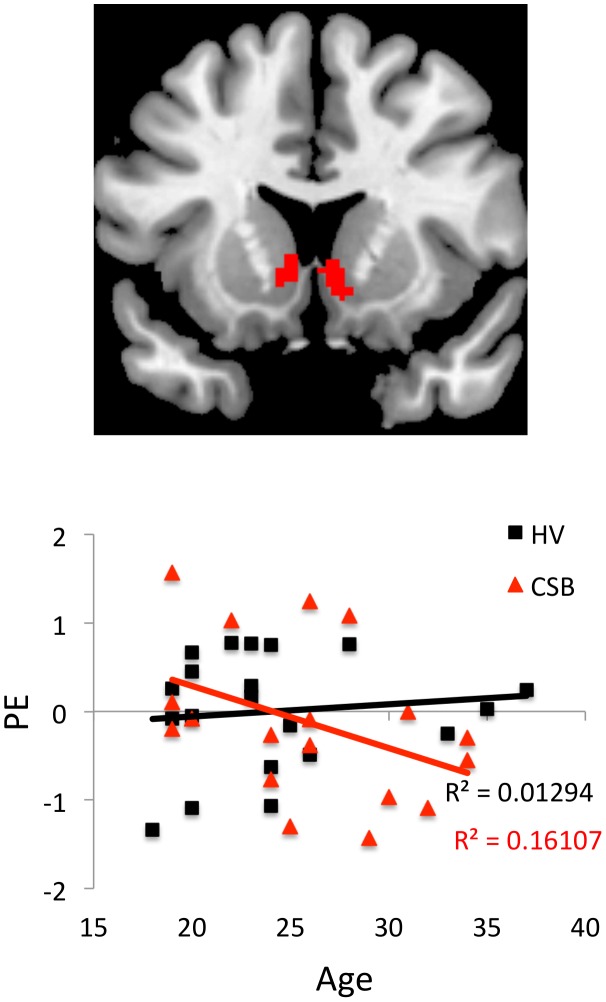
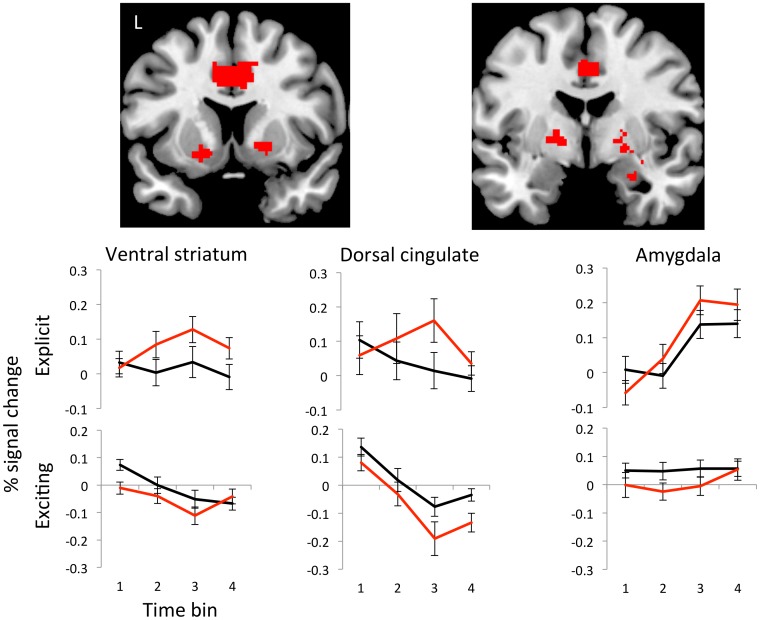
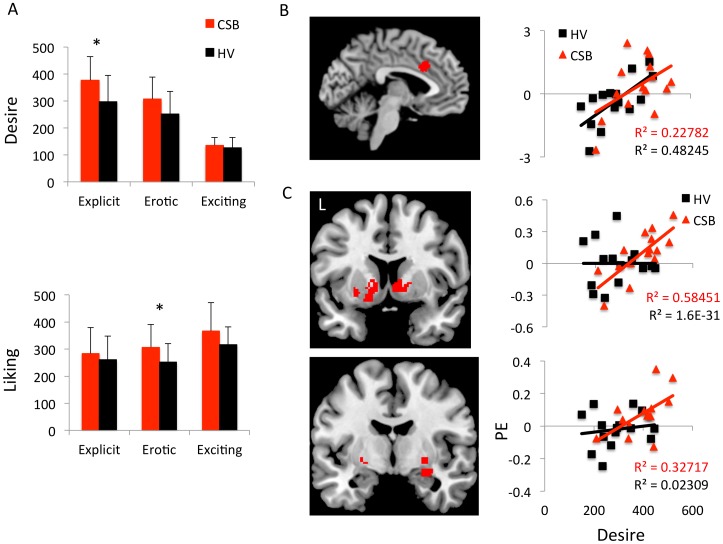
Although compulsive sexual behaviour (CSB) has been conceptualized as a "behavioural" addiction and common or overlapping neural circuits may govern the processing of natural and drug rewards, little is known regarding the responses to sexually explicit materials in individuals with and without CSB. Here, the processing of cues of varying sexual content was assessed in individuals with and without CSB, focusing on neural regions identified in prior studies of drug-cue reactivity. 19 CSB subjects and 19 healthy volunteers were assessed using functional MRI comparing sexually explicit videos with non-sexual exciting videos. Ratings of sexual desire and liking were obtained. Relative to healthy volunteers, CSB subjects had greater desire but similar liking scores in response to the sexually explicit videos. Exposure to sexually explicit cues in CSB compared to non-CSB subjects was associated with activation of the dorsal anterior cingulate, ventral striatum and amygdala. Functional connectivity of the dorsal anterior cingulate-ventral striatum-amygdala network was associated with subjective sexual desire (but not liking) to a greater degree in CSB relative to non-CSB subjects. The dissociation between desire or wanting and liking is consistent with theories of incentive motivation underlying CSB as in drug addictions. Neural differences in the processing of sexual-cue reactivity were identified in CSB subjects in regions previously implicated in drug-cue reactivity studies. The greater engagement of corticostriatal limbic circuitry in CSB following exposure to sexual cues suggests neural mechanisms underlying CSB and potential biological targets for interventions.
尽管强迫性性行为(CSB)已被概念化为一种“行为”成瘾,并且常见或重叠的神经回路可能支配着对自然奖励和药物奖励的处理,但对于有和没有CSB的个体对露骨色情材料的反应却知之甚少。在此,对有和没有CSB的个体中不同性内容线索的处理进行了评估,重点关注先前药物线索反应性研究中确定的神经区域。使用功能磁共振成像(fMRI)对19名CSB受试者和19名健康志愿者进行评估,将露骨色情视频与非性刺激视频进行比较。获得了性欲和喜好的评分。相对于健康志愿者,CSB受试者对露骨色情视频的欲望更强,但喜好评分相似。与非CSB受试者相比,CSB受试者暴露于露骨色情线索时,背侧前扣带回、腹侧纹状体和杏仁核会被激活。与非CSB受试者相比,CSB受试者中背侧前扣带回-腹侧纹状体-杏仁核网络的功能连接与主观性欲(而非喜好)的关联程度更高。欲望或渴望与喜好之间的分离与CSB中潜在的激励动机理论一致,如同在药物成瘾中一样。在CSB受试者中,在先前药物线索反应性研究中涉及的区域发现了性线索反应处理中的神经差异。CSB受试者在暴露于性线索后,皮质纹状体边缘回路的参与度更高,这表明了CSB的神经机制以及潜在的干预生物学靶点。