Department of Chemistry, Washington University in St. Louis , St. Louis, Missouri 63130, United States.
Biochemistry. 2014 Aug 5;53(30):4924-30. doi: 10.1021/bi5006464. Epub 2014 Jul 21.
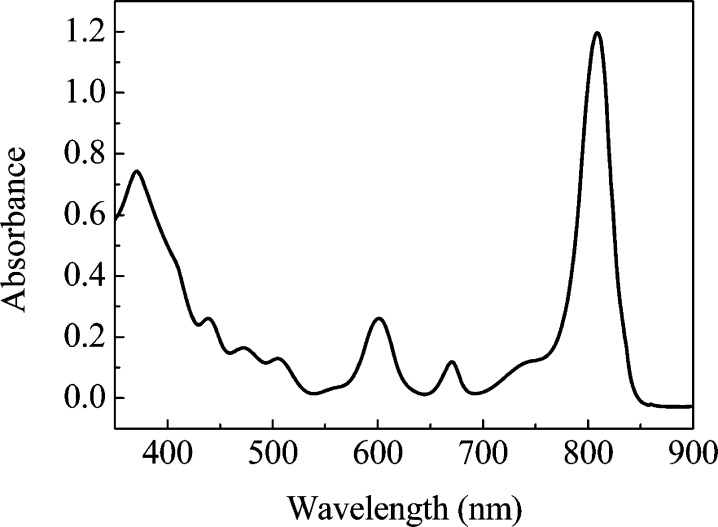
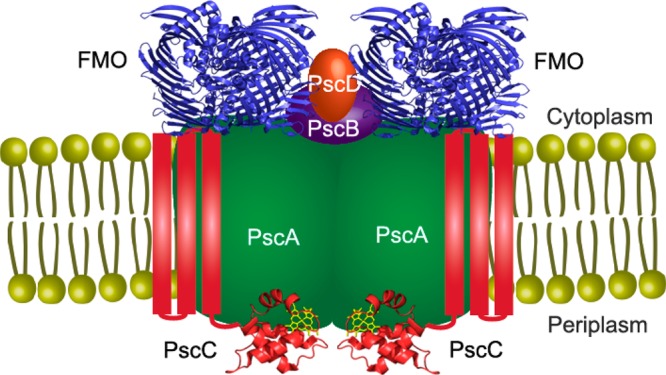
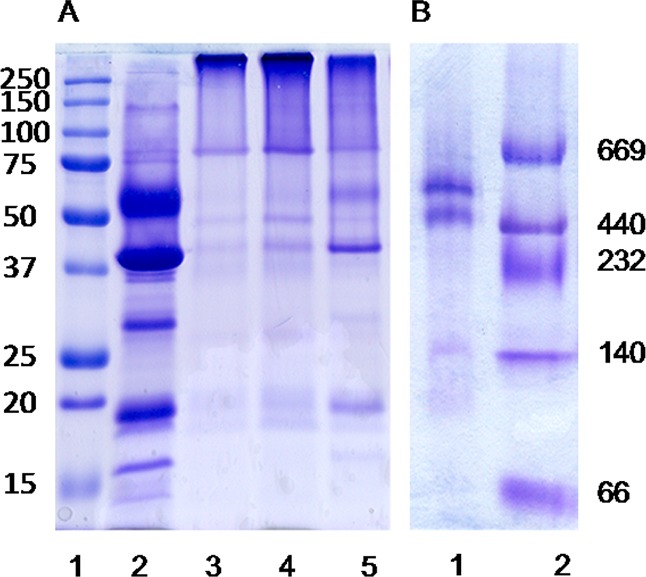
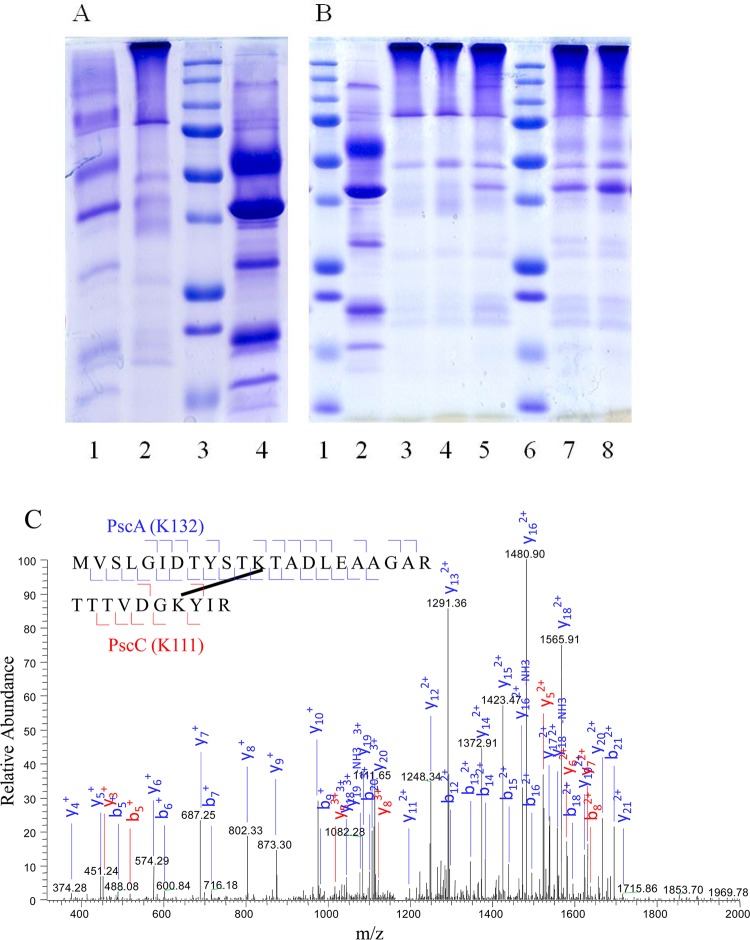
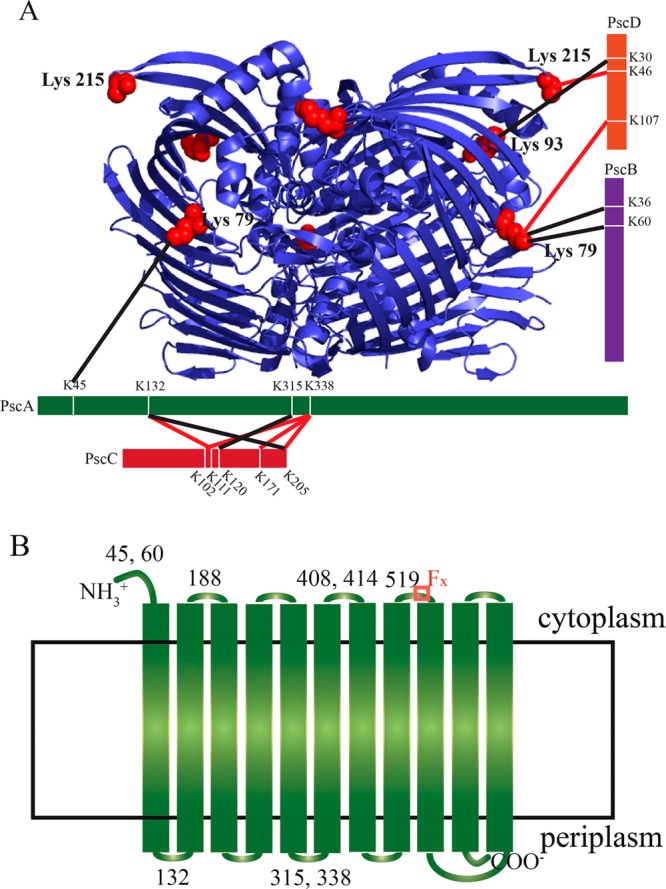
The reaction center (RC) complex of the green sulfur bacterium Chlorobaculum tepidum is composed of the Fenna-Matthews-Olson antenna protein (FMO) and the reaction center core (RCC) complex. The RCC complex has four subunits: PscA, PscB, PscC, and PscD. We studied the FMO/RCC complex by chemically cross-linking the purified sample followed by biochemical and spectroscopic analysis. Blue-native gels showed that there were two types of FMO/RCC complexes, which are consistent with complexes with one copy of FMO per RCC and two copies of FMO per RCC. Sodium dodecyl sulfate-polyacrylamide gel electrophoresis analysis of the samples after cross-linking showed that all five subunits of the RC can be linked by three different cross-linkers: bissulfosuccinimidyl suberate, disuccinimidyl suberate, and 3,3-dithiobis-sulfosuccinimidyl propionate. The interaction sites of the cross-linked complex were also studied using liquid chromatography coupled to tandem mass spectrometry. The results indicated that FMO, PscB, PscD, and part of PscA are exposed on the cytoplasmic side of the membrane. PscD helps stabilize FMO to the reaction center and may facilitate transfer of the electron from the RC to ferredoxin. The soluble domain of the heme-containing cytochrome subunit PscC and part of the core subunit PscA are located on the periplasmic side of the membrane. There is a close relationship between the periplasmic portions of PscA and PscC, which is needed for the efficient transfer of the electron between PscC and P840.
绿硫菌的反应中心(RC)复合物由 Fenna-Matthews-Olson 天线蛋白(FMO)和反应中心核心(RCC)复合物组成。RCC 复合物有四个亚基:PscA、PscB、PscC 和 PscD。我们通过对纯化样品进行化学交联,然后进行生化和光谱分析来研究 FMO/RCC 复合物。蓝色非变性凝胶显示存在两种类型的 FMO/RCC 复合物,这与每个 RCC 有一个 FMO 拷贝和每个 RCC 有两个 FMO 拷贝的复合物一致。交联后样品的十二烷基硫酸钠-聚丙烯酰胺凝胶电泳分析表明,三种不同的交联剂:双琥珀酰亚胺基琥珀酸酯、琥珀酰亚胺基琥珀酸酯和 3,3-二硫代双琥珀酰亚胺基丙酸酯,均可将 RC 的所有五个亚基连接起来。使用液相色谱-串联质谱联用技术还研究了交联复合物的相互作用位点。结果表明,FMO、PscB、PscD 和部分 PscA 暴露在膜的细胞质侧。PscD 有助于将 FMO 稳定到反应中心,并可能促进电子从 RC 向铁氧还蛋白的转移。含血红素细胞色素亚基 PscC 的可溶性结构域和部分核心亚基 PscA 位于膜的周质侧。PscA 和 PscC 的周质部分之间存在密切关系,这对于 PscC 和 P840 之间电子的有效转移是必需的。