Weinhardt Lance S, Galvao Loren W, Mwenyekonde Thokozani, Grande Katarina M, Stevens Patricia, Yan Alice F, Mkandawire-Valhmu Lucy, Masanjala Winford, Kibicho Jennifer, Ngui Emmanuel, Emer Lindsay, Watkins Susan C
Joseph J. Zilber School of Public Health, University of Wisconsin Milwaukee, PO Box 413, Milwaukee, WI 53201 USA.
Center for Global Health Equity, College of Nursing, University of Wisconsin Milwaukee, PO Box 413, Milwaukee, WI 53201-0413 USA.
Springerplus. 2014 Jun 12;3:296. doi: 10.1186/2193-1801-3-296. eCollection 2014.
Poverty and lack of a predictable, stable source of food are two fundamental determinants of ill health, including HIV/AIDS. Conversely, episodes of poor health and death from HIV can disrupt the ability to maintain economic stability in affected households, especially those that rely on subsistence farming. However, little empirical research has examined if, and how, improvements in people's economic status and food security translate into changes in HIV vulnerability.
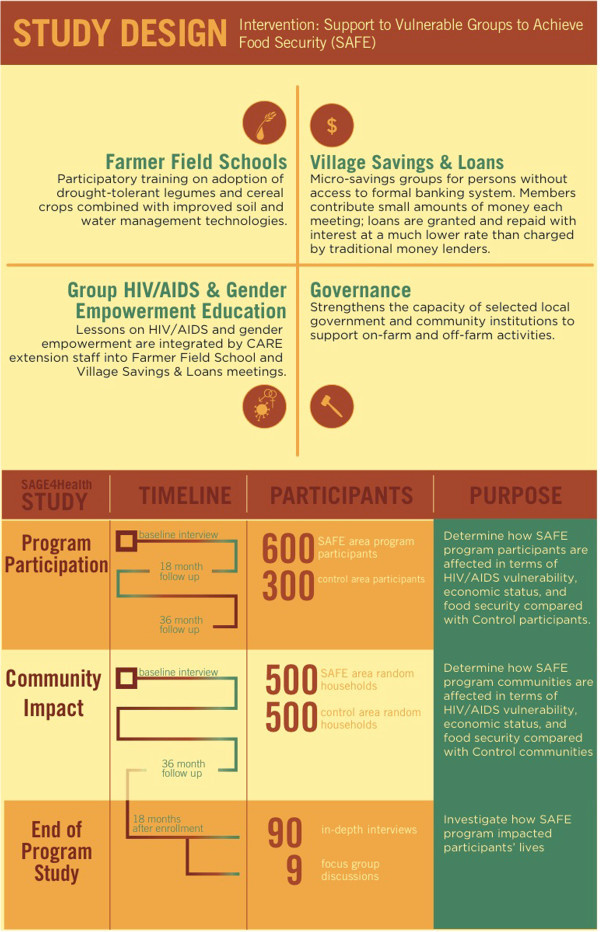
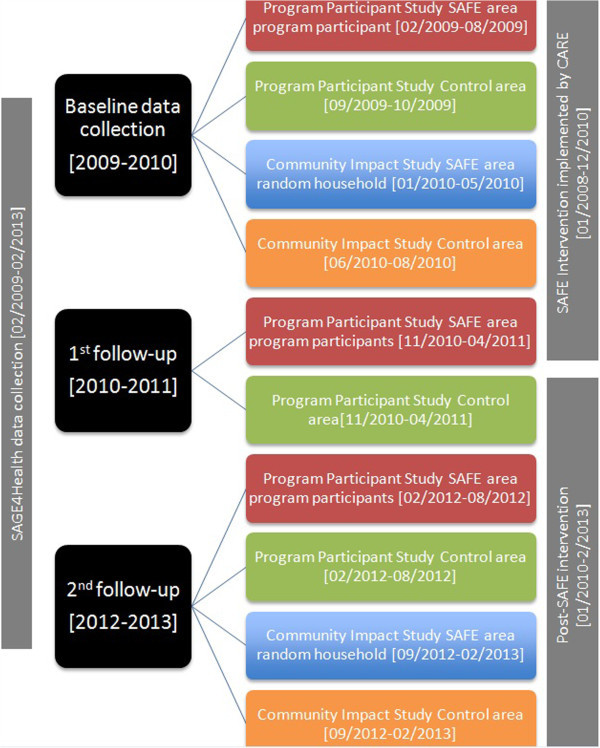
In this paper, we describe in detail the methods and protocol of an academic-NGO collaboration on a quasi-experimental, longitudinal study of the mechanisms and magnitude of the impact of a multilevel economic and food security program (Support to Able-Bodied Vulnerable Groups to Achieve Food Security; SAFE), as implemented by CARE. Primary outcomes include HIV vulnerability (i.e., HIV risk behaviors, HIV infection), economic status (i.e., income, household assets) and food security (including anthropometric measures). We recruited participants from two types of areas of rural central Malawi: traditional authorities (TA) selected by CARE to receive the SAFE program (intervention group) and TAs receiving other unrelated CARE programming (controls). In the intervention TAs, we recruited 598 program participants (398 women, 200 men) and interviewed them at baseline and 18- and 36-month follow-ups; we interviewed 301 control households. In addition, we conducted random surveys (n = 1002) in the intervention and control areas with a 36-month assessment interval, prior to and after implementation of SAFE. Thus, we are examining intervention outcomes both in direct SAFE program participants and their larger communities. We are using multilevel modeling to examine mediators and moderators of the effects of SAFE on HIV outcomes at the individual and community levels and determine the ways in which changes in HIV outcomes feed back into economic outcomes and food security at later interviews. Finally, we are conducting a qualitative end-of-program evaluation consisting of in-depth interviews with 90 SAFE participants.
In addition to examining pathways linking structural factors to HIV vulnerability, this research will yield important information for understanding the impact of a multilevel environmental/structural intervention on HIV, with the potential for other sustainable long-term public health benefits.
贫困以及缺乏可预测、稳定的食物来源是包括艾滋病毒/艾滋病在内的健康不佳的两个基本决定因素。相反,健康状况不佳和因艾滋病毒导致的死亡会破坏受影响家庭维持经济稳定的能力,尤其是那些依赖自给农业的家庭。然而,很少有实证研究考察人们经济状况和粮食安全的改善是否以及如何转化为艾滋病毒易感性的变化。
在本文中,我们详细描述了一项学术机构与非政府组织合作开展的准实验性纵向研究的方法和方案,该研究旨在探究由救助儿童会实施的多层次经济和粮食安全项目(支持健全弱势群体实现粮食安全;SAFE)的影响机制和影响程度。主要结果包括艾滋病毒易感性(即艾滋病毒风险行为、艾滋病毒感染)、经济状况(即收入、家庭资产)和粮食安全(包括人体测量指标)。我们从马拉维中部农村的两类地区招募参与者:救助儿童会挑选的接受SAFE项目的传统当局(TA)(干预组)和接受其他不相关救助儿童会项目的传统当局(对照组)。在干预地区的传统当局中,我们招募了598名项目参与者(398名女性,200名男性),并在基线、18个月和36个月随访时对他们进行访谈;我们对301个对照家庭进行了访谈。此外,我们在干预地区和对照地区进行了随机调查(n = 1002),在SAFE项目实施前后,评估间隔为36个月。因此,我们正在直接考察SAFE项目参与者及其所在更大社区的干预结果。我们正在使用多层次模型来考察SAFE项目在个体和社区层面上对艾滋病毒结果影响的中介因素和调节因素,并确定在后续访谈中艾滋病毒结果的变化如何反馈到经济结果和粮食安全中。最后,我们正在进行一项项目结束时的定性评估,包括对90名SAFE项目参与者进行深入访谈。
除了考察将结构因素与艾滋病毒易感性联系起来的途径外,这项研究还将产生重要信息,以了解多层次环境/结构干预对艾滋病毒的影响,并有可能带来其他可持续的长期公共卫生益处。