Zhu Zhi, Hang Suqin, Mao Shengyong, Zhu Weiyun
College of Animal Science and Technology, Nanjing Agricultural University, Nanjing 210095, China.
Asian-Australas J Anim Sci. 2014 Feb;27(2):179-86. doi: 10.5713/ajas.2013.13373.
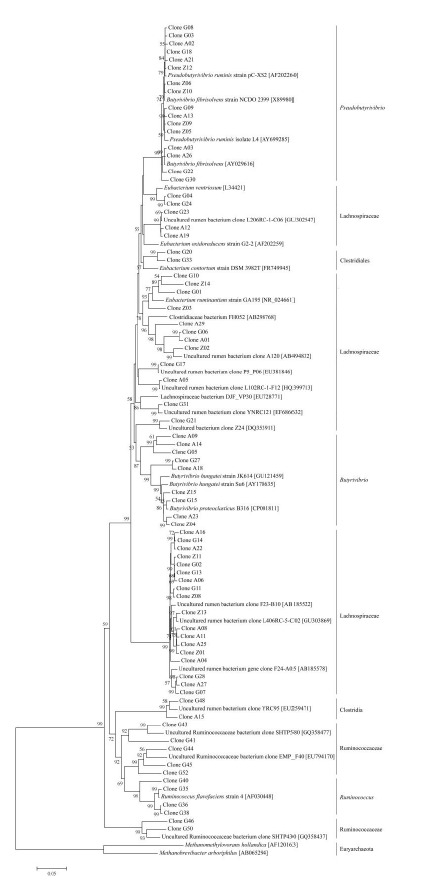
This study aimed to investigate the diversity of the Butyrivibrio group bacteria in goat rumen and its response to garlic oil (GO) supplementation as revealed by molecular analysis of cloned 16S rRNA genes. Six wethers fitted with ruminal fistulas were assigned to two groups for a cross-over design with 28-d experimental period and 14-d interval. Goats were fed a basal diet without (control) or with GO ruminal infusion (0.8 g/d). Ruminal contents were used for DNA extraction collected before morning feeding on d 28. A total bacterial clone library was firstly constructed by nearly full-length 16S rRNA gene cloned sequences using universal primers. The resulting plasmids selected by Butyrivibrio-specific primers were used to construct a Butyrivibrio group-specific bacterial clone library. Butyrivibrio group represented 12.98% and 10.95% of total bacteria in control and GO group, respectively. In libraries, clones were classified to the genus Pseudobutyrivibrio, Butyrivibrio and others within the family Lachnospiraceae. Additionally, some specific clones were observed in GO group, being classified to the genus Ruminococcus and others within the family Ruminococcaceae. Based on the criterion that the similarity was 97% or greater with database sequences, there were 29.73% and 18.42% of clones identified as known isolates (i.e. B. proteoclasticus and Ps. ruminis) in control and GO groups, respectively. Further clones identified as B. fibrisolvens (5.41%) and R. flavefaciens (7.89%) were specifically found in control and GO groups, respectively. The majority of clones resembled Ps. ruminis (98% to 99% similarity), except for Lachnospiraceae bacteria (87% to 92% similarity) in the two libraries. The two clone libraries also appeared different in Shannon diversity index (control 2.47 and GO group 2.91). Our results indicated that the Butyrivibrio group bacteria had a complex community with considerable unknown species in the goat rumen.
本研究旨在通过对克隆的16S rRNA基因进行分子分析,探究山羊瘤胃中丁酸弧菌属细菌的多样性及其对添加大蒜油(GO)的反应。将6只安装有瘤胃瘘管的阉羊分为两组,采用交叉设计,试验期为28天,间隔期为14天。山羊饲喂基础日粮,一组不添加(对照组),另一组瘤胃灌注GO(0.8 g/d)。在第28天早晨饲喂前采集瘤胃内容物用于DNA提取。首先使用通用引物通过近乎全长的16S rRNA基因克隆序列构建总细菌克隆文库。用丁酸弧菌特异性引物筛选得到的质粒用于构建丁酸弧菌属特异性细菌克隆文库。丁酸弧菌属在对照组和GO组中分别占总细菌的12.98%和10.95%。在文库中,克隆被分类到毛螺菌科内的假丁酸弧菌属、丁酸弧菌属和其他属。此外,在GO组中观察到一些特定克隆,被分类到瘤胃球菌科内的瘤胃球菌属和其他属。根据与数据库序列相似度为97%或更高的标准,对照组和GO组中分别有29.73%和18.42%的克隆被鉴定为已知分离株(即解蛋白丁酸弧菌和反刍兽假丁酸弧菌)。进一步分别在对照组和GO组中特异性发现被鉴定为溶纤维丁酸弧菌(5.41%)和黄化瘤胃球菌(7.89%)的克隆。除了两个文库中的毛螺菌科细菌(相似度为87%至92%)外,大多数克隆与反刍兽假丁酸弧菌相似(相似度为98%至99%)。两个克隆文库在香农多样性指数上也有所不同(对照组为2.47,GO组为2.91)。我们的结果表明,山羊瘤胃中的丁酸弧菌属细菌群落复杂,存在大量未知物种。