Castillo Guillermo, Cruz Laura L, Tapia-López Rosalinda, Olmedo-Vicente Erika, Carmona Diego, Anaya-Lang Ana Luisa, Fornoni Juan, Andraca-Gómez Guadalupe, Valverde Pedro L, Núñez-Farfán Juan
Departamento de Ecología Evolutiva, Instituto de Ecología, Universidad Nacional Autónoma de México, Mexico City, Distrito Federal, México.
Departamento de Ecología Funcional, Instituto de Ecología, Universidad Nacional Autónoma de México, Mexico City, Distrito Federal, México.
PLoS One. 2014 Jul 22;9(7):e102478. doi: 10.1371/journal.pone.0102478. eCollection 2014.
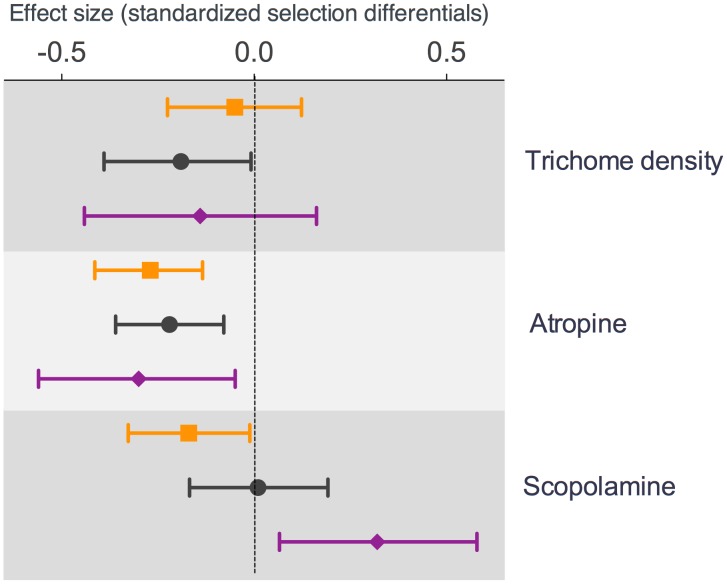
Selection exerted by herbivores is a major force driving the evolution of plant defensive characters such as leaf trichomes or secondary metabolites. However, plant defense expression is highly variable among populations and identifying the sources of this variation remains a major challenge. Plant populations are often distributed across broad geographic ranges and are exposed to different herbivore communities, ranging from generalists (that feed on diverse plant species) to specialists (that feed on a restricted group of plants). We studied eight populations of the plant Datura stramonium usually eaten by specialist or generalist herbivores, in order to examine whether the pattern of phenotypic selection on secondary compounds (atropine and scopolamine) and a physical defense (trichome density) can explain geographic variation in these traits. Following co-evolutionary theory, we evaluated whether a more derived alkaloid (scopolamine) confers higher fitness benefits than its precursor (atropine), and whether this effect differs between specialist and generalist herbivores. Our results showed consistent directional selection in almost all populations and herbivores to reduce the concentration of atropine. The most derived alkaloid (scopolamine) was favored in only one of the populations, which is dominated by a generalist herbivore. In general, the patterns of selection support the existence of a selection mosaic and accounts for the positive correlation observed between atropine concentration and plant damage by herbivores recorded in previous studies.
食草动物施加的选择是推动植物防御特征(如叶毛或次生代谢产物)进化的主要力量。然而,植物防御表达在种群间高度可变,确定这种变异的来源仍然是一项重大挑战。植物种群通常分布在广阔的地理范围内,并面临不同的食草动物群落,从广食性动物(以多种植物为食)到专食性动物(以有限的一组植物为食)。我们研究了通常被专食性或广食性食草动物食用的曼陀罗植物的八个种群,以检验对次生化合物(阿托品和东莨菪碱)和物理防御(毛状体密度)的表型选择模式是否可以解释这些性状的地理变异。根据协同进化理论,我们评估了一种更衍生的生物碱(东莨菪碱)是否比其前体(阿托品)赋予更高的适应性益处,以及这种效应在专食性和广食性食草动物之间是否不同。我们的结果表明,几乎在所有种群和食草动物中都存在一致的定向选择,以降低阿托品的浓度。最衍生的生物碱(东莨菪碱)仅在一个以广食性食草动物为主的种群中受到青睐。总体而言,选择模式支持选择镶嵌的存在,并解释了先前研究中记录的阿托品浓度与食草动物对植物造成的损害之间观察到的正相关。