Pinilla-Buitrago Gonzalo, Martínez-Morales Miguel Angel, González-García Fernando, Enríquez Paula L, Rangel-Salazar José Luis, Romero Carlos Alberto Guichard, Navarro-Sigüenza Adolfo G, Monterrubio-Rico Tiberio César, Escalona-Segura Griselda
El Colegio de la Frontera Sur, unidad Campeche. Avenida Rancho Polígono 2-A, Ciudad Industrial, Lerma, Campeche, Campeche, 24500, Mexico ; Present address: Instituto de Ciencias Naturales, Universidad Nacional de Colombia. Ciudad Universitaria, Av. Carrera 30 No. 45, Bogotá DC, 111321, Colombia.
El Colegio de la Frontera Sur, unidad Campeche. Avenida Rancho Polígono 2-A, Ciudad Industrial, Lerma, Campeche, Campeche, 24500, Mexico.
Zookeys. 2014 Jun 25(420):87-115. doi: 10.3897/zookeys.420.7050. eCollection 2014.
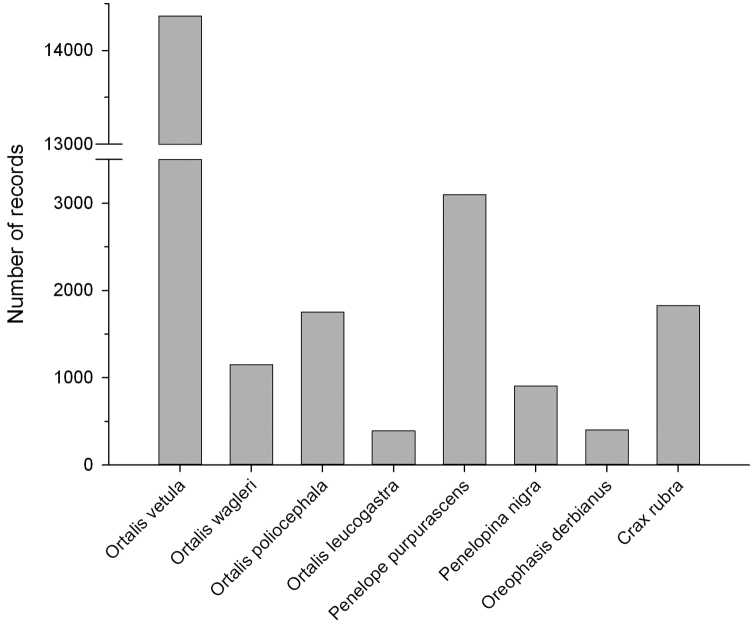
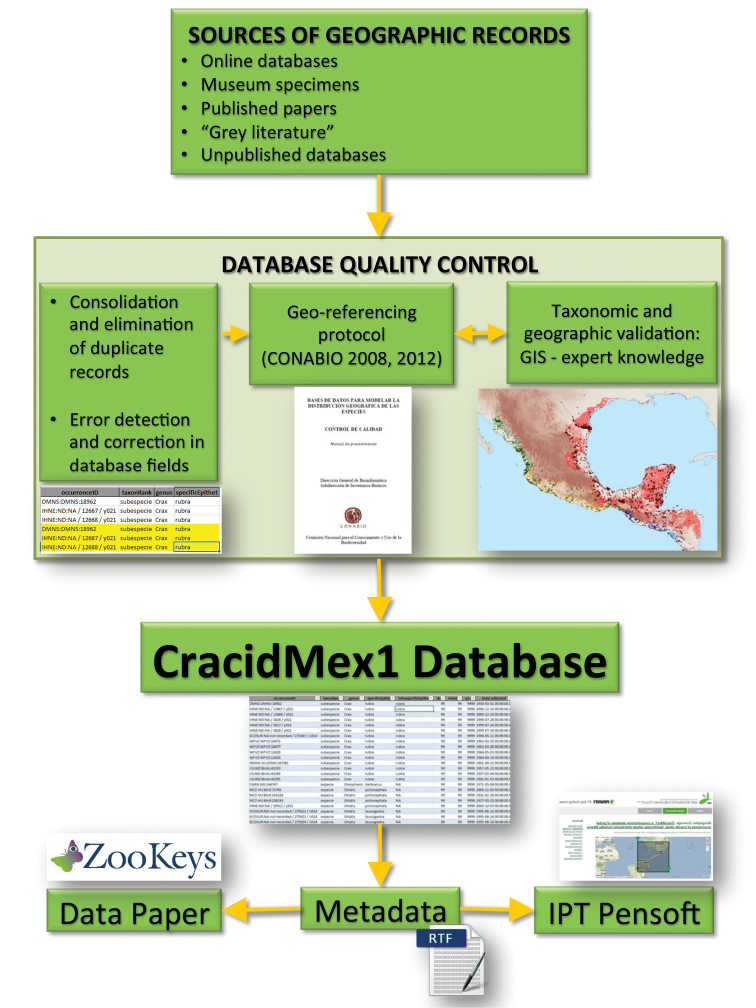
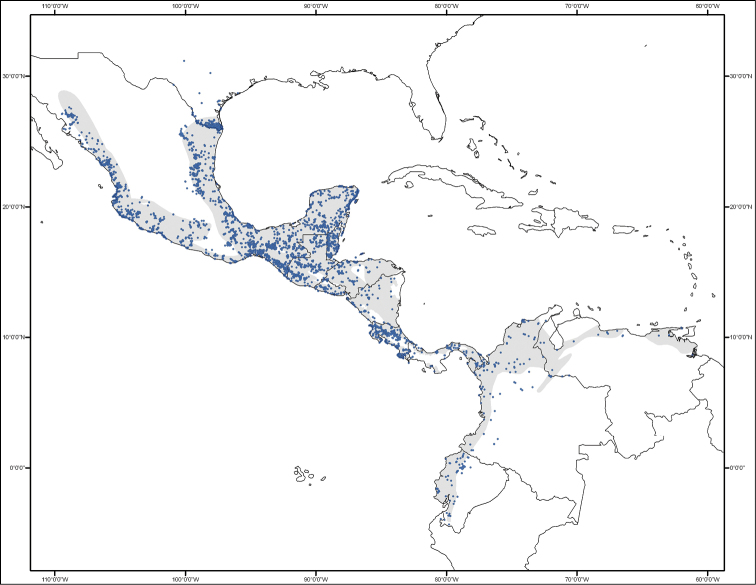
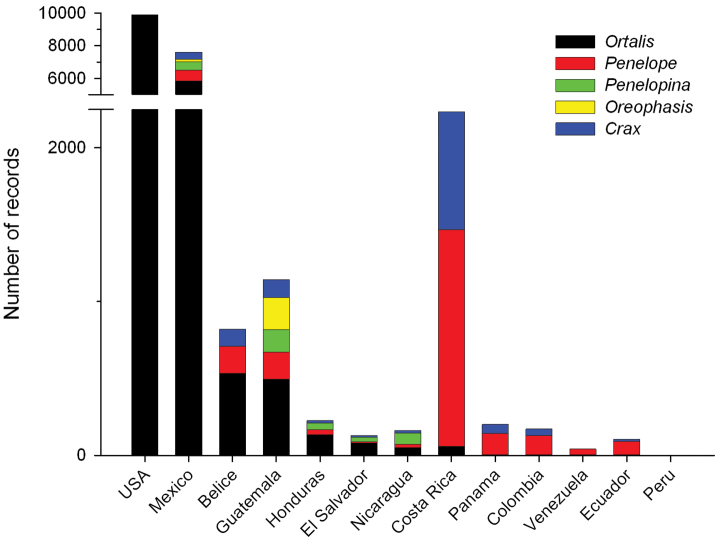
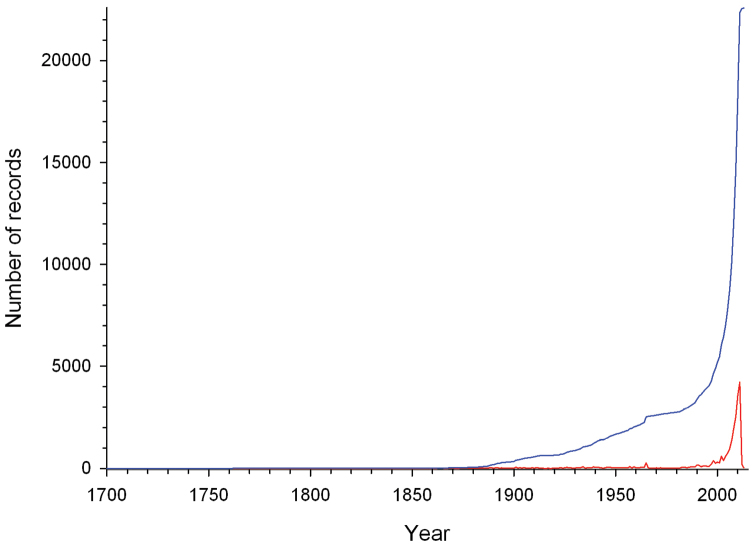
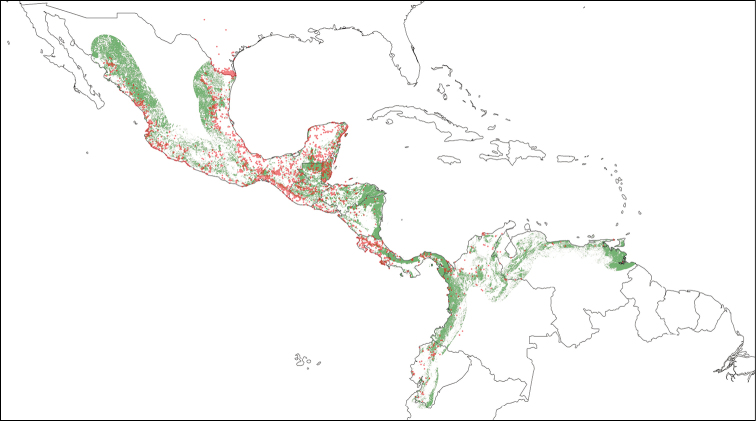
Cracids are among the most vulnerable groups of Neotropical birds. Almost half of the species of this family are included in a conservation risk category. Twelve taxa occur in Mexico, six of which are considered at risk at national level and two are globally endangered. Therefore, it is imperative that high quality, comprehensive, and high-resolution spatial data on the occurrence of these taxa are made available as a valuable tool in the process of defining appropriate management strategies for conservation at a local and global level. We constructed the CracidMex1 database by collating global records of all cracid taxa that occur in Mexico from available electronic databases, museum specimens, publications, "grey literature", and unpublished records. We generated a database with 23,896 clean, validated, and standardized geographic records. Database quality control was an iterative process that commenced with the consolidation and elimination of duplicate records, followed by the geo-referencing of records when necessary, and their taxonomic and geographic validation using GIS tools and expert knowledge. We followed the geo-referencing protocol proposed by the Mexican National Commission for the Use and Conservation of Biodiversity. We could not estimate the geographic coordinates of 981 records due to inconsistencies or lack of sufficient information in the description of the locality. Given that current records for most of the taxa have some degree of distributional bias, with redundancies at different spatial scales, the CracidMex1 database has allowed us to detect areas where more sampling effort is required to have a better representation of the global spatial occurrence of these cracids. We also found that particular attention needs to be given to taxa identification in those areas where congeners or conspecifics co-occur in order to avoid taxonomic uncertainty. The construction of the CracidMex1 database represents the first comprehensive research effort to compile current, available global geographic records for a group of cracids. The database can now be improved by continuous revision and addition of new records. The CracidMex1 database will provide high quality input data that could be used to generate species distribution models, to assess temporal changes in species distributions, to identify priority areas for research and conservation, and in the definition of management strategies for this bird group. This compilation exercise could be replicated for other cracid groups or regions to attain a better knowledge of the global occurrences of the species in this vulnerable bird family.
凤冠雉科鸟类是新热带界鸟类中最脆弱的群体之一。该科近一半的物种被列入受保护风险类别。墨西哥有12个分类单元,其中6个在国家层面被视为有风险,2个在全球范围内濒危。因此,迫切需要提供关于这些分类单元分布的高质量、全面且高分辨率的空间数据,作为在制定地方和全球层面适当保护管理策略过程中的宝贵工具。我们通过整理来自现有电子数据库、博物馆标本、出版物、“灰色文献”和未发表记录中所有在墨西哥出现的凤冠雉科分类单元的全球记录,构建了CracidMex1数据库。我们生成了一个包含23,896条经过清理、验证和标准化的地理记录的数据库。数据库质量控制是一个迭代过程,首先是合并和消除重复记录,必要时对记录进行地理参考,并使用地理信息系统工具和专业知识对其进行分类和地理验证。我们遵循了墨西哥国家生物多样性利用和保护委员会提出的地理参考协议。由于地点描述不一致或缺乏足够信息,我们无法估计981条记录的地理坐标。鉴于目前大多数分类单元的记录存在一定程度的分布偏差,在不同空间尺度上存在冗余,CracidMex1数据库使我们能够检测出需要更多采样工作的区域,以便更好地呈现这些凤冠雉科鸟类在全球的空间分布情况。我们还发现,在同属或同种共存的区域,需要特别关注分类单元的识别,以避免分类学上的不确定性。CracidMex1数据库的构建是首次全面的研究工作,旨在汇编一组凤冠雉科鸟类当前可用的全球地理记录。现在可以通过持续修订和添加新记录来改进该数据库。CracidMex1数据库将提供高质量的输入数据,可用于生成物种分布模型、评估物种分布的时间变化、确定研究和保护的优先区域,以及定义该鸟类群体的管理策略。这项汇编工作可以在其他凤冠雉科群体或地区进行复制,以更好地了解这个脆弱鸟类家族中物种的全球分布情况。