Chen Yu-Wei, Fiscella Kimberly A, Bacharach Samuel Z, Tanda Gianluigi, Shaham Yavin, Calu Donna J
Behavioral Neuroscience Research Branch, NIDA, NIH, DHHS, Baltimore, MD, USA.
Medication Development Program, Intramural Research Program, NIDA, NIH, DHHS, Baltimore, MD, USA.
Addict Biol. 2015 Jul;20(4):690-700. doi: 10.1111/adb.12164. Epub 2014 Jul 27.
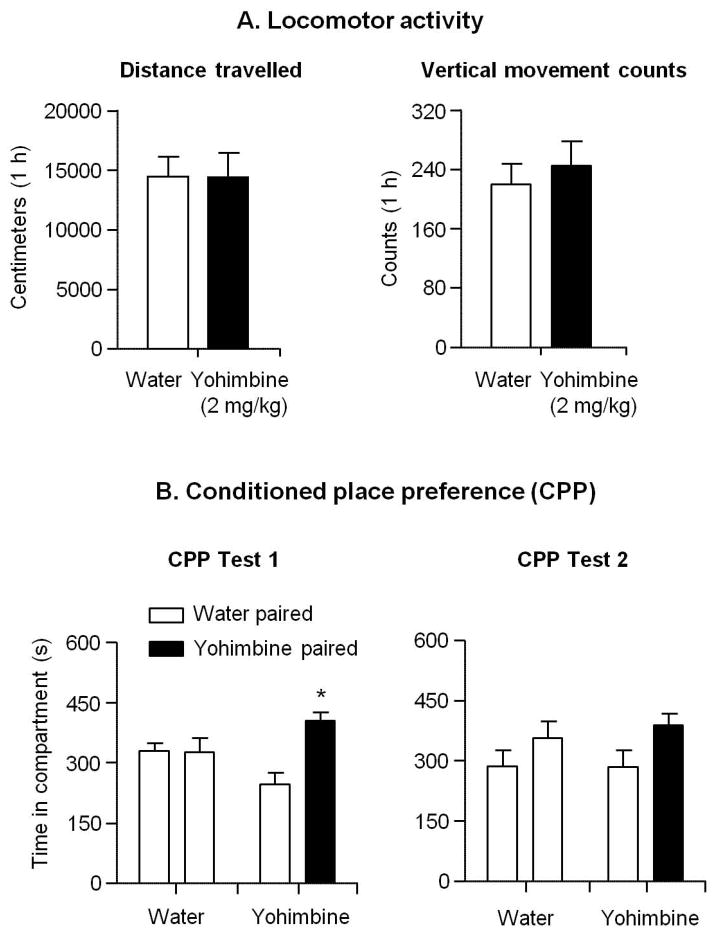
Yohimbine is an alpha-2 adrenoceptor antagonist that has been used in numerous studies as a pharmacological stressor in rodents, monkeys and humans. Recently, yohimbine has become the most common stress manipulation in studies on reinstatement of drug and food seeking. However, the wide range of conditions under which yohimbine promotes reward seeking is significantly greater than that of stressors like intermittent footshock. Here, we addressed two fundamental questions regarding yohimbine's effect on reinstatement of reward seeking: (1) whether the drug's effect on operant responding is dependent on previous reward history or cue contingency, and (2) whether yohimbine is aversive or rewarding under conditions typically used in reinstatement studies. We also used in vivo microdialysis to determine yohimbine's effect on dopamine levels in nucleus accumbens (NAc) and medial prefrontal cortex (mPFC). We found that the magnitude of yohimbine-induced (0.5, 1.0, 2.0 mg/kg) operant responding during the reinstatement tests was critically dependent on the contingency between lever pressing and discrete tone-light cue delivery but not the previous history with food reward during training. We also found that yohimbine (2 mg/kg) did not cause conditioned place aversion. Finally, we found that yohimbine modestly increased dopamine levels in mPFC but not NAc. Results suggest that yohimbine's effects on operant responding in reinstatement studies are likely independent of the history of contingent self-administration of food or drug rewards and may not be related to the commonly assumed stress-like effects of yohimbine.
育亨宾是一种α-2肾上腺素能受体拮抗剂,在众多研究中被用作啮齿动物、猴子和人类的药理学应激源。最近,育亨宾已成为药物和食物寻求恢复研究中最常见的应激操作。然而,育亨宾促进奖励寻求的条件范围比间歇性足部电击等应激源要大得多。在此,我们针对育亨宾对奖励寻求恢复的影响提出了两个基本问题:(1)药物对操作性反应的影响是否依赖于先前的奖励历史或线索关联性,以及(2)在恢复研究通常使用的条件下,育亨宾是厌恶的还是有奖励作用的。我们还使用体内微透析来确定育亨宾对伏隔核(NAc)和内侧前额叶皮质(mPFC)中多巴胺水平的影响。我们发现,在恢复测试期间,育亨宾诱导的(0.5、1.0、2.0mg/kg)操作性反应的幅度关键取决于杠杆按压与离散音调-灯光线索呈现之间的关联性,而不是训练期间食物奖励的先前历史。我们还发现,育亨宾(2mg/kg)不会引起条件性位置厌恶。最后,我们发现育亨宾适度增加了mPFC中的多巴胺水平,但没有增加NAc中的多巴胺水平。结果表明,育亨宾在恢复研究中对操作性反应的影响可能独立于食物或药物奖励的偶然自我给药历史,并且可能与育亨宾通常被认为的类似应激的作用无关。