Sundaram Sneha, Le Trinh L, Essaid Luma, Freemerman Alex J, Huang Megan J, Galanko Joseph A, McNaughton Kirk K, Bendt Katharine M, Darr David B, Troester Melissa A, Makowski Liza
Department of Nutrition, Gillings School of Global Public Health and School of Medicine, The University of North Carolina at Chapel Hill , Chapel Hill, NC , USA ; Lineberger Comprehensive Cancer Center, The University of North Carolina at Chapel Hill , Chapel Hill, NC , USA.
Department of Nutrition, Gillings School of Global Public Health and School of Medicine, The University of North Carolina at Chapel Hill , Chapel Hill, NC , USA.
Front Oncol. 2014 Jul 8;4:175. doi: 10.3389/fonc.2014.00175. eCollection 2014.
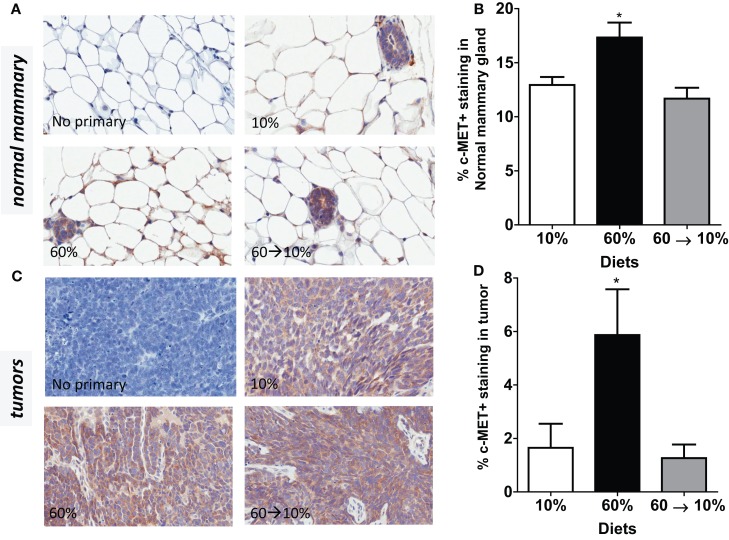
Epidemiologic studies demonstrate that obesity is associated with an aggressive subtype of breast cancer called basal-like breast cancer (BBC). Using the C3(1)-TAg murine model of BBC, we previously demonstrated that mice displayed an early onset of tumors when fed obesogenic diets in the adult window of susceptibility. Obesity was also shown to elevate mammary gland expression and activation of hepatocyte growth factor (HGF)/c-Met compared to lean controls, a pro-tumorigenic pathway associated with BBC in patients. Epidemiologic studies estimate that weight loss could prevent a large proportion of BBC. We sought to investigate whether weight loss in adulthood prior to tumor onset would protect mice from accelerated tumorigenesis observed in obese mice. Using a life-long model of obesity, C3(1)-TAg mice were weaned onto and maintained on an obesogenic high-fat diet. Obese mice displayed significant elevations in tumor progression, but not latency or burden. Tumor progression was significantly reversed when obese mice were induced to lose weight by switching to a control low-fat diet prior to tumor onset compared to mice maintained on obesogenic diet. We investigated the HGF/c-Met pathway known to regulate tumorigenesis. Importantly, HGF/c-Met expression in normal mammary glands and c-Met in tumors was elevated with obesity and was significantly reversed with weight loss. Changes in tumor growth could not be explained by measures of HGF action including phospho-AKT or phospho-S6. Other mediators associated with oncogenesis such as hyperinsulinemia and a high leptin:adiponectin ratio were elevated by obesity and reduced with weight loss. In sum, weight loss significantly blunted the obesity-responsive pro-tumorigenic HGF/c-Met pathway and improved several metabolic risk factors associated with BBC, which together may have contributed to the dramatic reversal of obesity-driven tumor progression. Future research aims to evaluate the role of obesity and the HGF/c-Met pathway in basal-like breast cancer progression.
流行病学研究表明,肥胖与一种侵袭性乳腺癌亚型——基底样乳腺癌(BBC)有关。利用BBC的C3(1)-TAg小鼠模型,我们之前证明,在成年易感期喂食致肥胖饮食时,小鼠肿瘤出现得更早。与瘦对照相比,肥胖还显示出乳腺中肝细胞生长因子(HGF)/c-Met的表达和激活增加,这是一种与患者BBC相关的促肿瘤发生途径。流行病学研究估计,体重减轻可以预防很大一部分BBC。我们试图研究肿瘤发生前成年期体重减轻是否能保护小鼠免受肥胖小鼠中观察到的加速肿瘤发生。使用肥胖的终生模型,将C3(1)-TAg小鼠断奶后喂食致肥胖的高脂肪饮食并维持该饮食。肥胖小鼠的肿瘤进展显著加快,但潜伏期或肿瘤负荷没有变化。与维持致肥胖饮食的小鼠相比,在肿瘤发生前将肥胖小鼠改为对照低脂饮食诱导其体重减轻时,可以显著逆转肿瘤进展。我们研究了已知调节肿瘤发生的HGF/c-Met途径。重要的是,肥胖时正常乳腺中的HGF/c-Met表达和肿瘤中的c-Met表达升高,体重减轻后显著逆转。肿瘤生长的变化无法用HGF作用的指标(包括磷酸化AKT或磷酸化S6)来解释。与肿瘤发生相关的其他介质,如高胰岛素血症和高瘦素:脂联素比值,在肥胖时升高,体重减轻时降低。总之,体重减轻显著减弱了肥胖反应性促肿瘤发生的HGF/c-Met途径,并改善了与BBC相关的几种代谢危险因素,这些因素共同可能导致了肥胖驱动的肿瘤进展的显著逆转。未来的研究旨在评估肥胖和HGF/c-Met途径在基底样乳腺癌进展中的作用。