Raya R R, Kleeman E G, Luchansky J B, Klaenhammer T R
Department of Food Science, North Carolina State University, Raleigh 27695-7624.
Appl Environ Microbiol. 1989 Sep;55(9):2206-13. doi: 10.1128/aem.55.9.2206-2213.1989.
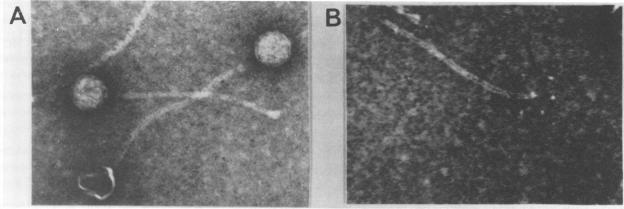
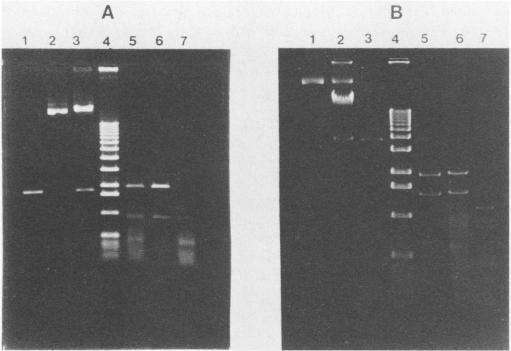
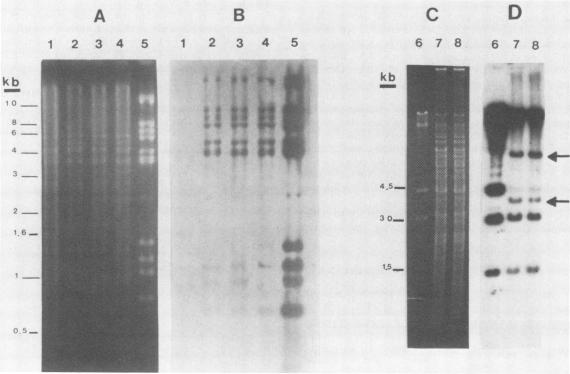
Lactobacillus acidophilus ADH is lysogenic and harbors an inducible prophage, phi adh. Bacteriophage were detected in cell lysates induced by treatment with mitomycin C or UV light. Electron microscopy of lysates revealed phage particles with a hexagonal head (62 nm) and a long, noncontractile, flexible tail (398 nm) ending in at last five short fibers. Phage phi adh was classified within Bradley's B1 phage group and the Siphoviridae family. The phi adh genome is a linear double-stranded DNA molecule of 41.7 kilobase pairs with cohesive ends: a physical map of the phi adh genome was constructed. A prophage-cured derivative of strain ADH, designated NCK102, was isolated from cells that survived UV exposure. NCK102 did not exhibit mitomycin C-induced lysis, but broth cultures lysed upon addition of phage. Phage phi adh produced clear plaques on NCK102 in media containing 10 mM CaCl2 at pH values between 5.2 and 5.5. A relysogenized derivative (NCK103) of NCK102 was isolated that exhibited mitomycin C-induced lysis and superinfection immunity to phage phi adh. Hybridization experiments showed that the phi adh genome was present in the ADH and NCK103 chromosomes, but absent in NCK102. These results demonstrated classic lytic and lysogenic cycles of replication for the temperate phage phi adh induced from L. acidophilus ADH. Phage phi adh also mediates transduction of plasmid DNA. Transductants of strain ADH containing pC194, pGK12, pGB354, and pVA797 were detected at frequencies in the range of 3.6 x 10(-8) to 8.3 x 10(-10) per PFU. Rearrangements or deletions were not detected in these plasmids as a consequence of transduction. This is the first description of plasmid transduction in the genus Lactobacillus.
嗜酸乳杆菌ADH是溶源性的,含有一种可诱导的原噬菌体phi adh。在用丝裂霉素C或紫外线处理诱导的细胞裂解物中检测到噬菌体。裂解物的电子显微镜检查显示噬菌体颗粒具有六边形头部(62纳米)和一条长的、不可收缩的、柔性尾部(398纳米),尾部末端至少有五条短纤维。噬菌体phi adh被归类于布拉德利的B1噬菌体组和长尾噬菌体科。phi adh基因组是一个具有粘性末端的41.7千碱基对的线性双链DNA分子:构建了phi adh基因组的物理图谱。从紫外线照射后存活的细胞中分离出菌株ADH的一种原噬菌体清除衍生物,命名为NCK102。NCK102未表现出丝裂霉素C诱导的裂解,但肉汤培养物在添加噬菌体后裂解。噬菌体phi adh在含有10 mM氯化钙、pH值在5.2至5.5之间的培养基中在NCK102上产生清晰的噬菌斑。分离出NCK102的一种再溶源化衍生物(NCK103),其表现出丝裂霉素C诱导的裂解和对噬菌体phi adh的超感染免疫。杂交实验表明,phi adh基因组存在于ADH和NCK103染色体中,但不存在于NCK102中。这些结果证明了从嗜酸乳杆菌ADH诱导的温和噬菌体phi adh的经典裂解和溶源复制周期。噬菌体phi adh还介导质粒DNA的转导。在每噬菌斑形成单位中,检测到含有pC194、pGK12、pGB354和pVA797的菌株ADH转导子的频率范围为3.6×10^(-8)至8.3×10^(-10)。转导后未在这些质粒中检测到重排或缺失。这是乳酸杆菌属中质粒转导的首次描述。