
采用红外敏感有机发光二极管的多光谱成像
Multi-spectral imaging with infrared sensitive organic light emitting diode.
作者信息
Kim Do Young, Lai Tzung-Han, Lee Jae Woong, Manders Jesse R, So Franky
机构信息
Department of Materials Science and Engineering, University of Florida, Gainesville, FL 32611 (USA).
出版信息
Sci Rep. 2014 Aug 5;4:5946. doi: 10.1038/srep05946.
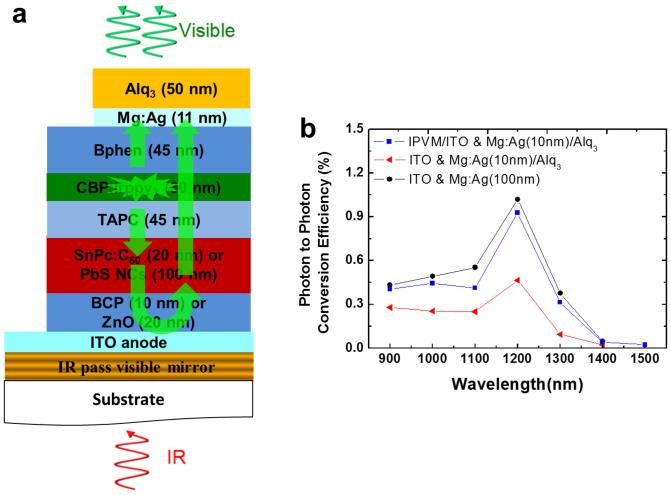
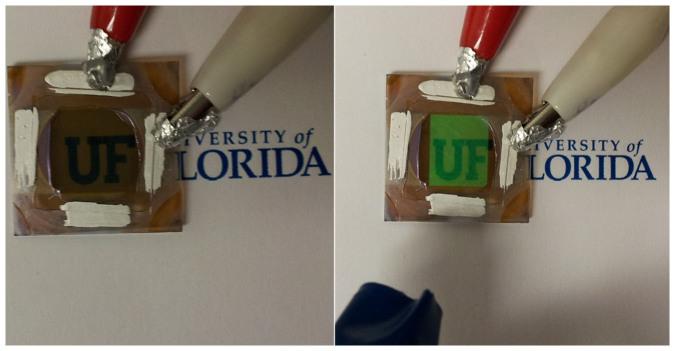
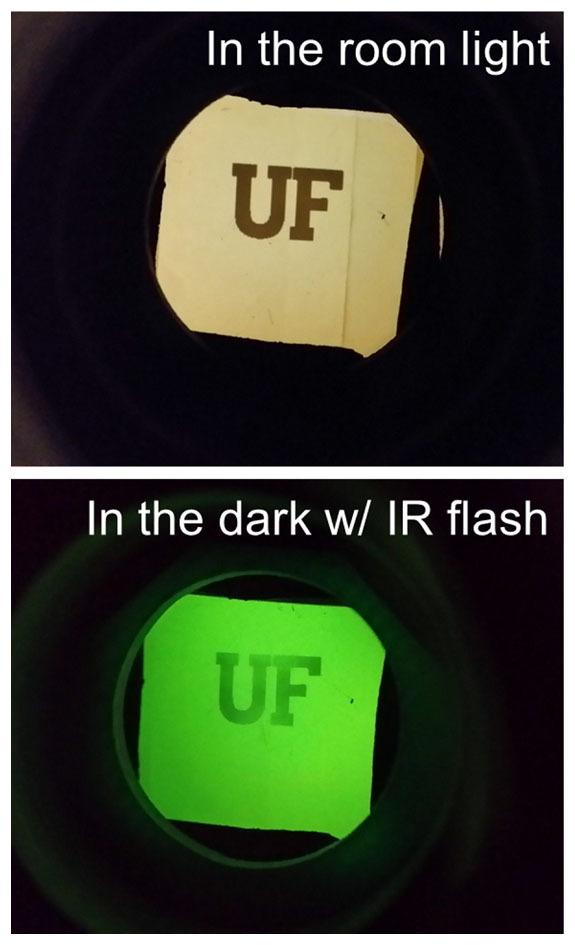
Commercially available near-infrared (IR) imagers are fabricated by integrating expensive epitaxial grown III-V compound semiconductor sensors with Si-based readout integrated circuits (ROIC) by indium bump bonding which significantly increases the fabrication costs of these image sensors. Furthermore, these typical III-V compound semiconductors are not sensitive to the visible region and thus cannot be used for multi-spectral (visible to near-IR) sensing. Here, a low cost infrared (IR) imaging camera is demonstrated with a commercially available digital single-lens reflex (DSLR) camera and an IR sensitive organic light emitting diode (IR-OLED). With an IR-OLED, IR images at a wavelength of 1.2 µm are directly converted to visible images which are then recorded in a Si-CMOS DSLR camera. This multi-spectral imaging system is capable of capturing images at wavelengths in the near-infrared as well as visible regions.
市售的近红外(IR)成像仪是通过铟凸点键合将昂贵的外延生长的III-V族化合物半导体传感器与基于硅的读出集成电路(ROIC)集成在一起制造的,这显著增加了这些图像传感器的制造成本。此外,这些典型的III-V族化合物半导体对可见光区域不敏感,因此不能用于多光谱(可见光到近红外)传感。在此,展示了一种低成本的红外(IR)成像相机,它由市售的数码单反(DSLR)相机和对红外敏感的有机发光二极管(IR-OLED)组成。使用IR-OLED时,波长为1.2 µm的红外图像会直接转换为可见光图像,然后记录在硅互补金属氧化物半导体(Si-CMOS)数码单反相机中。这种多光谱成像系统能够在近红外以及可见光区域的波长下捕获图像。


 Zotero 插件