Department of Pathology , University of California San Francisco , San Francisco, CA 94143 , USA.
Interface Focus. 2014 Aug 6;4(4):20140037. doi: 10.1098/rsfs.2014.0037.
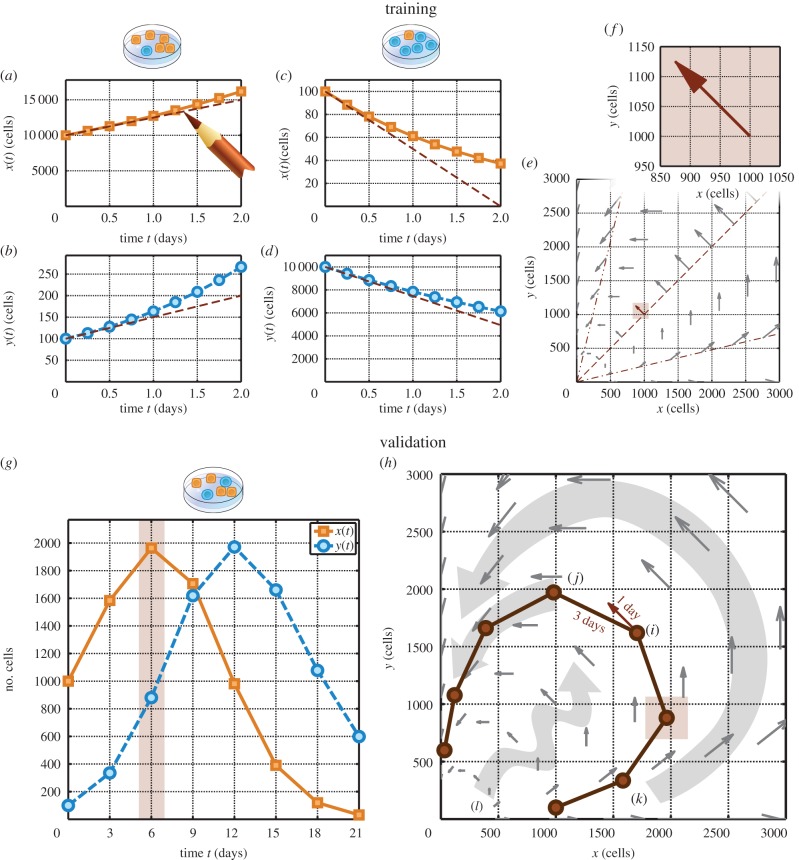
Failure to understand evolutionary dynamics has been hypothesized as limiting our ability to control biological systems. An increasing awareness of similarities between macroscopic ecosystems and cellular tissues has inspired optimism that game theory will provide insights into the progression and control of cancer. To realize this potential, the ability to compare game theoretic models and experimental measurements of population dynamics should be broadly disseminated. In this tutorial, we present an analysis method that can be used to train parameters in game theoretic dynamics equations, used to validate the resulting equations, and used to make predictions to challenge these equations and to design treatment strategies. The data analysis techniques in this tutorial are adapted from the analysis of reaction kinetics using the method of initial rates taught in undergraduate general chemistry courses. Reliance on computer programming is avoided to encourage the adoption of these methods as routine bench activities.
未能理解进化动力学被认为限制了我们控制生物系统的能力。人们越来越意识到宏观生态系统和细胞组织之间的相似性,这激发了人们的乐观情绪,即博弈论将为癌症的发展和控制提供新的见解。为了实现这一潜力,应该广泛传播比较博弈论模型和种群动态实验测量的能力。在本教程中,我们提出了一种分析方法,可用于训练博弈论动力学方程中的参数,用于验证得到的方程,并用于做出预测以挑战这些方程并设计治疗策略。本教程中的数据分析技术改编自使用本科普通化学课程中介绍的初始速率法分析反应动力学。避免依赖计算机编程,以鼓励将这些方法作为常规实验活动来采用。