
探讨连续空间模型中增殖性和侵袭性癌症表型之间的竞争。
Exploring the competition between proliferative and invasive cancer phenotypes in a continuous spatial model.
机构信息
Computational Medicine Laboratory, Institute of Computer Science, Foundation for Research and Technology-Hellas, Heraklion, Greece.
出版信息
PLoS One. 2014 Aug 6;9(8):e103191. doi: 10.1371/journal.pone.0103191. eCollection 2014.
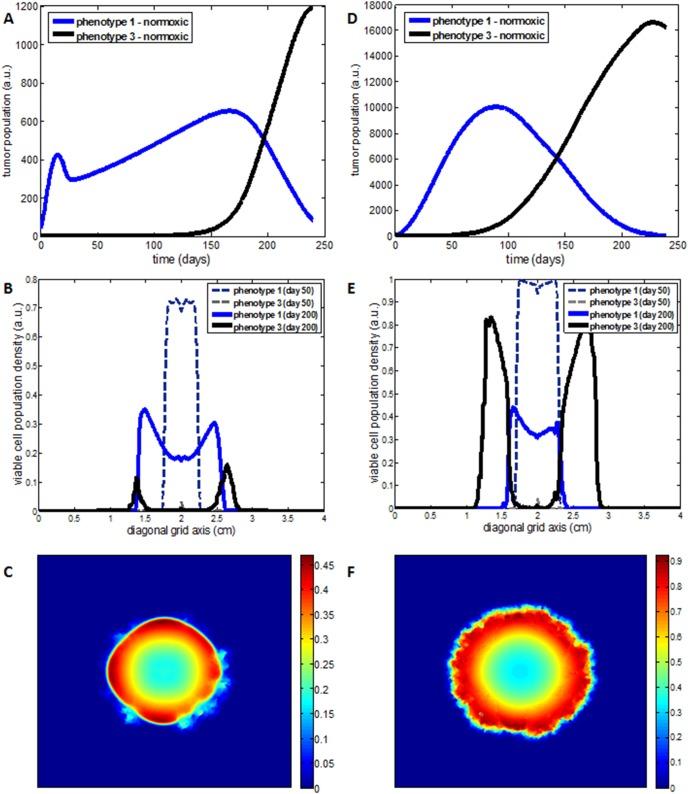
Tumor is characterized by extensive heterogeneity with respect to its microenvironment and its genetic composition. We extend a previously developed monoclonal continuous spatial model of tumor growth to account for polyclonal cell populations and investigate the interplay between a more proliferative and a more invasive phenotype under different conditions. The model simulations demonstrate a transition from the dominance of the proliferative to the dominance of the invasive phenotype resembling malignant tumor progression and show a time period where both subpopulations are abundant. As the dominant phenotype switches from proliferative to invasive, the geometry of tumor changes from a compact and almost spherical shape to a more diffusive and fingered morphology with the proliferative phenotype to be restricted in the tumor bulk and the invasive to dominate at tumor edges. Different micro-environmental conditions and different phenotypic properties can promote or inhibit invasion demonstrating their mutual importance. The model provides a computational framework to investigate tumor heterogeneity and the constant interplay between the environment and the specific characteristics of phenotypes that should be taken into account for the prediction of tumor evolution, morphology and effective treatment.
肿瘤在其微环境和遗传组成方面表现出广泛的异质性。我们扩展了之前开发的用于肿瘤生长的单克隆连续空间模型,以考虑多克隆细胞群体,并研究在不同条件下更具增殖性和更具侵袭性表型之间的相互作用。模型模拟表明,从增殖性表型向侵袭性表型的主导地位的转变类似于恶性肿瘤的进展,并显示出两个亚群都丰富的时间段。当主导表型从增殖性转变为侵袭性时,肿瘤的几何形状从紧凑且几乎球形的形状转变为更扩散和指状的形态,其中增殖性表型在肿瘤块中受到限制,而侵袭性则在肿瘤边缘占主导地位。不同的微环境条件和不同的表型特性可以促进或抑制侵袭,证明它们相互重要。该模型提供了一个计算框架,用于研究肿瘤异质性以及环境与表型特定特征之间的持续相互作用,这些特征对于预测肿瘤的进化、形态和有效治疗都应该加以考虑。


 Zotero 插件