Douglas Nataki C, Zimmermann Ralf C, Tan Qian Kun, Sullivan-Pyke Chantae S, Sauer Mark V, Kitajewski Jan K, Shawber Carrie J
Department of Obstetrics and Gynecology, PH 16-64, Division of Reproductive Endocrinology and Infertility, Columbia University Medical Center, 622 W. 168th Street, New York, NY 10032, USA.
Department of Obstetrics and Gynecology, Division of Reproductive Sciences, College of Physicians and Surgeons, Columbia University Medical Center, 630 West 168th St, New York, NY 10032, USA.
Vasc Cell. 2014 Aug 1;6:16. doi: 10.1186/2045-824X-6-16. eCollection 2014.
Angiogenesis and macrophage recruitment to the uterus are key features of uterine decidualization; the progesterone-mediated uterine changes that allow for embryo implantation and initiation of pregnancy. In the current study, we characterized the expression of vascular endothelial growth factor receptor-1 (VEGFR-1) in macrophages and endothelial cells of the peri-implantation uterus and determined if VEGFR-1 function is required for decidual angiogenesis, macrophage recruitment, and/or the establishment of pregnancy.
Expression of VEGFR-1 in uterine endothelial cells and macrophages was determined with immunohistochemistry. To assess the effect of continuous VEGFR-1 blockade, adult female mice were given VEGFR-1 blocking antibody, MF-1, every 3 days for 18 days. After 6 doses, females were mated and a final dose of MF-1 was given on embryonic day 3.5. Endothelial cells and macrophages were quantified on embryonic day 7.5. Pregnancy was analyzed on embryonic days 7.5 and 10.5.
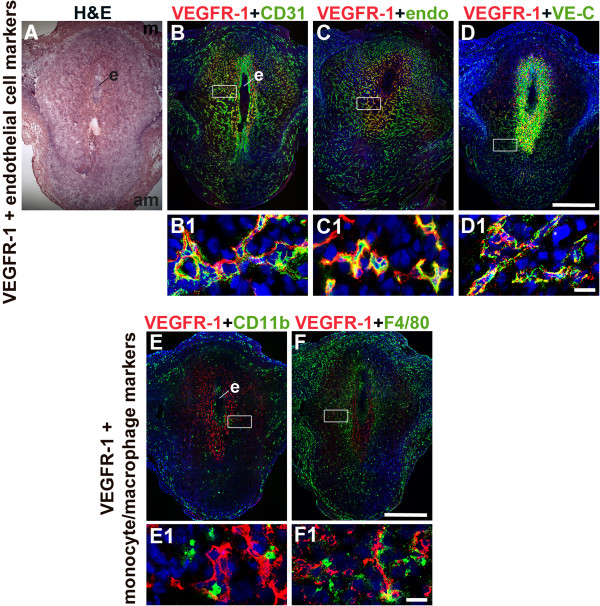
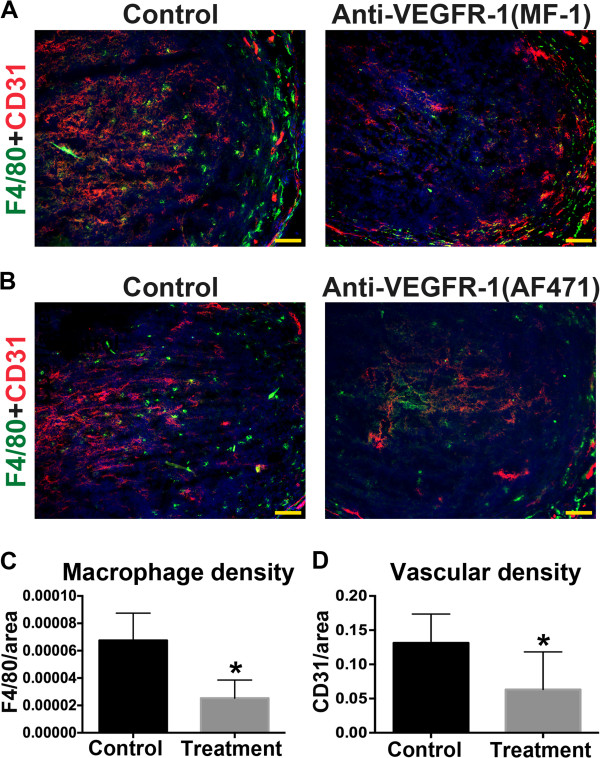
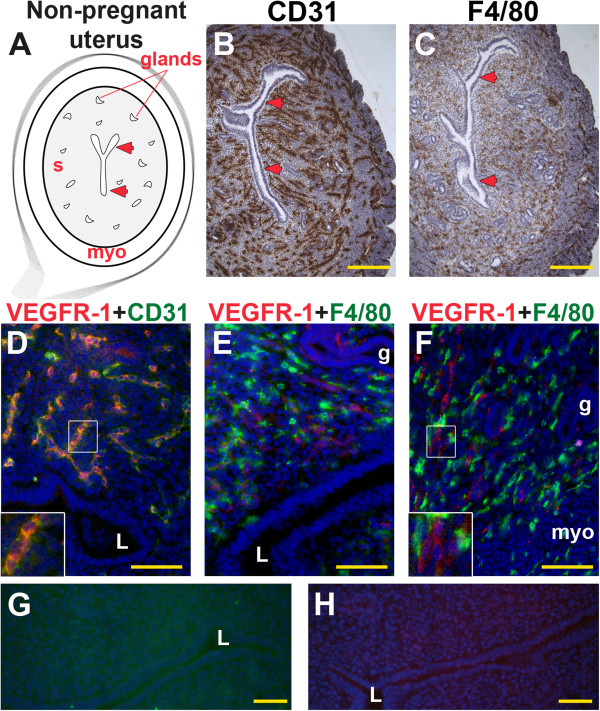
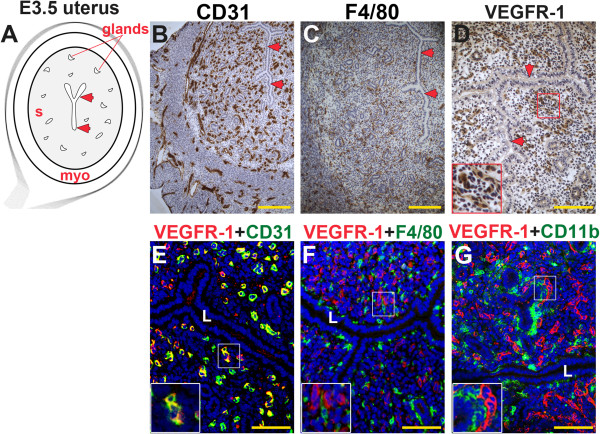
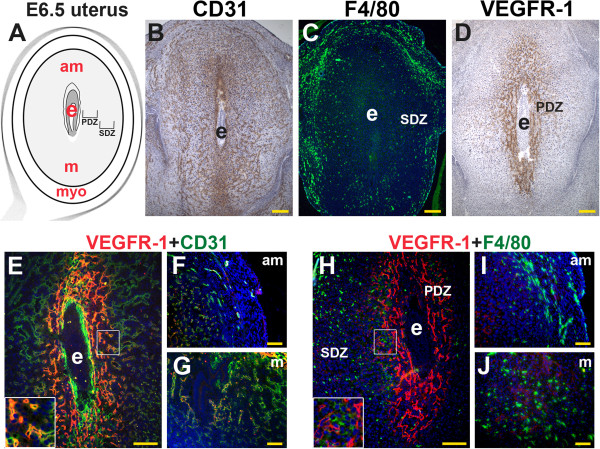
F4/80(+) macrophages are observed throughout the stroma and are abundant adjacent to the endometrial lumen and glands prior to embryo implantation and scatter throughout the decidua post implantation. VEGFR-1 expression is restricted to the uterine endothelial cells. F4/80(+) macrophages were often found adjacent to VEGFR-1(+) endothelial cells in the primary decidual zone. Continuous VEGFR-1 blockade correlates with a significant reduction in decidual vascular and macrophage density, but does not affect embryo implantation or maintenance of pregnancy up to embryonic day 10.5.
We found that VEGFR-1 functions in both decidual angiogenesis and macrophage recruitment to the implantation site during pregnancy. VEGFR-1 is expressed by endothelial cells, however blocking VEGFR-1 function in endothelial cells results in reduced macrophage recruitment to the uterus. VEGFR-1 blockade did not compromise the establishment and/or maintenance of pregnancy.
血管生成和巨噬细胞募集至子宫是子宫蜕膜化的关键特征;这是孕激素介导的子宫变化,可使胚胎着床并启动妊娠。在本研究中,我们对植入前子宫巨噬细胞和内皮细胞中血管内皮生长因子受体-1(VEGFR-1)的表达进行了表征,并确定蜕膜血管生成、巨噬细胞募集和/或妊娠建立是否需要VEGFR-1发挥功能。
采用免疫组织化学法测定子宫内皮细胞和巨噬细胞中VEGFR-1的表达。为评估持续阻断VEGFR-1的效果,成年雌性小鼠每3天给予VEGFR-1阻断抗体MF-1,共给药18天。6次给药后,雌性小鼠进行交配,并在胚胎第3.5天给予最后一剂MF-1。在胚胎第7.5天对内皮细胞和巨噬细胞进行定量分析。在胚胎第7.5天和第10.5天分析妊娠情况。
在整个基质中均观察到F4/80(+)巨噬细胞,在胚胎着床前,其在内膜腔和腺体附近大量存在,着床后则散布于整个蜕膜中。VEGFR-1表达仅限于子宫内皮细胞。在初级蜕膜区,F4/80(+)巨噬细胞常与VEGFR-1(+)内皮细胞相邻。持续阻断VEGFR-1与蜕膜血管和巨噬细胞密度显著降低相关,但在胚胎第10.5天之前不影响胚胎着床或妊娠维持。
我们发现VEGFR-1在妊娠期蜕膜血管生成和巨噬细胞募集至着床部位的过程中均发挥作用。VEGFR-1由内皮细胞表达,然而,阻断内皮细胞中的VEGFR-1功能会导致募集至子宫的巨噬细胞减少。阻断VEGFR-1并不影响妊娠的建立和/或维持。