Kao Albert B, Miller Noam, Torney Colin, Hartnett Andrew, Couzin Iain D
Department of Ecology and Evolutionary Biology, Princeton University, Princeton, New Jersey, United States of America.
Centre for Mathematics and the Environment, University of Exeter, Cornwall, United Kingdom.
PLoS Comput Biol. 2014 Aug 7;10(8):e1003762. doi: 10.1371/journal.pcbi.1003762. eCollection 2014 Aug.
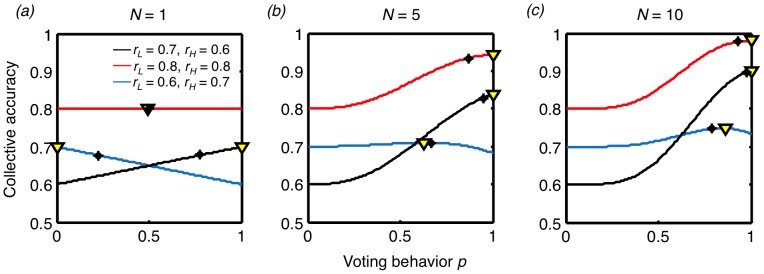
Learning has been studied extensively in the context of isolated individuals. However, many organisms are social and consequently make decisions both individually and as part of a collective. Reaching consensus necessarily means that a single option is chosen by the group, even when there are dissenting opinions. This decision-making process decouples the otherwise direct relationship between animals' preferences and their experiences (the outcomes of decisions). Instead, because an individual's learned preferences influence what others experience, and therefore learn about, collective decisions couple the learning processes between social organisms. This introduces a new, and previously unexplored, dynamical relationship between preference, action, experience and learning. Here we model collective learning within animal groups that make consensus decisions. We reveal how learning as part of a collective results in behavior that is fundamentally different from that learned in isolation, allowing grouping organisms to spontaneously (and indirectly) detect correlations between group members' observations of environmental cues, adjust strategy as a function of changing group size (even if that group size is not known to the individual), and achieve a decision accuracy that is very close to that which is provably optimal, regardless of environmental contingencies. Because these properties make minimal cognitive demands on individuals, collective learning, and the capabilities it affords, may be widespread among group-living organisms. Our work emphasizes the importance and need for theoretical and experimental work that considers the mechanism and consequences of learning in a social context.
学习已经在孤立个体的背景下得到了广泛研究。然而,许多生物是社会性的,因此它们既会单独做出决策,也会作为群体的一部分做出决策。达成共识必然意味着群体选择了单一选项,即使存在不同意见。这种决策过程打破了动物偏好与其经历(决策结果)之间原本直接的关系。相反,由于个体习得的偏好会影响其他个体的经历,进而影响它们所学的内容,集体决策将社会生物之间的学习过程联系了起来。这引入了一种新的、此前未被探索过的偏好、行动、经历和学习之间的动态关系。在这里,我们对做出共识决策的动物群体中的集体学习进行建模。我们揭示了作为集体一部分的学习如何导致与孤立学习截然不同的行为,使群居生物能够自发地(并间接地)检测群体成员对环境线索观察之间的相关性,根据群体规模的变化调整策略(即使个体不知道群体规模),并实现非常接近可证明最优的决策准确性,而不受环境偶然性的影响。由于这些特性对个体的认知要求极低,集体学习及其所具备的能力可能在群居生物中广泛存在。我们的工作强调了在社会背景下考虑学习机制和后果的理论和实验工作的重要性和必要性。