Sheppard Michael, Bronstein Marcello D, Freda Pamela, Serri Omar, De Marinis Laura, Naves Luciana, Rozhinskaya Liudmila, Hermosillo Reséndiz Karina, Ruffin Matthieu, Chen YinMiao, Colao Annamaria
Centre for Endocrinology, Diabetes and Metabolism, University of Birmingham, Edgbaston, Birmingham, B15 2TT, UK,
Pituitary. 2015 Jun;18(3):385-94. doi: 10.1007/s11102-014-0585-6.
A large, randomized, double-blind, Phase III core study demonstrated that pasireotide LAR was significantly superior to octreotide LAR at providing GH <2.5 μg/L and normalized IGF-1 after 12 months' treatment in patients with acromegaly. We report the efficacy and safety of pasireotide LAR and octreotide LAR after up to 26 months' treatment.
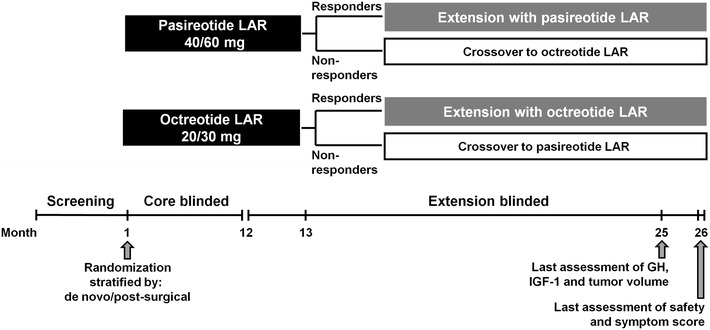
Patients with GH <2.5 μg/L and IGF-1 ≤1× ULN at month 12, or patients considered to be experiencing clinical benefit, were eligible to continue receiving their randomized therapy in the extension. Efficacy and safety in the pasireotide LAR and octreotide LAR groups were evaluated for up to 26 months.
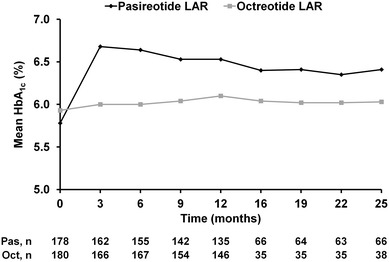
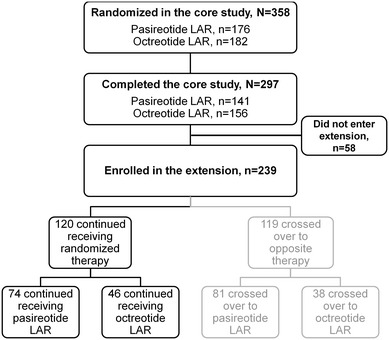
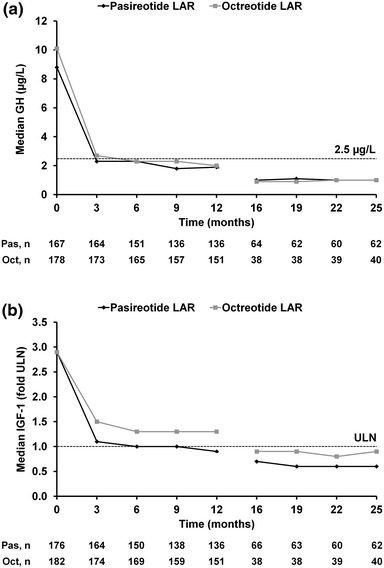
Overall, 120 patients who completed the core study continued receiving pasireotide LAR (n = 74) or octreotide LAR (n = 46) in the extension. At month 25, biochemical control (GH <2.5 μg/L and normal IGF-1) was achieved by 48.6% (36/74) and 45.7% (21/46) of patients in the pasireotide LAR and octreotide LAR arms [60.8% (45/74) and 52.2% (24/46) when including patients with IGF-1 < LLN], respectively. In total, 74.7% of pasireotide LAR and 71.6% of octreotide LAR patients had tumor volume decrease ≥20% from baseline to month 26. Most AEs were mild or moderate. Hyperglycemia-related AEs were seen in 62.9 and 25.0% of pasireotide LAR and octreotide LAR patients, respectively. No new safety signals were observed in the extension compared with the core study.
GH and IGF-1 suppression is maintained for up to 25 months during pasireotide LAR treatment. The safety profile of pasireotide LAR is typical of a somatostatin analogue, except for the frequency and degree of hyperglycemia.
一项大型、随机、双盲的III期核心研究表明,在肢端肥大症患者中,经过12个月的治疗,帕西瑞肽长效注射剂在使生长激素(GH)<2.5μg/L以及使胰岛素样生长因子-1(IGF-1)恢复正常方面显著优于奥曲肽长效注射剂。我们报告了长达26个月治疗期内帕西瑞肽长效注射剂和奥曲肽长效注射剂的疗效和安全性。
在第12个月时生长激素<2.5μg/L且IGF-1≤1×正常上限(ULN)的患者,或被认为有临床获益的患者,有资格在延长期继续接受其随机分组的治疗。对帕西瑞肽长效注射剂组和奥曲肽长效注射剂组长达26个月的疗效和安全性进行了评估。
总体而言,120名完成核心研究的患者在延长期继续接受帕西瑞肽长效注射剂(n = 74)或奥曲肽长效注射剂(n = 46)治疗。在第25个月时,帕西瑞肽长效注射剂组和奥曲肽长效注射剂组分别有48.6%(36/74)和45.7%(21/46)的患者实现了生化控制(GH<2.5μg/L且IGF-1正常)[若将IGF-1<正常下限(LLN)的患者包括在内,则分别为60.8%(45/74)和52.2%(24/46)]。总体而言,从基线到第26个月,74.7%的帕西瑞肽长效注射剂组患者和71.6%的奥曲肽长效注射剂组患者肿瘤体积缩小≥20%。大多数不良事件为轻度或中度。帕西瑞肽长效注射剂组和奥曲肽长效注射剂组分别有62.9%和25.0%的患者出现与高血糖相关的不良事件。与核心研究相比,在延长期未观察到新的安全信号。
在帕西瑞肽长效注射剂治疗期间,生长激素和IGF-1的抑制作用可维持长达25个月。除了高血糖的发生频率和程度外,帕西瑞肽长效注射剂的安全性特征符合生长抑素类似物的典型情况。