Laboratory of Molecular Immunoregulation, Cancer and Inflammation Program, Center for Cancer Research, National Cancer Institute, Frederick, MD 21702, USA ; Endoscopic Center, Zhongshan Hospital, Fudan University, Shanghai 200032, China.
Laboratory of Molecular Immunoregulation, Cancer and Inflammation Program, Center for Cancer Research, National Cancer Institute, Frederick, MD 21702, USA ; Department of Pulmonary Medicine, Ruijin Hospital, Shanghai Jiaotong University School of Medicine, Shanghai 200025, China.
Biomed Res Int. 2014;2014:751392. doi: 10.1155/2014/751392. Epub 2014 Jul 10.
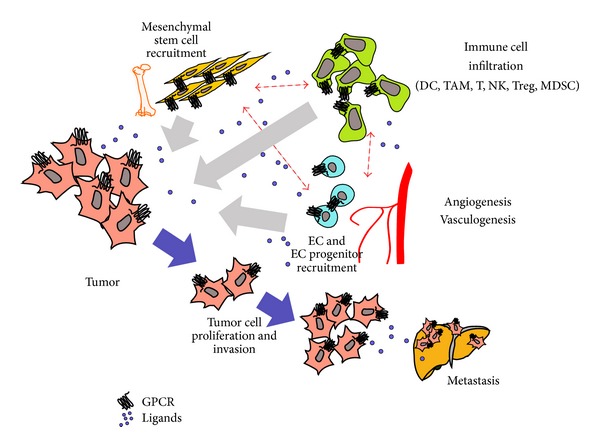
Chemoattractant receptors are a family of seven transmembrane G protein coupled receptors (GPCRs) initially found to mediate the chemotaxis and activation of immune cells. During the past decades, the functions of these GPCRs have been discovered to not only regulate leukocyte trafficking and promote immune responses, but also play important roles in homeostasis, development, angiogenesis, and tumor progression. Accumulating evidence indicates that chemoattractant GPCRs and their ligands promote the progression of malignant tumors based on their capacity to orchestrate the infiltration of the tumor microenvironment by immune cells, endothelial cells, fibroblasts, and mesenchymal cells. This facilitates the interaction of tumor cells with host cells, tumor cells with tumor cells, and host cells with host cells to provide a basis for the expansion of established tumors and development of distant metastasis. In addition, many malignant tumors of the nonhematopoietic origin express multiple chemoattractant GPCRs that increase the invasiveness and metastasis of tumor cells. Therefore, GPCRs and their ligands constitute targets for the development of novel antitumor therapeutics.
趋化因子受体是一类七次跨膜 G 蛋白偶联受体 (GPCR),最初被发现介导免疫细胞的趋化性和激活。在过去的几十年中,这些 GPCR 的功能不仅被发现可以调节白细胞的迁移并促进免疫反应,而且在维持内稳态、发育、血管生成和肿瘤进展中也发挥着重要作用。越来越多的证据表明,趋化因子 GPCR 及其配体通过协调免疫细胞、内皮细胞、成纤维细胞和间充质细胞浸润肿瘤微环境,促进恶性肿瘤的进展。这有利于肿瘤细胞与宿主细胞、肿瘤细胞与肿瘤细胞以及宿主细胞与宿主细胞之间的相互作用,为已建立的肿瘤的扩张和远处转移的发展提供了基础。此外,许多非造血来源的恶性肿瘤表达多种趋化因子 GPCR,增加了肿瘤细胞的侵袭性和转移能力。因此,GPCR 及其配体成为开发新型抗肿瘤治疗药物的靶点。