Knezevic Olivera M, Mirkov Dragan M, Kadija Marko, Nedeljkovic Aleksandar, Jaric Slobodan
University of Belgrade, Institute for Medical Research, Department of Neurophysiology, Belgrade, Serbia; University of Belgrade, Faculty of Sport and Physical Education, The Research Centre, Belgrade, Serbia.
University of Belgrade, Faculty of Sport and Physical Education, The Research Centre, Belgrade, Serbia.
Knee. 2014 Dec;21(6):1039-45. doi: 10.1016/j.knee.2014.07.021. Epub 2014 Jul 27.
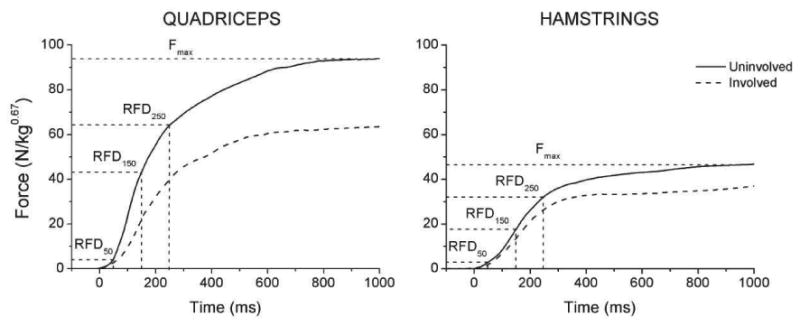
Despite its apparent functional importance, there is a general lack of data regarding the time-related changes in explosive strength and the corresponding side-to-side asymmetries in individuals recovering from an ACL reconstruction (ACLR). The present study was designed to assess changes in the maximum and explosive strength of the quadriceps and hamstring muscles in athletes recovering from an ACLR.
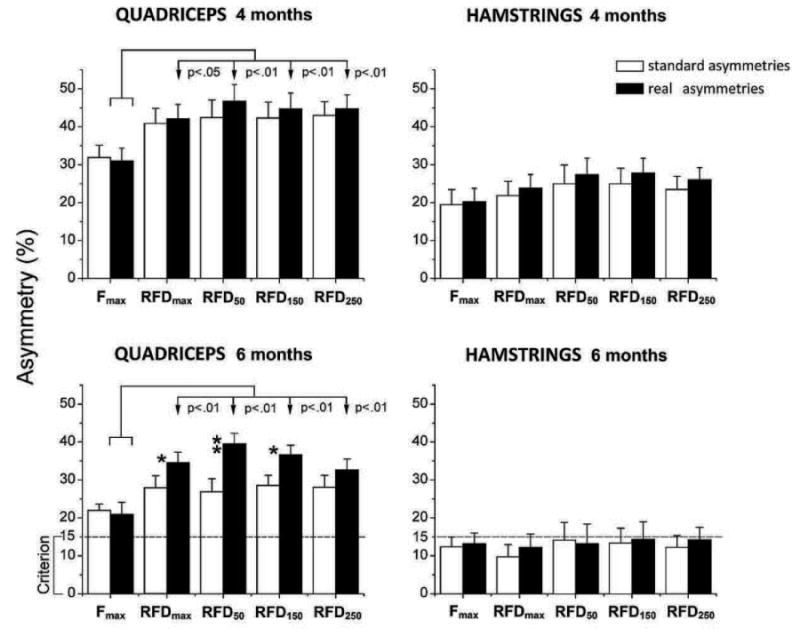
Twenty male athletes with an ACL injury completed a standard isometric testing protocol pre-ACLR, four and sixmonths post-ACLR. In addition to the maximum strength (Fmax), the explosive strength of quadriceps and hamstrings was assessed through four variables derived from the slope of the force-time curves over various time intervals (RFDmax, RFD50, RFD150 and RFD250). Side-to-side asymmetries were calculated relative to post-ACLR measures of the uninvolved leg ("standard" asymmetries), and relative to pre-ACLR value of the uninvolved leg ("real" asymmetries).
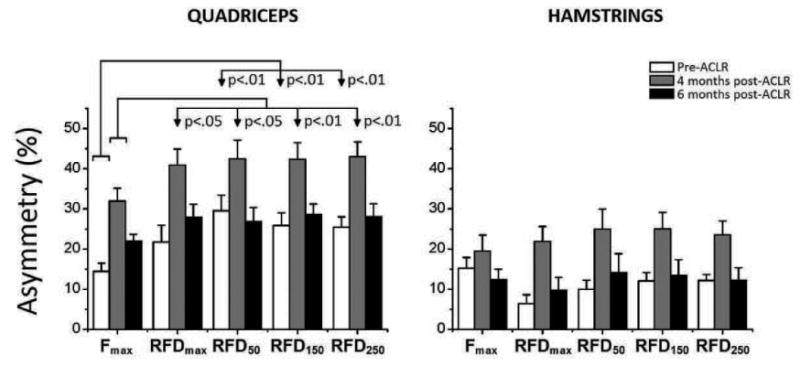
Pre-ACLR asymmetries in quadriceps RFD (average 26%) were already larger than in Fmax (14%) (p<0.05). Six months post-ACLR real asymmetries in RFD variables (33-39%) were larger than the corresponding standard asymmetries (26-28%; p<0.01). Average asymmetries in hamstrings' RFD and Fmax were 10%, 25% and 15% for pre-ACLR and two post-ACLR sessions, respectively (all p>0.05).
In addition to the maximum strength, the indices of explosive strength should also be included in monitoring recovery of muscle function following an ACLR. Furthermore, pre-injury/reconstruction values should be used for the post-ACLR side-to-side comparisons, providing a more valid criterion regarding the muscle recovery and readiness for a return to sports.
尽管爆发力在功能上具有明显的重要性,但对于前交叉韧带重建术(ACLR)康复期个体的爆发力随时间的变化以及相应的双侧不对称性,普遍缺乏相关数据。本研究旨在评估ACLR康复期运动员股四头肌和腘绳肌的最大力量和爆发力变化。
20名ACL损伤的男性运动员在ACLR术前、术后4个月和6个月完成了标准的等长测试方案。除了最大力量(Fmax)外,还通过从不同时间间隔的力-时间曲线斜率得出的四个变量(RFDmax、RFD50、RFD150和RFD250)评估股四头肌和腘绳肌的爆发力。双侧不对称性是相对于未受伤腿的ACLR术后测量值计算得出(“标准”不对称性),以及相对于未受伤腿的ACLR术前值计算得出(“实际”不对称性)。
ACLR术前股四头肌RFD的不对称性(平均26%)已经大于Fmax的不对称性(14%)(p<0.05)。ACLR术后6个月,RFD变量的实际不对称性(33 - 39%)大于相应的标准不对称性(26 - 28%;p<0.01)。ACLR术前和术后两个阶段,腘绳肌RFD和Fmax的平均不对称性分别为10%、25%和15%(所有p>0.05)。
除了最大力量外,爆发力指标也应纳入ACLR术后肌肉功能恢复的监测中。此外,ACLR术后双侧比较应采用受伤前/重建前的值,以便为肌肉恢复和恢复运动的准备情况提供更有效的标准。