Wildschutte Julia H, Ram Daniel, Subramanian Ravi, Stevens Victoria L, Coffin John M
Department of Molecular Biology and Microbiology, Tufts University School of Medicine, 136 Harrison Avenue, Boston 02111, MA, USA.
Retrovirology. 2014 Aug 12;11:62. doi: 10.1186/s12977-014-0062-3.
Integration of retroviral DNA into a germ cell can result in a provirus that is transmitted vertically to the host's offspring. In humans, such endogenous retroviruses (HERVs) comprise >8% of the genome. The HERV-K(HML-2) proviruses consist of ~90 elements related to mouse mammary tumor virus, which causes breast cancer in mice. A subset of HERV-K(HML-2) proviruses has some or all genes intact, and even encodes functional proteins, though a replication competent copy has yet to be observed. More than 10% of HML-2 proviruses are human-specific, having integrated subsequent to the Homo-Pan divergence, and, of these, 11 are currently known to be polymorphic in integration site with variable frequencies among individuals. Increased expression of the most recent HML-2 proviruses has been observed in tissues and cell lines from several types of cancer, including breast cancer, for which expression may provide a meaningful marker of the disease.
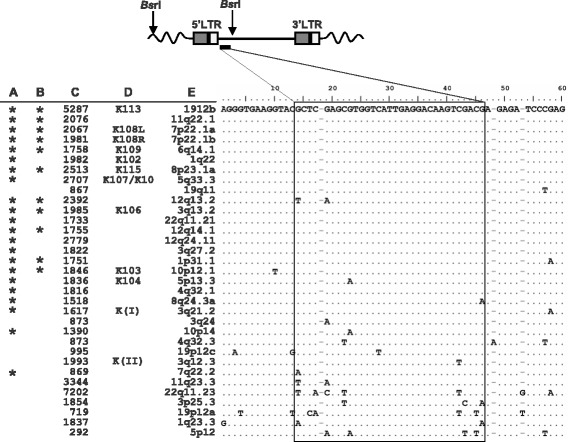
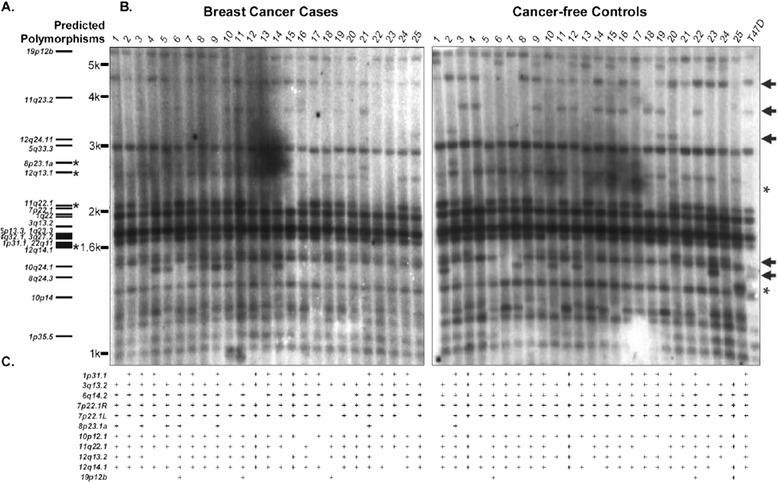
In this study, we performed a case-control analysis to investigate the possible relationship between the genome-wide presence of individual polymorphic HML-2 proviruses with the occurrence of breast cancer. For this purpose, we screened 50 genomic DNA samples from individuals diagnosed with breast cancer or without history of the disease (n = 25 per group) utilizing a combination of locus-specific PCR screening, in silico analysis of HML-2 content within the reference human genome sequence, and high-resolution genomic hybridization in semi-dried agarose. By implementing this strategy, we were able to analyze the distribution of both annotated and previously undescribed polymorphic HML-2 proviruses within our sample set, and to assess their possible association with disease outcome.
In a case-control analysis of 50 humans with regard to breast cancer diagnosis, we found no significant difference in the prevalence of proviruses between groups, suggesting common polymorphic HML-2 proviruses are not associated with breast cancer. Our findings indicate a higher level of putatively novel HML-2 sites within the population, providing support for additional recent insertion events, implying ongoing, yet rare, activities. These findings do not rule out either the possibility of involvement of such proviruses in a subset of breast cancers, or their possible utility as tissue-specific markers of disease.
逆转录病毒DNA整合到生殖细胞中可产生一种前病毒,该前病毒会垂直传播给宿主的后代。在人类中,此类内源性逆转录病毒(HERV)占基因组的比例超过8%。HERV-K(HML-2)前病毒由约90个与小鼠乳腺肿瘤病毒相关的元件组成,该病毒可在小鼠中引发乳腺癌。HERV-K(HML-2)前病毒的一个子集具有部分或全部完整基因,甚至可编码功能性蛋白质,不过尚未观察到具有复制能力的拷贝。超过10%的HML-2前病毒是人类特有的,在人-黑猩猩分化之后整合进来,其中目前已知有11种在整合位点上具有多态性,个体间频率各异。在包括乳腺癌在内的几种癌症的组织和细胞系中,已观察到最新的HML-2前病毒表达增加,其表达可能为该疾病提供有意义的标志物。
在本研究中,我们进行了一项病例对照分析,以调查个体多态性HML-2前病毒在全基因组中的存在与乳腺癌发生之间的可能关系。为此,我们使用了位点特异性PCR筛选、对参考人类基因组序列中HML-2含量的计算机分析以及半干琼脂糖中的高分辨率基因组杂交相结合的方法,对50份来自被诊断患有乳腺癌或无该疾病病史的个体的基因组DNA样本进行了筛选(每组n = 25)。通过实施该策略,我们能够分析样本集中已注释和先前未描述的多态性HML-2前病毒两者的分布情况,并评估它们与疾病结果的可能关联。
在一项针对50名人类乳腺癌诊断的病例对照分析中,我们发现两组之间前病毒的流行率没有显著差异,这表明常见的多态性HML-2前病毒与乳腺癌无关。我们的研究结果表明人群中存在更高水平的推测性新HML-2位点,为更多近期插入事件提供了支持,意味着这些事件仍在发生,但较为罕见。这些发现既不排除此类前病毒参与一部分乳腺癌发生的可能性,也不排除它们作为疾病组织特异性标志物的潜在用途。