Division of Pulmonology, University Hospital Zurich, Rämistrasse 100, 8091 Zurich, Switzerland.
BMC Pulm Med. 2014 Aug 12;14:138. doi: 10.1186/1471-2466-14-138.
Solitary fibrous tumors of the pleura (SFTP) are rare and their long-term outcome is difficult to predict, as there are insufficient data which allow accurate characterization of the malignant variant. Thus the aim of this study was to describe the outcome and possible determinants of malignant behavior of SFTPs.
Data were collected retrospectively from medical records of patients treated at the University Hospital Zurich from 1992 to 2012. Kaplan-Meier and Cox regression analysis were performed to define disease-free survival time (defined as survival without tumor-recurrence or tumor-related death) using the classical histo-morphological criteria (tumor size, localization, pedunculation, tumor necrosis or hemorrhage, mitotic activity and nuclear pleomorphism) and immunohistochemical parameters.
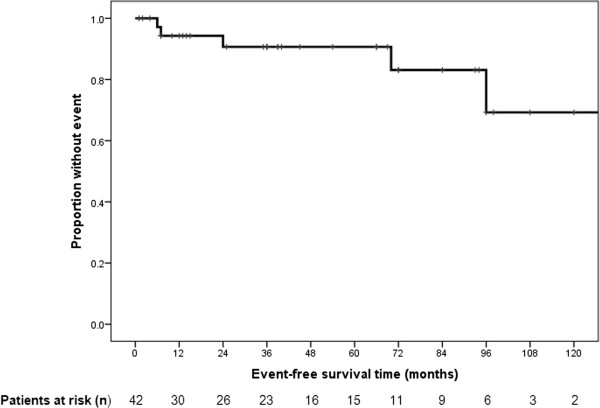
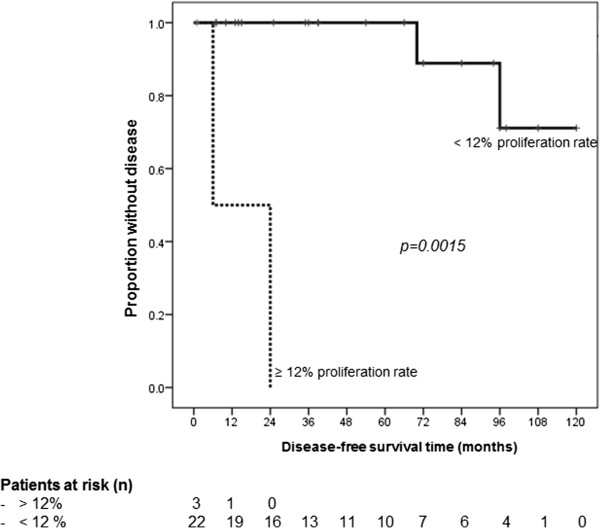
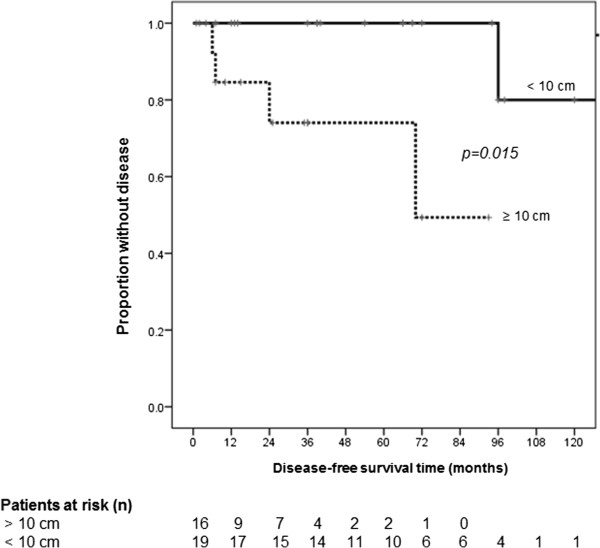
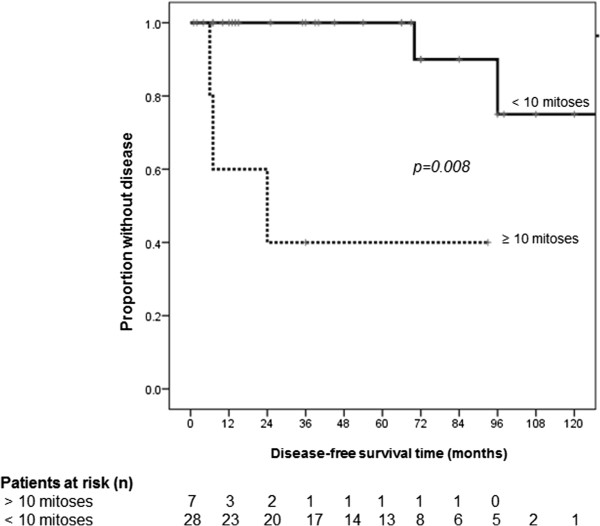
42 patients (20 males) with SFTP (median (IQR) age 62 (56-71) years) could be identified. SFTP were associated with symptoms in 50% of all cases. Complete resection was achieved by video-assisted thoracic surgery or thoracotomy in 20 and 22 patients, respectively. Three SFTP-related deaths (7.1%) and four tumor recurrences (9.5%) were observed. Mean disease-free survival time was 136.2 (± 13.1) months, and 2-, 5- and 10-year disease-free survival was 91%, 84%, and 67%, respectively. Mean disease-free survival inversely correlated with the mean tumor diameter, number of mitotic figures and proliferation rate (Ki-67 expression). Other criteria (tumor necrosis, atypical localization, sessile tumor, and pleomorphism) were not statistically significant prognostic parameters.
Patients with large SFTP with a high mitotic index and high proliferation rate should be followed-up closely and over a prolonged time period in order to recognize recurrence of the SFTP early and at a treatable stage. Future research on this topic should focus on the prognostic role of immunohistochemistry including Ki-67 expression and molecular parameters.
胸膜孤立性纤维瘤(SFTP)较为罕见,其长期预后难以预测,因为目前尚无足够的数据能够准确地对恶性变体进行特征描述。因此,本研究旨在描述 SFTP 的恶性行为的结局和可能的决定因素。
从 1992 年至 2012 年在苏黎世大学医院接受治疗的患者的病历中回顾性收集数据。使用经典的组织形态学标准(肿瘤大小、定位、蒂部、肿瘤坏死或出血、有丝分裂活性和核异型性)和免疫组织化学参数,通过 Kaplan-Meier 和 Cox 回归分析来定义无病生存时间(定义为无肿瘤复发或肿瘤相关死亡的生存时间)。
共确定了 42 名(20 名男性)SFTP 患者(中位数(IQR)年龄 62(56-71)岁)。所有病例中,SFTP 伴有症状的占 50%。20 名患者和 22 名患者分别通过电视辅助胸腔镜手术或开胸手术实现了完全切除。观察到 3 例 SFTP 相关死亡(7.1%)和 4 例肿瘤复发(9.5%)。平均无病生存时间为 136.2(±13.1)个月,2 年、5 年和 10 年无病生存率分别为 91%、84%和 67%。平均无病生存时间与肿瘤直径、有丝分裂数和增殖率(Ki-67 表达)呈负相关。其他标准(肿瘤坏死、非典型定位、无蒂肿瘤和多形性)不是统计学上显著的预后参数。
对于具有高有丝分裂指数和高增殖率的大型 SFTP 患者,应密切随访并延长随访时间,以便及早发现 SFTP 的复发,并在可治疗阶段进行治疗。未来关于这个主题的研究应侧重于免疫组织化学的预后作用,包括 Ki-67 表达和分子参数。