Department of Pulmonology, University Hospital Zurich, Raemistrasse 100, 8091, Zurich, Switzerland.
Institute of Pathology and Molecular Pathology, University Hospital Zurich, Zurich, Switzerland.
Respir Res. 2017 Dec 16;18(1):210. doi: 10.1186/s12931-017-0693-8.
Although the majority of solitary fibrous tumors of the pleura (SFTP) follow a benign course, 10-25% of patients suffer from recurrence or metastatic disease. Several scoring models have been proposed to predict the outcome. However, none of these included immunohistochemical (IHC) markers as possible prognosticators.
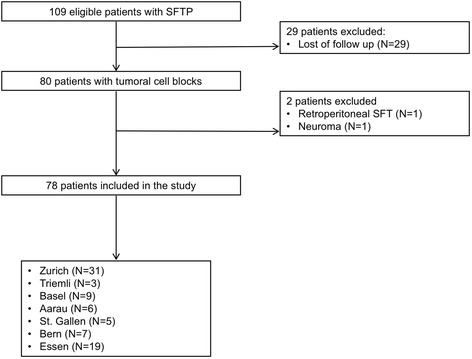
In this multicenter study, we collected clinical data and formalin-fixed and paraffin-embedded (FFPE) tissue blocks of patients with histologically proven SFTP which had been surgically resected between 2000 und 2015. After systematic and extensive IHC staining on tissue microarrays, the results were analyzed and compared to histomorphological and clinical data for their possible prognostic value.
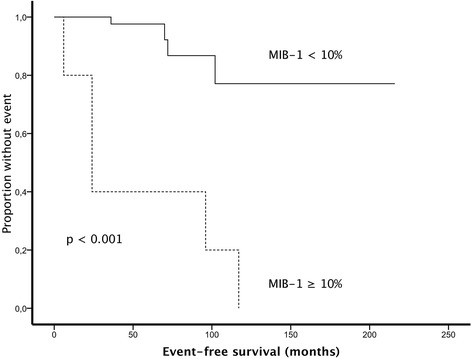
In total, 78 patients (mean age 61 ± 11 years) were included. Of these, 9 patients (11%) had an adverse outcome including SFTP recurrence (n = 6) or SFTP-related death (n = 3). Mean overall survival was 172 ± 13 months. 1 and 10-year event-free survival rates were 99% and 93%. In the multivariable analysis only MIB-1 proliferation index (Ki-67) ≥10% (HR 12.3, CI 1.1-139.5, p = 0.043), ≥4 mitoses per 10 high power fields (HR 36.5, CI 1.2-1103.7, p = 0.039) and tumor size larger than 10 cm (HR 81.8, CI 1.7-4016.8, p = 0.027) were independently associated with adverse outcome.
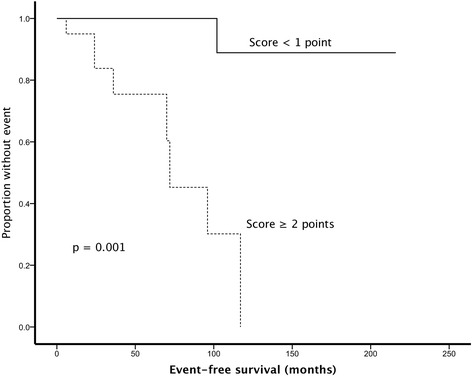
A high proliferation rate by MIB-1 IHC was associated with impaired outcome. Upon this, we established a new score using mitosis, necrosis, size of the tumor and MIB-1, which performed better than the traditional scores in our data set. This prognostic score could help to better evaluate outcome of SFTP, but requires external validation.
尽管大多数胸膜孤立性纤维瘤(SFTP)呈良性病程,但仍有 10-25%的患者出现复发或转移疾病。已经提出了几种评分模型来预测结局。然而,这些模型均未将免疫组织化学(IHC)标志物纳入可能的预后标志物。
在这项多中心研究中,我们收集了 2000 年至 2015 年间手术切除的经组织学证实的 SFTP 患者的临床数据和福尔马林固定石蜡包埋(FFPE)组织块。在组织微阵列上进行系统广泛的免疫组化染色后,分析结果并与组织形态学和临床数据进行比较,以评估其可能的预后价值。
共纳入 78 例患者(平均年龄 61±11 岁)。其中 9 例(11%)出现不良结局,包括 SFTP 复发(n=6)或 SFTP 相关死亡(n=3)。中位总生存期为 172±13 个月。1 年和 10 年无事件生存率分别为 99%和 93%。多变量分析仅显示 MIB-1 增殖指数(Ki-67)≥10%(HR 12.3,CI 1.1-139.5,p=0.043)、每 10 高倍视野≥4 个有丝分裂(HR 36.5,CI 1.2-1103.7,p=0.039)和肿瘤大小大于 10cm(HR 81.8,CI 1.7-4016.8,p=0.027)与不良结局独立相关。
MIB-1 IHC 的高增殖率与预后不良相关。基于此,我们建立了一个新的评分系统,该系统使用有丝分裂、坏死、肿瘤大小和 MIB-1,在我们的数据集中比传统评分表现更好。该预后评分有助于更好地评估 SFTP 的结局,但需要外部验证。