Eilam Omer, Zarecki Raphy, Oberhardt Matthew, Ursell Luke K, Kupiec Martin, Knight Rob, Gophna Uri, Ruppin Eytan
Department of Molecular Microbiology and Biotechnology, Faculty of Life Sciences, Tel Aviv University, Tel Aviv, Israel
School of Computer Science, Tel-Aviv University, Tel-Aviv, Israel.
mBio. 2014 Aug 12;5(4):e01526-14. doi: 10.1128/mBio.01526-14.
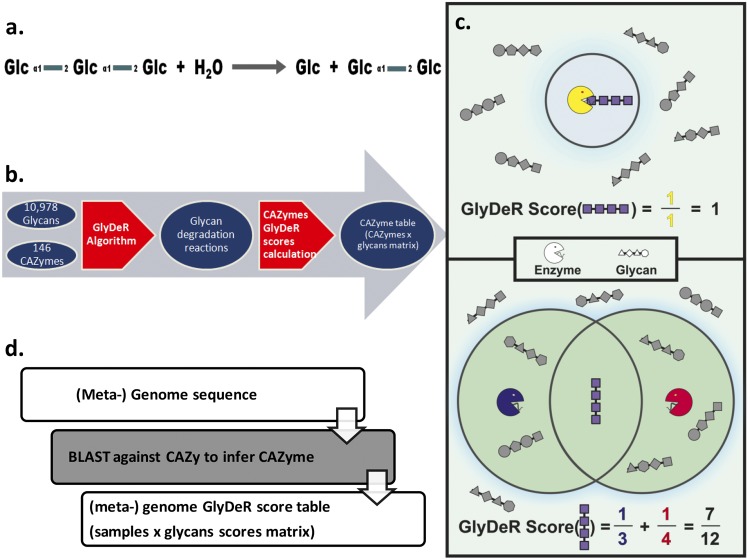
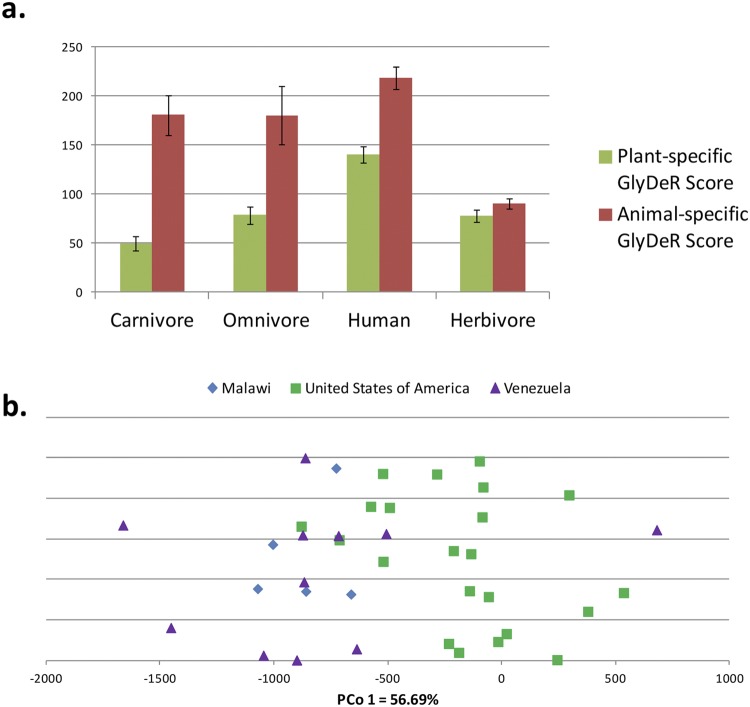
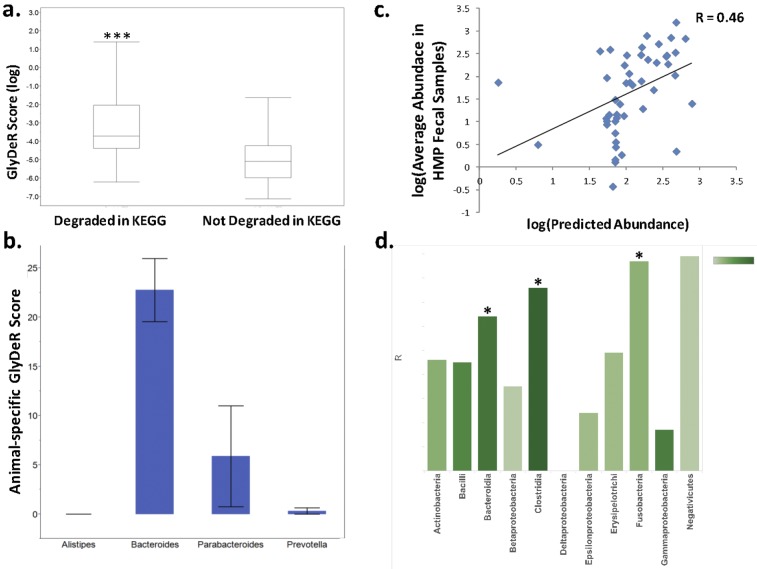
Glycans form the primary nutritional source for microbes in the human gut, and understanding their metabolism is a critical yet understudied aspect of microbiome research. Here, we present a novel computational pipeline for modeling glycan degradation (GlyDeR) which predicts the glycan degradation potency of 10,000 reference glycans based on either genomic or metagenomic data. We first validated GlyDeR by comparing degradation profiles for genomes in the Human Microbiome Project against KEGG reaction annotations. Next, we applied GlyDeR to the analysis of human and mammalian gut microbial communities, which revealed that the glycan degradation potential of a community is strongly linked to host diet and can be used to predict diet with higher accuracy than sequence data alone. Finally, we show that a microbe's glycan degradation potential is significantly correlated (R = 0.46) with its abundance, with even higher correlations for potential pathogens such as the class Clostridia (R = 0.76). GlyDeR therefore represents an important tool for advancing our understanding of bacterial metabolism in the gut and for the future development of more effective prebiotics for microbial community manipulation.
The increased availability of high-throughput sequencing data has positioned the gut microbiota as a major new focal point for biomedical research. However, despite the expenditure of huge efforts and resources, sequencing-based analysis of the microbiome has uncovered mostly associative relationships between human health and diet, rather than a causal, mechanistic one. In order to utilize the full potential of systems biology approaches, one must first characterize the metabolic requirements of gut bacteria, specifically, the degradation of glycans, which are their primary nutritional source. We developed a computational framework called GlyDeR for integrating expert knowledge along with high-throughput data to uncover important new relationships within glycan metabolism. GlyDeR analyzes particular bacterial (meta)genomes and predicts the potency by which they degrade a variety of different glycans. Based on GlyDeR, we found a clear connection between microbial glycan degradation and human diet, and we suggest a method for the rational design of novel prebiotics.
聚糖构成了人类肠道微生物的主要营养来源,了解它们的代谢是微生物组研究中一个关键但尚未充分研究的方面。在此,我们提出了一种用于聚糖降解建模的新型计算流程(GlyDeR),它基于基因组或宏基因组数据预测10000种参考聚糖的聚糖降解能力。我们首先通过将人类微生物组计划中基因组的降解谱与KEGG反应注释进行比较来验证GlyDeR。接下来,我们将GlyDeR应用于人类和哺乳动物肠道微生物群落分析,结果表明群落的聚糖降解潜力与宿主饮食密切相关,并且与仅使用序列数据相比,它能够以更高的准确性预测饮食。最后,我们表明微生物的聚糖降解潜力与其丰度显著相关(R = 0.46),对于诸如梭菌纲等潜在病原体,相关性甚至更高(R = 0.76)。因此,GlyDeR是推进我们对肠道细菌代谢的理解以及未来开发更有效的益生元以操纵微生物群落的重要工具。
高通量测序数据可用性的增加使肠道微生物群成为生物医学研究的一个主要新焦点。然而,尽管投入了巨大的努力和资源,基于测序的微生物组分析大多揭示了人类健康与饮食之间的关联关系,而非因果性、机制性的关系。为了充分利用系统生物学方法的潜力,必须首先表征肠道细菌的代谢需求,特别是作为其主要营养来源的聚糖的降解。我们开发了一个名为GlyDeR的计算框架,用于整合专家知识和高通量数据,以揭示聚糖代谢中的重要新关系。GlyDeR分析特定细菌(宏)基因组,并预测它们降解各种不同聚糖的能力。基于GlyDeR,我们发现了微生物聚糖降解与人类饮食之间的明确联系,并提出了一种合理设计新型益生元的方法。