Jhunjhunwala Ketan, Pal Pramod K
Department of Neurology, National Institute of Mental Health & Neurosciences, Bangalore-560029, Karnataka, India.
Tremor Other Hyperkinet Mov (N Y). 2014 Aug 5;4:255. doi: 10.7916/D8D798MZ. eCollection 2014.
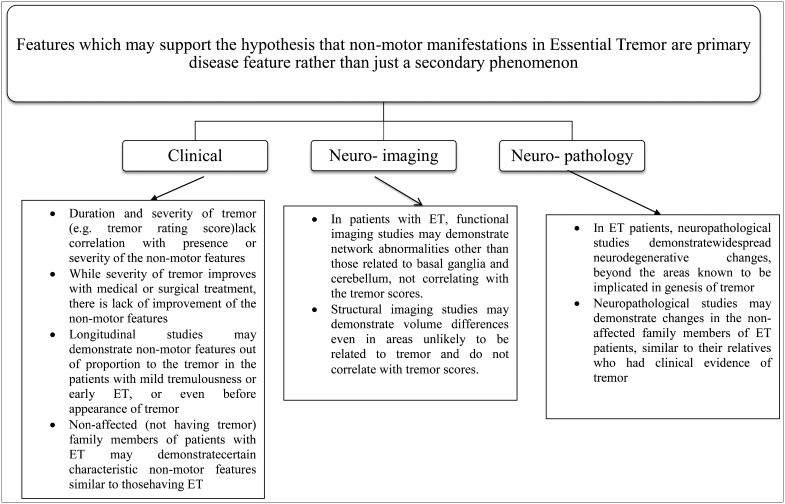
Essential tremor (ET) is a pathologically heterogeneous neurodegenerative disorder with both motor and increasingly recognized non-motor features. It is debated whether the non-motor manifestations in ET result from widespread neurodegeneration or are merely secondary to impaired motor functions and decreased quality of life due to tremor. It is important to review these features to determine how to best treat the non-motor symptoms of patients and to understand the basic pathophysiology of the disease and develop appropriate pharmacotherapies. In this review, retrospective and prospective clinical studies were critically analyzed to identify possible correlations between the severities of non-motor features and tremor. We speculated that if such a correlation existed, the non-motor features were likely to be secondary to tremor. According to the current literature, the deficits in executive function, attention, concentration, and memory often observed in ET are likely to be a primary manifestation of the disease. It has also been documented that patients with ET often exhibit characteristic personality traits. However, it remains to be determined whether the other non-motor features often seen in ET, such as anxiety, depression, and sleep disturbances are primary or secondary to motor manifestations of ET and subsequent poor quality of life. Finally, there is evidence that patients with ET can also have impaired color vision, disturbances of olfaction, and hearing impairments, though there are few studies in these areas. Further investigations of large cohorts of patients with ET are required to understand the prevalence, nature, and true significance of the non-motor features in ET.
特发性震颤(ET)是一种病理异质性神经退行性疾病,具有运动特征以及越来越被认可的非运动特征。ET中的非运动表现是由广泛的神经退行性变引起,还是仅仅继发于运动功能受损以及因震颤导致的生活质量下降,目前仍存在争议。回顾这些特征对于确定如何最佳治疗患者的非运动症状、理解该疾病的基本病理生理学以及开发合适的药物治疗方法至关重要。在本综述中,对回顾性和前瞻性临床研究进行了批判性分析,以确定非运动特征的严重程度与震颤之间可能存在的相关性。我们推测,如果存在这种相关性,那么非运动特征很可能继发于震颤。根据当前文献,ET中经常观察到的执行功能、注意力、专注力和记忆力缺陷可能是该疾病的主要表现。也有文献记载,ET患者常表现出特征性的人格特质。然而,ET中常见的其他非运动特征,如焦虑、抑郁和睡眠障碍,是ET运动表现及随后生活质量下降的原发性还是继发性表现,仍有待确定。最后,有证据表明ET患者也可能存在色觉受损、嗅觉障碍和听力损害,尽管这些领域的研究较少。需要对大量ET患者队列进行进一步研究,以了解ET中非运动特征的患病率、性质和真正意义。