Dong Dawei W, Pereira Filipe, Barrett Steven P, Kolesar Jill E, Cao Kajia, Damas Joana, Yatsunyk Liliya A, Johnson F Brad, Kaufman Brett A
Department of Animal Biology, University of Pennsylvania School of Veterinary Medicine, Philadelphia, PA, USA.
BMC Genomics. 2014 Aug 13;15(1):677. doi: 10.1186/1471-2164-15-677.
Mitochondrial DNA (mtDNA) deletions cause disease and accumulate during aging, yet our understanding of the molecular mechanisms underlying their formation remains rudimentary. Guanine-quadruplex (GQ) DNA structures are associated with nuclear DNA instability in cancer; recent evidence indicates they can also form in mitochondrial nucleic acids, suggesting that these non-B DNA structures could be associated with mtDNA deletions. Currently, the multiple types of GQ sequences and their association with human mtDNA stability are unknown.
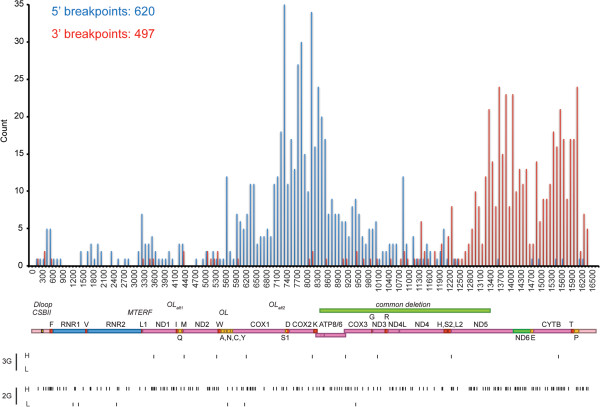
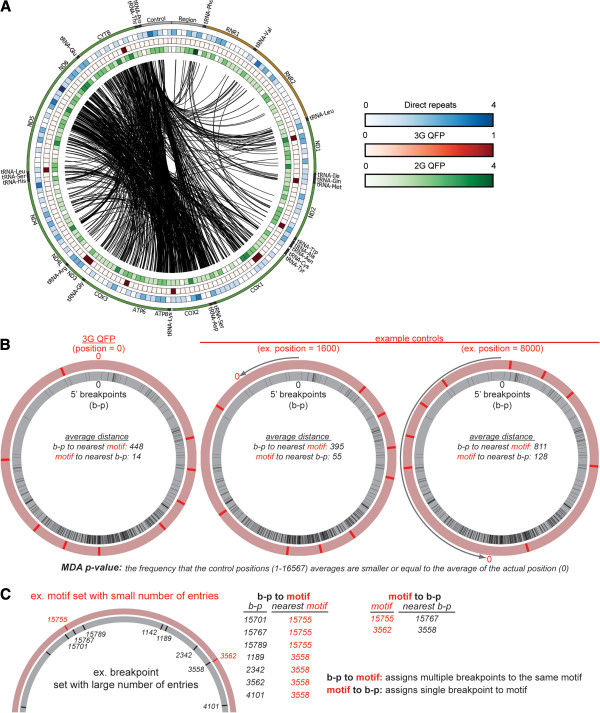
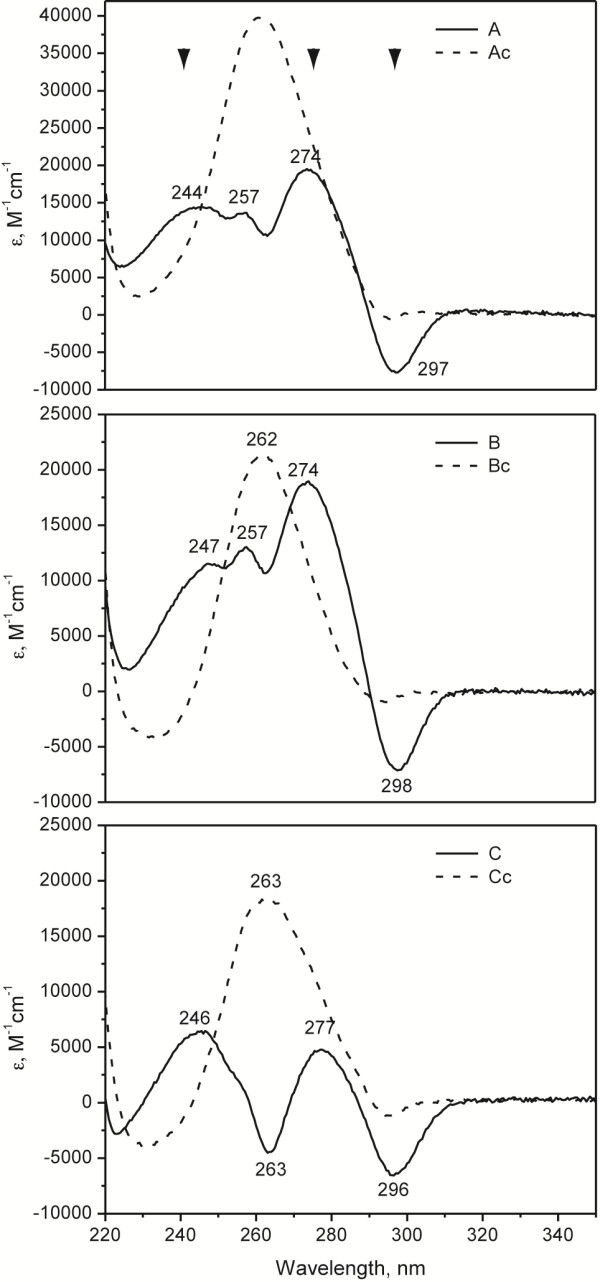
Here, we show an association between human mtDNA deletion breakpoint locations (sites where DNA ends rejoin after deletion of a section) and sequences with G-quadruplex forming potential (QFP), and establish the ability of selected sequences to form GQ in vitro. QFP contain four runs of either two or three consecutive guanines (2G and 3G, respectively), and we identified four types of QFP for subsequent analysis: intrastrand 2G, intrastrand 3G, duplex derived interstrand (ddi) 2G, and ddi 3G QFP sequences. We analyzed the position of each motif set relative to either 5' or 3' unique mtDNA deletion breakpoints, and found that intrastrand QFP sequences, but not ddi QFP sequences, showed significant association with mtDNA deletion breakpoint locations. Moreover, a large proportion of these QFP sequences occur at smaller distances to breakpoints relative to distribution-matched controls. The positive association of 2G QFP sequences persisted when breakpoints were divided into clinical subgroups. We tested in vitro GQ formation of representative mtDNA sequences containing these 2G QFP sequences and detected robust GQ structures by UV-VIS and CD spectroscopy. Notably, the most frequent deletion breakpoints, including those of the "common deletion", are bounded by 2G QFP sequence motifs.
The potential for GQ to influence mitochondrial genome stability supports a high-priority investigation of these structures and their regulation in normal and pathological mitochondrial biology. These findings emphasize the potential importance of helicases that subsequently resolve GQ to maintain the stability of the mitochondrial genome.
线粒体DNA(mtDNA)缺失会引发疾病并在衰老过程中积累,然而我们对其形成背后分子机制的理解仍很基础。鸟嘌呤四链体(GQ)DNA结构与癌症中的核DNA不稳定性相关;最近的证据表明它们也能在线粒体核酸中形成,这表明这些非B型DNA结构可能与mtDNA缺失有关。目前,多种类型的GQ序列及其与人类mtDNA稳定性的关联尚不清楚。
在此,我们展示了人类mtDNA缺失断点位置(一段DNA被删除后两端重新连接的位点)与具有G-四链体形成潜力(QFP)的序列之间的关联,并确定了所选序列在体外形成GQ的能力。QFP包含四段连续的两个或三个鸟嘌呤(分别为2G和3G),我们确定了四种类型的QFP用于后续分析:链内2G、链内3G、双链衍生链间(ddi)2G和ddi 3G QFP序列。我们分析了每个基序集相对于5'或3'独特mtDNA缺失断点的位置,发现链内QFP序列而非ddi QFP序列与mtDNA缺失断点位置存在显著关联。此外,相对于分布匹配的对照,这些QFP序列中有很大一部分出现在距断点较近的位置。当断点被分为临床亚组时,2G QFP序列的正相关仍然存在。我们测试了包含这些2G QFP序列的代表性mtDNA序列的体外GQ形成,并通过紫外可见光谱和圆二色光谱检测到了稳定的GQ结构。值得注意的是,最常见的缺失断点,包括“常见缺失”的断点,都由2G QFP序列基序界定。
GQ影响线粒体基因组稳定性的潜力支持了对这些结构及其在正常和病理线粒体生物学中的调控进行高度优先的研究。这些发现强调了解旋酶随后解开GQ以维持线粒体基因组稳定性的潜在重要性。