Nosek Leszek, Coester Hans-Veit, Roepstorff Carsten, Thomsen Henrik F, Kristensen Niels R, Haahr Hanne, Heise Tim
Profil Institut für Stoffwechselforschung GmbH, Hellersbergstraße 9, 41460, Neuss, Germany,
Clin Drug Investig. 2014 Sep;34(9):673-9. doi: 10.1007/s40261-014-0218-x.
Patients with diabetes mellitus inject insulin in different regions of the body. This study investigated the pharmacokinetic and pharmacodynamic properties of insulin degludec (IDeg), a new-generation once-daily basal insulin with an ultra-long duration of action, after subcutaneous (SC) administration in different injection regions.
In this study, 20 healthy subjects received single SC doses of IDeg (0.4 U/kg; separated by 13-21 days) in the thigh, abdomen and deltoid in a randomised, open-label, single-centre, single-dose, complete crossover trial. Each dose was followed by a 24-h euglycaemic clamp and 120-h pharmacokinetic blood sampling. The obtained pharmacokinetic/pharmacodynamic profiles were extrapolated to steady state by simulation using a pharmacokinetic/pharmacodynamic model.
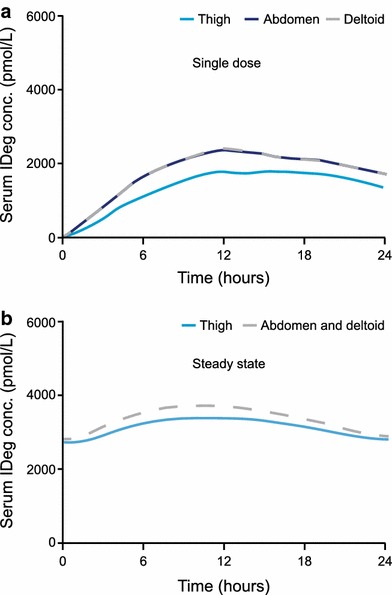
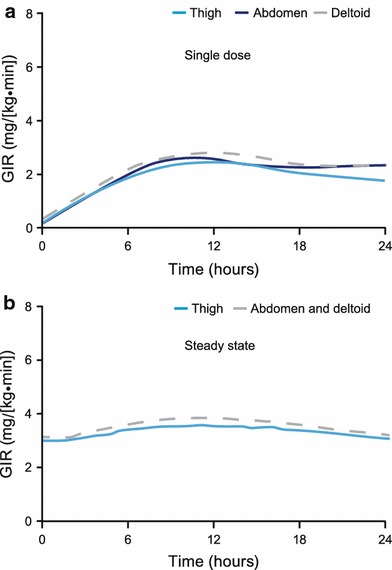
Total IDeg exposure [area under the IDeg serum concentration-time curve 0-120 h after a single dose (AUCIDeg,0-120h,SD)] and maximum serum concentration [maximum IDeg serum concentration after a single dose (C max,IDeg,SD)] were higher (6-7 and 23-27 %, respectively) following a single SC dose in the deltoid or abdomen, compared with the thigh, as also observed with other insulin preparations. No statistical difference was observed in these measures between deltoid and abdominal administration. No pronounced differences were observed in the glucose-lowering effect of IDeg [area under the glucose infusion rate (GIR) curve 0-24 h after a single dose (AUCGIR,0-24h,SD) and maximum GIR after a single dose (GIRmax,SD)] when injected in the thigh, abdomen or deltoid (AUCGIR,0-24h,SD 2,572, 2,833 and 2,960 mg/kg, respectively). Simulated mean steady-state pharmacokinetic and pharmacodynamic profiles supported a flat and stable IDeg exposure and effect regardless of injection region, with comparable total glucose-lowering effects [area under the GIR curve at steady state (AUCGIR,τ,SS)] between the thigh, abdomen and deltoid.
These findings support administering IDeg SC in the thigh, upper arm or abdominal wall without affecting IDeg absorption or effect at steady state.
糖尿病患者在身体的不同部位注射胰岛素。本研究调查了新一代每日一次、作用持续时间超长的基础胰岛素德谷胰岛素(IDeg)在不同注射部位皮下给药后的药代动力学和药效学特性。
在本项随机、开放标签、单中心、单剂量、完全交叉试验中,20名健康受试者在大腿、腹部和三角肌接受单剂量皮下注射IDeg(0.4 U/kg;间隔13 - 21天)。每次给药后进行24小时血糖钳夹和120小时药代动力学血样采集。使用药代动力学/药效学模型通过模拟将获得的药代动力学/药效学曲线外推至稳态。
与在大腿注射相比,在三角肌或腹部进行单剂量皮下注射后,德谷胰岛素的总暴露量[单剂量后0 - 120小时德谷胰岛素血清浓度 - 时间曲线下面积(AUCIDeg,0 - 120h,SD)]和最大血清浓度[单剂量后德谷胰岛素最大血清浓度(Cmax,IDeg,SD)]更高(分别高出6 - 7%和23 - 27%),其他胰岛素制剂也有类似情况。三角肌注射与腹部注射在这些指标上未观察到统计学差异。当在大腿、腹部或三角肌注射时,德谷胰岛素的降糖效果[单剂量后0 - 24小时葡萄糖输注速率(GIR)曲线下面积(AUCGIR,0 - 24h,SD)和单剂量后最大GIR(GIRmax,SD)]未观察到明显差异(AUCGIR,0 - 24h,SD分别为2,572、2,833和2,960 mg/kg)。模拟的平均稳态药代动力学和药效学曲线表明,无论注射部位如何,德谷胰岛素的暴露量和效果均平稳且稳定,大腿、腹部和三角肌之间的总降糖效果[稳态时GIR曲线下面积(AUCGIR,τ,SS)]相当。
这些研究结果支持在大腿、上臂或腹壁进行德谷胰岛素皮下注射,且不影响其稳态吸收或效果。