Lamos Elizabeth M, Younk Lisa M, Davis Stephen N
Division of Endocrinology, Diabetes and Nutrition, University of Maryland School of Medicine, Baltimore, MD, USA.
Department of Medicine, University of Maryland School of Medicine, Baltimore, MD, USA.
Ther Clin Risk Manag. 2016 Mar 9;12:389-400. doi: 10.2147/TCRM.S99855. eCollection 2016.
Insulin therapy plays a critical role in the treatment of type 1 and type 2 diabetes mellitus. However, there is still a need to find basal insulins with 24-hour coverage and reduced risk of hypoglycemia. Additionally, with increasing obesity and insulin resistance, the ability to provide clinically necessary high doses of insulin at low volume is also needed.
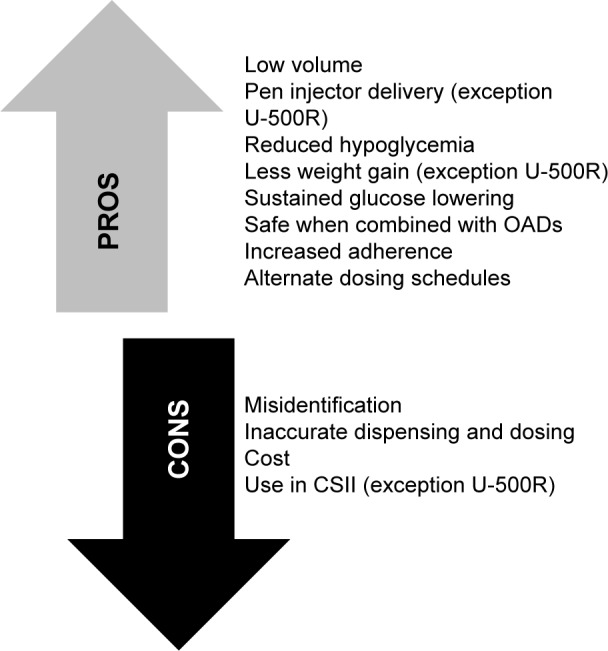
This review highlights the published reports of the pharmacokinetic (PK) and glucodynamic properties of concentrated insulins: Humulin-R U500, insulin degludec U200, and insulin glargine U300, describes the clinical efficacy, risk of hypoglycemic, and metabolic changes observed, and finally, discusses observations about the complexity of introducing a new generation of concentrated insulins to the therapeutic market.
Humulin-R U500 has a similar onset but longer duration of action compared with U100 regular insulin. Insulin glargine U300 has differential PK/pharmacodynamic effects when compared with insulin glargine U100. In noninferiority studies, glycemic control with degludec U200 and glargine U300 is similar to insulin glargine U100 and nocturnal hypoglycemia is reduced. Concentrated formulations appear to behave as separate molecular entities when compared with earlier U100 insulin analog compounds. In the review of available published data, newer concentrated basal insulins may offer an advantage in terms of reduced intraindividual variability as well as reducing the injection burden in individuals requiring high-dose and large volume insulin therapy. Understanding the PK and pharmacodynamic properties of this new generation of insulins is critical to safe dosing, dispensing, and administration.
胰岛素治疗在1型和2型糖尿病的治疗中起着关键作用。然而,仍需要找到具有24小时覆盖且低血糖风险降低的基础胰岛素。此外,随着肥胖和胰岛素抵抗的增加,还需要具备以低容量提供临床所需高剂量胰岛素的能力。
本综述重点介绍了浓缩胰岛素(优泌林 - R U500、德谷胰岛素U200和甘精胰岛素U300)的药代动力学(PK)和糖动力学特性的已发表报告,描述了观察到的临床疗效、低血糖风险和代谢变化,最后讨论了关于将新一代浓缩胰岛素引入治疗市场的复杂性的观察结果。
与U100常规胰岛素相比,优泌林 - R U500起效时间相似,但作用持续时间更长。与甘精胰岛素U100相比,甘精胰岛素U300具有不同的PK/药效学效应。在非劣效性研究中,德谷胰岛素U200和甘精胰岛素U300的血糖控制与甘精胰岛素U100相似,夜间低血糖减少。与早期的U100胰岛素类似物化合物相比,浓缩制剂似乎表现为独立的分子实体。在对现有已发表数据的综述中,新型浓缩基础胰岛素在降低个体内变异性以及减轻需要高剂量和大容量胰岛素治疗的个体的注射负担方面可能具有优势。了解这新一代胰岛素的PK和药效学特性对于安全给药、调配和管理至关重要。