Belloni Virginia, Scaraffia Patricia Y
Department of Tropical Medicine, Vector-Borne Infectious Disease Research Center, School of Public Health and Tropical Medicine, Tulane University, 1430 Tulane Ave,, SL-17, New Orleans, LA 70112, USA.
Parasit Vectors. 2014 Aug 16;7:373. doi: 10.1186/1756-3305-7-373.
It was previously demonstrated that alanine aminotransferase (ALAT, EC 2.6.1.2) participates in maintaining the alanine-proline cycle between flight muscles and fat body during Aedes aegypti flight. ALAT is also actively involved in the metabolism of ammonia in A. aegypti. Here, we investigated the survival and behavioral costs of ALAT inhibition in A. aegypti females to better understand the role of ALAT in blood-fed mosquitoes.
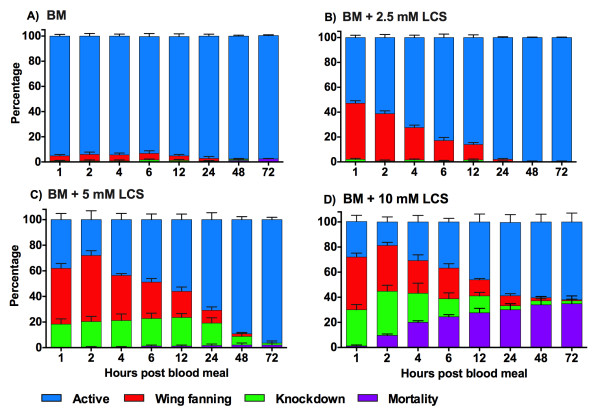
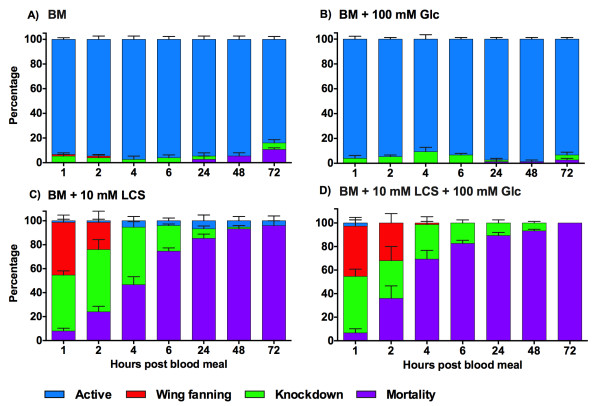
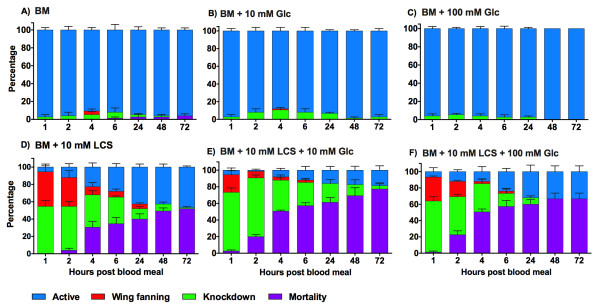
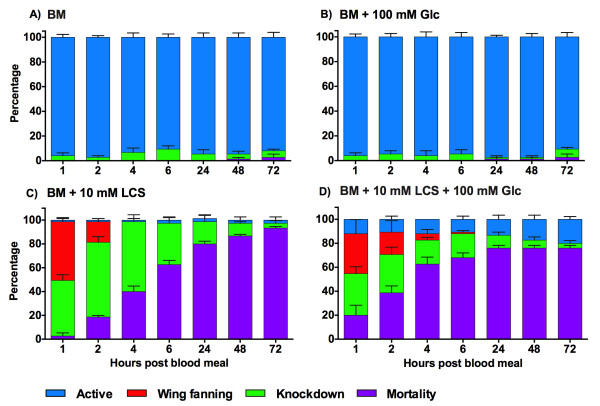
We analyzed how A. aegypti female mosquitoes respond to blood meals supplemented with 0, 2.5, 5 and 10 mM L-cycloserine, a well-known inhibitor of ALAT in animals. Mosquitoes were also exposed to blood meals supplemented with L-cycloserine and different concentrations of glucose (0, 10 and 100 mM). Additionally, the effects of ALAT inhibitor and glucose in mosquitoes starved for 24 or 48 h were investigated. Survival and behavioral phenotypes were analyzed during a time course (1, 2, 4, 6, 12, 24, 48 and 72 h after feeding).
L-cycloserine at 10 mM resulted in high mortality relative to control, with an acute effect during the first 6 h after treatment. A significant decrease in the number of active mosquitoes coinciding with an increase in futile wing fanning during the first 24 h was observed at all inhibitor concentrations. A high occurrence of knockdown phenotype was also recorded at this time for both 5 and 10 mM L-cycloserine. The supplementation of glucose in the blood meal amplified the effects of the ALAT inhibitor. In particular, we observed a higher mortality rate concomitant with an increase in the knockdown phenotype. Starvation prior to blood feeding also increased the effects of L-cycloserine with a rapid increase in mortality.
Our results provide evidence that exposure of high doses of L-cycloserine during A. aegypti blood feeding affects mosquito survival and motor activity, suggesting an interference with carbohydrate and ammonia metabolism in a time-dependent manner.
先前的研究表明,丙氨酸转氨酶(ALAT,EC 2.6.1.2)在埃及伊蚊飞行过程中参与维持飞行肌肉和脂肪体之间的丙氨酸 - 脯氨酸循环。ALAT也积极参与埃及伊蚊体内氨的代谢。在此,我们研究了抑制埃及伊蚊雌性体内ALAT的生存和行为代价,以更好地了解ALAT在吸食血液后的蚊子中的作用。
我们分析了埃及伊蚊雌性蚊子对添加了0、2.5、5和10 mM L - 环丝氨酸(一种动物中著名的ALAT抑制剂)的血餐的反应。蚊子还被暴露于添加了L - 环丝氨酸和不同浓度葡萄糖(0、10和100 mM)的血餐中。此外,还研究了ALAT抑制剂和葡萄糖对饥饿24或48小时的蚊子的影响。在喂食后的时间进程(1、2、4、6、12、24、48和72小时)中分析生存和行为表型。
相对于对照组,10 mM的L - 环丝氨酸导致高死亡率,在处理后的前6小时有急性效应。在所有抑制剂浓度下,在最初24小时内观察到活跃蚊子数量显著减少,同时无效扇翅增加。此时,5和10 mM L - 环丝氨酸也记录到高发生率的击倒表型。血餐中添加葡萄糖放大了ALAT抑制剂的作用。特别是,我们观察到更高的死亡率伴随着击倒表型的增加。吸血前饥饿也增加了L - 环丝氨酸的作用,死亡率迅速上升。
我们的结果提供了证据,表明在埃及伊蚊吸血期间暴露于高剂量的L - 环丝氨酸会影响蚊子的生存和运动活动,表明以时间依赖的方式干扰碳水化合物和氨的代谢。