ANOPIVA-kliniken, Karolinska University Hospital, 171 76, Solna, Sweden,
Pain Ther. 2013 Jun;2(1):37-48. doi: 10.1007/s40122-013-0009-8. Epub 2013 Feb 26.
Improvements are needed in the management of cancer-induced bone pain (CIBP). The objective of this study was to assess the efficacy and safety of pregabalin compared with placebo in the adjunctive treatment of patients with moderate to severe CIBP who were receiving opioids.
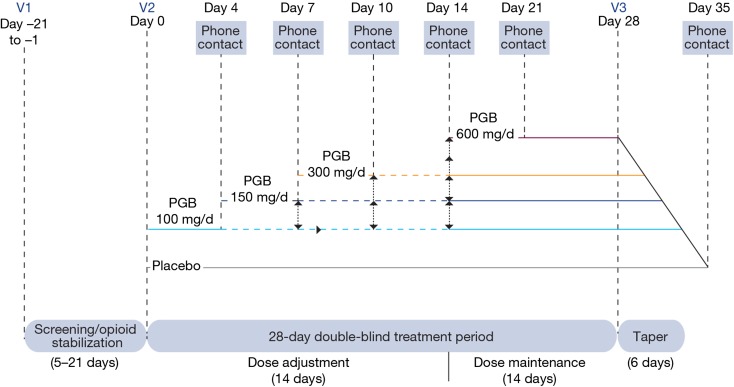
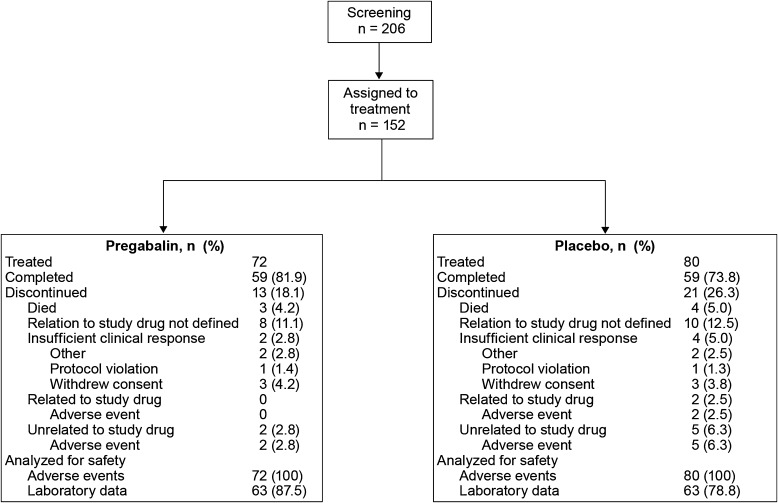
In this randomized, double-blind, placebo-controlled, parallel-group, multicenter trial, 152 adults diagnosed with a malignant, solid tumor with metastases to bone were randomized to flexible-dose pregabalin (100, 150, 300, or 600 mg/day) or placebo, as add-on to stable opioid analgesic therapy, which was optimized prior to the start of the study. The primary efficacy endpoint was the duration-adjusted average change (DAAC) from baseline in the daily worst pain at the reference site (measured by 11-point numeric rating scale [NRS]) during the fixed-dosage phase. The study was terminated early following an interim analysis that indicated an increase in sample size would be needed to satisfy statistical assumptions for the primary endpoint. Given the early termination of the study, only descriptive analyses were performed.
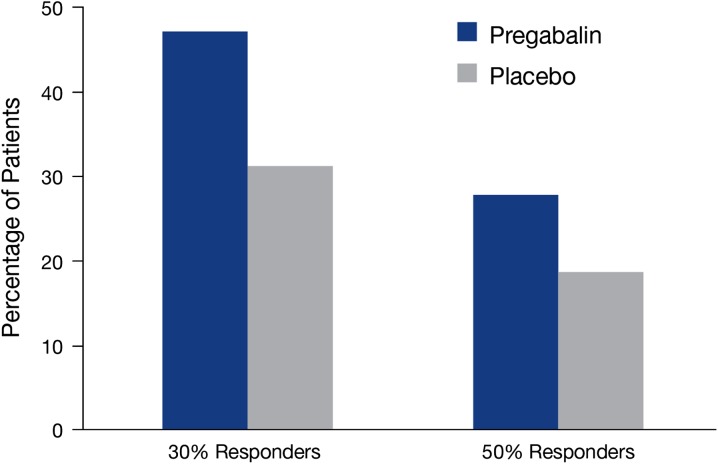
The mean (standard deviation) DAAC from baseline in NRS score for the primary endpoint favored pregabalin treatment: -1.53 (1.81) in the pregabalin group and -1.23 (1.74) in the placebo group. Mean DAAC for average pain and sleep interference (NRS) also favored pregabalin. More patients treated with pregabalin reported improvement ("very much improved," "much improved," or "minimally improved") based on Patient Global Impression of Change: 81.4% compared with 70.0% in the placebo group.
Data from this study indicate that pregabalin use may reduce metastatic bone pain. Due to the incomplete analysis, further study of pregabalin in the management of CIBP is required.
癌症骨痛(CIBP)的管理需要改进。本研究的目的是评估普瑞巴林与安慰剂在联合治疗接受阿片类药物治疗的中重度 CIBP 患者中的疗效和安全性。
在这项随机、双盲、安慰剂对照、平行组、多中心试验中,152 名被诊断患有恶性、有骨转移的实体瘤的成年人被随机分配至普瑞巴林(100、150、300 或 600mg/天)或安慰剂组,作为稳定阿片类药物镇痛治疗的附加治疗,在研究开始前优化了该治疗。主要疗效终点是参考部位每日最严重疼痛的持续时间调整平均变化(DAAC),通过 11 点数字评分量表(NRS)测量。在中期分析表明需要增加样本量才能满足主要终点的统计假设后,研究提前终止。鉴于研究提前终止,仅进行了描述性分析。
主要终点 NRS 评分的平均(标准差)DAAC 有利于普瑞巴林治疗:普瑞巴林组为-1.53(1.81),安慰剂组为-1.23(1.74)。平均疼痛和睡眠干扰(NRS)的 DAAC 也有利于普瑞巴林。根据患者总体变化印象评估,更多接受普瑞巴林治疗的患者报告有改善(“非常改善”、“改善”或“轻度改善”):81.4%,而安慰剂组为 70.0%。
这项研究的数据表明,普瑞巴林的使用可能会减轻转移性骨痛。由于分析不完整,需要进一步研究普瑞巴林在 CIBP 管理中的应用。