Leong F Joel, Zhao Rong, Zeng Shuqi, Magnusson Baldur, Diagana Thierry T, Pertel Peter
Novartis Institute for Tropical Diseases, Singapore
Novartis Institutes for BioMedical Research, Shanghai, People's Republic of China.
Antimicrob Agents Chemother. 2014 Nov;58(11):6437-43. doi: 10.1128/AAC.03478-14. Epub 2014 Aug 18.
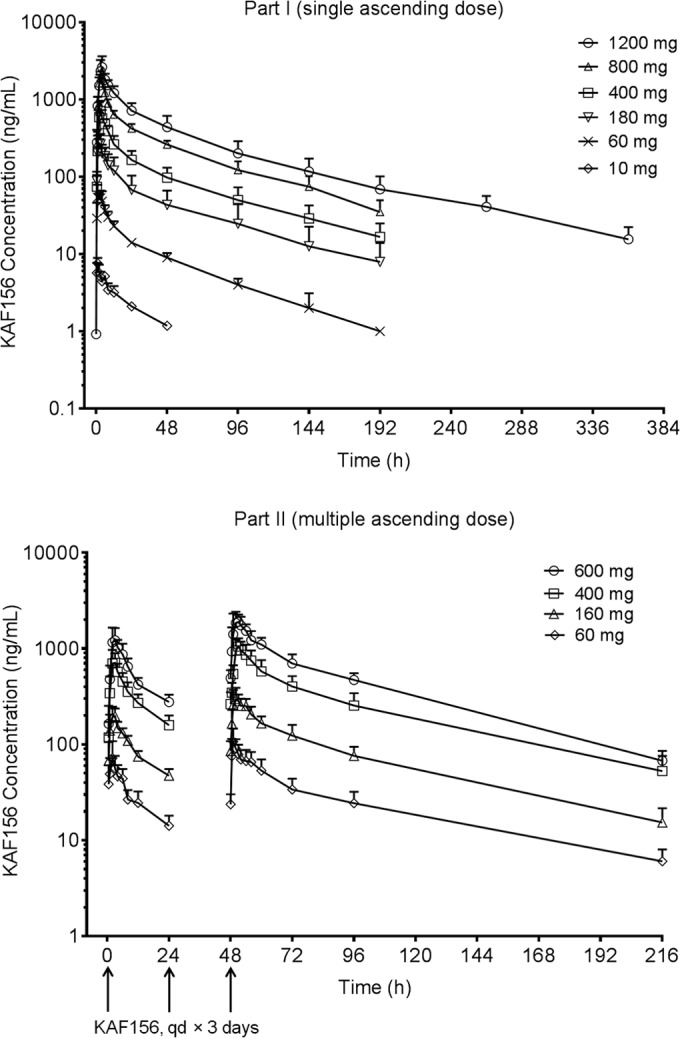
KAF156 belongs to a new class of antimalarial, the imidazolopiperazines, and is currently in clinical development for the treatment of uncomplicated malaria. This first-in-human, single- and multiple-ascending-dose study in 70 healthy male volunteers determined the maximum oral dose of KAF156 tolerated by healthy adults and derived pharmacokinetic data (including preliminary food effect) to enable dose calculations for malaria patients. KAF156 was studied in single-dose cohorts (10 to 1,200 mg, including one 400-mg food effect cohort (4 to 10 subjects/cohort), and in multiple-dose cohorts (60 to 600 mg once daily for 3 days; 8 subjects/cohort). The follow-up period was 6 to 14 days after the last dose. KAF156 was tolerated, with self-limited mild to moderate gastrointestinal and neurological adverse events. In treated subjects after single doses, headache (n = 4; 11.1%), diarrhea (n = 3; 8.3%), dizziness (n = 3; 8.3%), and abdominal pain (n = 2; 5.6%) were the most common adverse events. Headache (n = 4; 16.7%), nausea (n = 3; 12.5%), upper respiratory tract infection (n = 3; 12.5%), and dizziness (n = 2; 8.3%) were the most common adverse events following multiple doses. KAF156 time to maximum concentration (Tmax) was between 1.0 and 6.0 h. Both the area under the concentration-time curve (AUC) and maximum concentration (Cmax) increased more than dose-proportionally in both single- and multiple-ascending-dose cohorts (terminal half-life, 42.5 to 70.7 h). There was no significant accumulation over 3-day repeated administration. The extent of absorption was not significantly affected by food at a single dose of 400 mg, while mean Cmax decreased from 778 ng/ml to 627 ng/ml and Tmax was delayed from a median of 3.0 h under fasting conditions to 6.0 h under fed conditions. Renal elimination is a minor route.
KAF156属于一类新型抗疟药——咪唑并哌嗪,目前正处于治疗非复杂性疟疾的临床开发阶段。这项针对70名健康男性志愿者的首次人体单剂量和多剂量递增研究确定了健康成年人耐受的KAF156最大口服剂量,并得出药代动力学数据(包括初步的食物影响),以便为疟疾患者进行剂量计算。KAF156在单剂量队列(10至1200毫克,包括一个400毫克食物影响队列(每组4至10名受试者))和多剂量队列(每天一次60至600毫克,共3天;每组8名受试者)中进行了研究。随访期为最后一剂后的6至14天。KAF156耐受性良好,出现自限性轻度至中度胃肠道和神经系统不良事件。单剂量给药后,治疗受试者中最常见的不良事件为头痛(n = 4;11.1%)、腹泻(n = 3;8.3%)、头晕(n = 3;8.3%)和腹痛(n = 2;5.6%)。多剂量给药后,最常见的不良事件为头痛(n = 4;16.7%)、恶心(n = 3;12.5%)、上呼吸道感染(n = 3;12.5%)和头晕(n = 2;8.3%)。KAF156达到最大浓度的时间(Tmax)在1.0至6.0小时之间。在单剂量和多剂量递增队列中,浓度-时间曲线下面积(AUC)和最大浓度(Cmax)的增加均超过剂量比例(末端半衰期为42.5至70.7小时)。在3天的重复给药过程中没有明显的蓄积。单剂量400毫克时,食物对吸收程度没有显著影响,而平均Cmax从778纳克/毫升降至627纳克/毫升,Tmax从禁食条件下的中位数3.0小时延迟至进食条件下的6.0小时。肾脏排泄是次要途径。